|

|
|
| |
|
China Oil Painting Direct
|
|
100% hand painted, 100%
cotton canvas,
100% money back if not satisfaction.
|
|
|
|
ART WORKS
INDEX
A B C D E F G H I J K L M N O P Q R S T U V W X Y Z
|
|
ARTISTS
INDEX
A B C D E F G H I J K L M N O P Q R S T U V W X Y Z
|
|
|
|
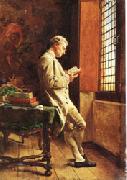 |
Ernest Meissonier 
|
|
Lyons 1815 - Paris 1891.
French Academic Painter, 1815-1891.
Lyons 1815 - Paris 1891. French Academic Painter, 1815-1891. French genre and military painter. His study of the Dutch masters was evident in his first Salon-exhibited painting, A Visit to the Burgomaster (1834). His small genre paintings are meticulous as to furnishings and costumes. Among Meissonier's battle scenes, chiefly of the Napoleonic Wars, are Napoleon I with His Staff (Louvre) and Friedland, 1807 (Metropolitan Mus.).
|
|
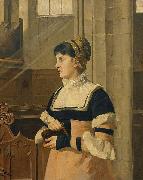 |
Ernst Meisel
|
|
painted Gretchen beim Kirchgang in 1894
|
|
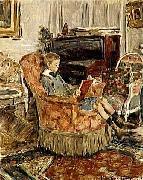 |
Etienne Moreau-Nelaton
|
|
Adolphe Etienne Auguste Moreau-Nelaton (2 December 1859, Paris- 25 April 1927, Paris) was a French painter, art collector and art historian. His large collection is today held in its entirety by National French museums.
Moreau-Nelaton's family's art collecting began with his grandfather Adolphe Moreau (1800-59). As a stockbroker he possessed ample capital with which to buy the work of artists with whom he was personally acquainted, including Eugene Delacroix and Alexandre-Gabriel Decamps. Moreau-Nelaton's father, who was also named Adolphe Moureau (1827-82), was a high government official and led the railroad company Chemins de fer de l'Est. In 1856 he married the ceramic artist Camille Nelaton (1840-97), with whom he further expanded the family's collection.
|
|
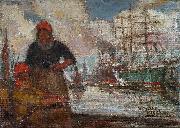 |
Eugeen Van Mieghem
|
|
(1 October 1875-1930) was a Belgian artist born in the port of Antwerp. As a boy Van Mieghem was confronted with the harsh reality of life at the waterfront.
Even at primary school he showed a talent for drawing. He was introduced to the work of Vincent van Gogh, Georges Seurat, Camille Pissarro, Henri de Toulouse-Lautrec and others at an exhibition organised by Flemish painter and architect Henry van de Velde at the Antwerp Academy around 1892. He attended the Antwerp Academy but was sent from school because his conservative teachers disliked his subject matter and his free, spontaneous way with it. He threw his lot in with progressive political and cultural movements, and joined an anarchist group. By the early 1900s was recognized as one of the most promising young artists of the Antwerp school. He would never renounce his idealism. He became the artist of the typical harbour folk: sack porters, sack makers, emigrants, dockers, bargees, and tramps.
Van Mieghem had his first taste of real success at La Libre Esthetique in Brussels, where his pastels and drawings hung alongside works by French impressionists such as Claude Monet, Paul Cezanne, Camille Pissarro, Jean Renoir and Edouard Vuillard.
|
|
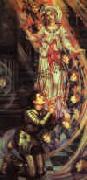 |
Evelyn De Morgan
|
|
1855-1919
British
Evelyn De Morgan Galleries
She was born Evelyn Pickering. Her parents were of upper middle class. Her father was Percival Pickering QC, the Recorder of Pontefract. Her mother was Anna Maria Wilhelmina Spencer Stanhope, the sister of the artist John Roddam Spencer Stanhope and a descendant of Coke of Norfolk who was an Earl of Leicester.
Evelyn was homeschooled and started drawing lessons when she was 15. On the morning of her seventeenth birthday, Evelyn recorded in her diary, "Art is eternal, but life is short..." "I will make up for it now, I have not a moment to lose." She went on to persuade her parents to let her go to art school. At first they discouraged it, but in 1873 she was enrolled at the Slade School of Art. Her uncle, John Roddam Spencer Stanhope, was a great influence to her works. Evelyn often visited him in Florence where he lived. This also enabled her to study the great artists of the Renaissance; she was particularly fond of the works of Botticelli. This influenced her to move away from the classical subjects favoured by the Slade school and to make her own style.
In 1887, she married the ceramicist William De Morgan. They lived together in London until he died in 1917. She died two years later on 2 May 1919 in London and was buried in Brookwood Cemetery, near Woking, Surrey.
|
|
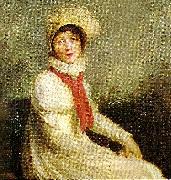 |
f. massot
|
|
|
|
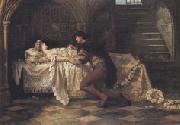 |
F.Sydney muschamp
|
|
fl.1870-1903,d.1929
|
|
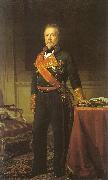 |
Federico de Madrazo y Kuntz
|
|
1815-1894
Spanish
Federico de Madrazo y Kuntz Gallery
Born in Rome, he was the son of the painter Madrazo y Agudo (1781-1859), and received his first instruction from his father. While still attending the classes at the Royal Academy of San Fernando, he painted his first picture, The Resurrection of Christ (1829), which was purchased by Queen Christina. Not long afterwards he painted Achilles in his Tent, and subsequently presented to the Academy The Continence of Scipio, which secured him admission as a member "for merit".
While decorating the palace of Vista Alegre he took up portraiture. In 1852 he went to Paris, where he studied under Franz Winterhalter, and painted portraits of Baron Taylor and Ingres. In 1837 he was commissioned to produce a picture for the gallery at Versailles, and painted "Godfrey de Bouillon proclaimed King of Jerusalem". The artist then went to Rome, where he worked at various subjects, sacred and profane. Then he painted Maria Christina in the Dress of a Nun by the Bedside of Ferdinand III (1843), Queen Isabella, The Duchess of Medina-Coeli, and The Countess de Vilches (1845-1847), besides a number of portraits of the Spanish aristocracy, some of which were sent to the exhibition of 1855.
He received the Legion of Honour in 1846. He was made a corresponding member of the Paris Academy of Fine Arts on 10 December 1853, and in 1873, on the death of Schnorr, the painter, he was chosen foreign member. After his father's death he succeeded him as director of the Museo del Prado and president of the Academy of San Fernando. He originated in Spain the production of art reviews and journals, such as El Artiste, El Renacimiento, and El Semanario pintoresco. He died at Madrid in 1894.
|
|
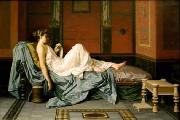 |
Federico Maldarelli
|
|
Federico Maldarelli (1826 - 1893)
|
|
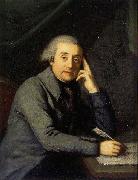 |
Felix Maria Diogg
|
|
(b Andermatt, 1 July 1762; d Rapperswil, Schwyz, 19 Feb 1834). Swiss painter. From 1782 he was a pupil of Johann Melchior Wyrsch in Besanion, under whom he developed the essential aspects of his portrait style. He also studied further in Rome and Naples from 1786 to 1788. He was capable of executing bright, incisive portraits in the manner of Angelica Kauffman, as in Portrait of an Artist or psychological studies, best seen in Ulysses von Salis-Marschlins. Several of his group portraits, such as the Esslinger Family, show the influence of Italian and British painting, with which he seemed to be familiar. He was a friend of Johann Kaspar Lavater, discoursed with Goethe and enjoyed the company of the Swiss historian Johannes von Miller (1752-1809), whose portrait he painted. His portraits are generally bust-length types set against a solid, dark background. This format was favoured by his Swiss clientele and is seen in Burgomaster Heinrich Krauer (1799; Lucerne, Kstmus.), which also reveals the dignified wooden pose frequently selected by his models. His direct, fashionable treatment of the sitter attracted a wide range of clients from all levels of society. He seemed to be as much at ease painting the Empress of Russia, Yelisaveta Alekseyevna (1814; Karlsruhe, Staatl. Ksthalle) as he was portraying the bourgeoisie of central Switzerland.
|
|
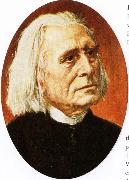 |
felix mendelssohn
|
|
Period: Romantic (1820-1869)
Country: Germany
Born: February 03, 1809 in Hamburg, Germany
Died: November 04, 1847 in Leipzig, Germany
|
|
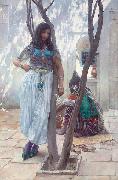 |
Ferdinand Max Bredt
|
|
painted In a courtyard, Tunis in 1921
|
|
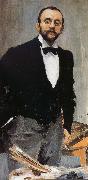 |
Filip Andreevich Malyavin
|
|
Russian, 1869-1940
|
|
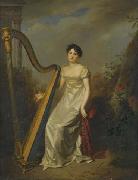 |
Firmin Massot
|
|
painted Portrait of a lady, wearing a white dress and seated beside a harp a landscape beyond in 1810
|
|
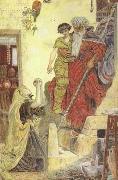 |
Ford Madox Brown
|
|
1821-1893
English painter and designer. The son of a retired ship's purser who had settled at Calais, Brown received an academic training under Albert Gregorius (1774-1853) at Bruges, under Pieter van Hanselaere (1786-1862) at Ghent and under Baron Gustaf Wappers at the Academie in Antwerp (1837-9). He moved to Paris in 1840, married the following year and studied independently of the ateliers
|
|
 |
Francesco de mura
|
|
Italian Painter , b. 1696, Napoli, d. 1782, Napoli
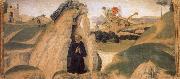
was an Italian painter of the late-Baroque period, active mainly in Naples and Turin. His late work reflects the style of neoclassicism. He was a pupil of Francesco Solimena, then later with Domenico Viola, where he met his contemporary, Mattia Preti. While still in his teens he painted frescoes (1715) in San Nicola alla Carit?? in Naples. He painted ten canvases of the Virtues and an Adoration of the Magi (1728) for the church of Santa Maria Donnaromita. His other works include frescoes of the Adoration of the Magi (1732) in the apsidal dome of the church of the Nunziatella.
|
|
 |
Francesco di Giorgio Martini
|
|
Italian Early Renaissance Painter and Sculptor, 1439-ca.1501
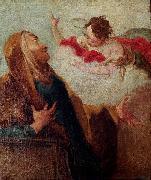
was an Italian painter of the Sienese School, a sculptor, an architect and theorist, and a military engineer who built almost seventy fortifications for the Duke of Urbino. Born in Siena, he apprenticed as a painter with Vecchietta. In panels painted for cassoni he departed from the traditional representations of joyful wedding processions in frieze-like formulas to express visions of ideal, symmetrical, vast and all but empty urban spaces rendered in perspective. Francesco di Giorgio is also known for architectural designs and sculptural work for Federico III da Montefeltro, Duke of Urbino, for whom he built star-shaped fortifications. He composed an architectural treatise Trattato di architettura, ingegneria e arte militare that he worked on for decades and finished sometime after 1482;
|
|
 |
Francesco Maria Raineri
|
|
(February 2, 1676 - February 28, 1758) was an Italian painter of the late-Baroque, mainly active in Mantua.
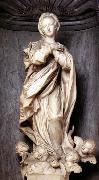
Also called Lo Schivenoglia after the town, just outside of the city of Mantua, of his birth. He was a pupil of Giovanni Canti. Among his works, he was known for his paintings of battle scenes, landscapes, and cappriccios (vedute of imaginary scenes) with historical or mythologic figures. He was named director of the Academy of painters in Mantua in 1752. He is known to have painted a St. Sebastian for the chapel of Santa Anna.
|
|
 |
Francesco Maria Schiaffino
|
|
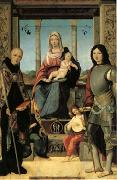
Italian Rococo Era Sculptor, 1688-1763,Brother of Bernardo Schiaffino. He was the pupil and then assistant of Bernardo, who in 1721 sent him to complete his training in Rome, where he entered the workshop of Camillo Rusconi. He remained there until 1724, enriching his technique and cultural education by studying the works of Bernini, Rusconi and other sculptors. Back in Genoa, he executed such works as St Dominic (Genoa, Teatro Carlo Felice), in which Rusconi's influence is evident. The marble group of Pluto and Proserpine, sculpted for the Durazzo family and still in its original location (Genoa, Pal. Reale), is based on a bozzetto by Rusconi. In 1731 Schiaffino executed the grandiose Crucifix with Angels for King John V of Portugal (Mafra, Convent) and in 1738 began the theatrical funeral monument to Caterina Fieschi Adorno (Genoa, SS Annunziata di Portoria). The wax models of the Eight Apostles and Four Doctors of the Church that he modelled in 1739 (all untraced) were clearly inspired by the large Apostles by Rusconi and other sculptors in S Giovanni in Laterano, Rome. They were made for the stuccoist Diego Francesco Carlone so that he could, under Schiaffino's directions, execute 12 monumental statues in stucco (Genoa, S Maria Assunta in Carignano). In these latter works the classicizing authority of Rusconi's figures was transformed into a freer and more restless arrangement, the compact forms dissolving in the light, animated draperies. The statues reveal how Schiaffino had combined his knowledge of Roman sculpture with his study of Pierre Puget's Genoese works and with the style of the Piola workshop. He emulated the free rhythms of the Rococo found in the painting of Gregorio de' Ferrari, developing a decorative approach that is even more marked in the Assumption of the Virgin (1740; Varazze, S Ambrogio) and in the Rococo chapel of S Francesco da Paola (1755; Genoa, S Francesco da Paola), which he covered in polychrome marbles. His last works include the Virgin of Loreto (1762; Sestri Levante, Parish Church).
|
|
 |
Francesco Marmitta
|
|
recorded at Parma 1496-1504
|
|
 |
Francesco Monti
|
|
Italian Painter, 1685-1768
Italian painter and draughtsman. He was the son of a tailor who served the Este court in Modena during the 1690s. Monti studied with the foremost painter in Modena, Sigismondo Caula (b 1637), for three years from c. 1700. In 1703 he moved to Bologna and entered the studio of Giovanni Gioseffo dal Sole. Roli (1962) defined the formative influences on Monti's art as dal Sole and Donato Creti on the one hand, and Giuseppe Maria Crespi and Antonio Gionima on the other. Monti evolved a distinctive personal idiom, characterized by graceful figures reminiscent of the style of Parmigianino, but perhaps more directly inspired by the more extravagant late Mannerist idiom of such painters as Bartholomeus Spranger and Josef Heintz I of the court of Rudolf II at Prague. Monti may have known their work through prints by Aegidius Sadeler II, Jan Muller and others. This exotic figure style, with fluent, swaying forms and faces suggestively muted by half-shadow was accompanied by unusual shades of colour that glow richly in darkened settings. Monti's art contributed to a neo-Mannerist strain in 18th-century Emilian painting
|
|
 |
Francesco Morandini Da Poppi
|
|
Italian Painter (1544-1597)
|
|
 |
Francesco Morone
|
|
Italian Painter, 1471-ca.1529
was an Italian painter, active in Verona in a Renaissance style. He was the son of the Veronese painter Domenico Morone. The art biographer Vasari praised his frescoes (1505-7) for the cupola of the sacristy in Santa Maria in Organo. He also painted the organ shutters in that church. Paolo Cavazzola was one of his pupils.
|
|
 |
Francis Davis Millet
|
|
(November 3, 1846 - April 15, 1912) was an American painter, sculptor, and writer who died in the sinking of the RMS Titanic on April 15, 1912.
Francis Davis Millet was born in Mattapoisett, Massachusetts. At age sixteen, Millet entered the Massachusetts regiment, first as a drummer boy and then a surgical assistant in the American Civil War. He repeatedly pointed to his experience working for his father as giving him an appreciation for the vivid blood red that he repeatedly used in his early paintings.
|
|
 |
Francis Luis Mora
|
|
Uruguayan-born American Painter, 1874-1940
|
|
 |
Francisco Domingo Marques
|
|
painted Cat in 1842 - 1920
|
|
 |
Francisco Miralles Y Galup
|
|
Spanish
1848-1901
|
|
 |
Francois-Marius Granet
|
|
1775-1849
French
Francois Marius Granet Gallery
French painter; student of J. L. David. Granet is known for his depictions of church interiors, among them his numerous versions of the Choir of the Capuchin Monastery, one of which is in the Metropolitan Museum. He bequeathed much of his own best work and also his fine collection of paintings to the museum of his native Aix-en-Provence.
|
|
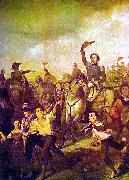 |
Francois-Rene Moreaux
|
|
painted Announcement of Independence in 1844
|
|
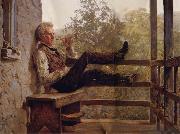 |
Frank Blackwell Mayer
|
|
American Painter, 1827-1899
|
|
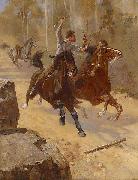 |
Frank Mahony
|
|
(4 December 1862 - 28 June 1916) was an Australian artist and member of the Dawn and Dusk Club.
Although christened "Francis Mahony", he later added 'Prout' and usually signed his work 'Frank P. Mahony'.
Mahony was born in Melbourne, third surviving child of Timothy Mahony, an Irish-born contractor, and his Cornish second wife Elizabeth, Johns. Mahony was taken to Sydney when 10 years old and studied at the Academy of Art under Giulio Anivitti.Mahony's work was accepted by The Bulletin and he became known for his excellent drawings of horses. In 1889 his oil painting Rounding up a Straggler, was bought for the Art Gallery of New South Wales; in 1896 The Cry of the Mothers was also purchased.Mahony did a lot of illustrative work for the Picturesque Atlas of Australia, Victoria and its Metropolis, the Antipodean and other magazines of the period, and was also responsible for some of the illustrations to Barcroft Boake's Where the Dead Men Lie.
|
|
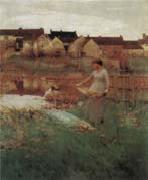 |
Frank O-Meara
|
|
1853-1888
|
|
 |
Frans de Momper
|
|
Flemish Baroque Era Painter, 1603-1660
Painter and draughtsman, nephew of (1) Josse de Momper II. In 1629 he became a master in the Antwerp Guild of St Luke. He left Antwerp for the northern Netherlands, working initially at The Hague; by 1647 he was in Haarlem and the following year Amsterdam, where he married in 1649. In 1650 Frans returned to Antwerp, where he painted numerous monochrome landscapes in the manner of Jan van Goyen. Paintings such as the Valley with Mountains (c. 1640-50; Philadelphia, PA, Mus. A.) prefigure the imaginative landscapes of Hercules Segers. The impression of vast panoramic spaces in Frans's work is adopted from his uncle's art. Frans executed a number of variations on the theme of a river landscape with boats and village (e.g. pen-and-ink drawing, Edinburgh, N.G.). In the late painting Landscape with a Ch?teau Encircled by Doves (Bordeaux, Mus. B.-A.), the low horizon and light-filled sky are adopted from the new Dutch school of tonal landscape painting, while the delicacy of the figures, feathery trees and buildings are features of the Italo-Flemish tradition exemplified by his uncle. Similar qualities of refinement and luminosity characterize the Winter Landscape (c. 1650; Prague, N.G., Sternberk Pal.),
|
|
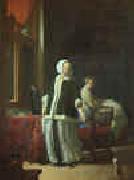 |
Frans Jansz van Mierisi
|
|
1635-1681
Dutch
Frans Jansz van Mierisi Gallery
|
|
 |
Frans Mortelmans
|
|
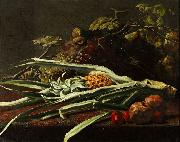
painted Still life with pineapple, grapes, apples and pomegranates in c. 1882
|
|
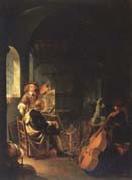 |
Frans van Mieris
|
|
Dutch Baroque Era Painter, 1635-1681
|
|
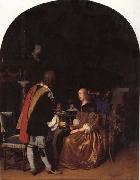 |
Frans van mieris the elder
|
|
Dutch Baroque Era Painter, 1635-1681
was a Dutch genre and portrait painter. The leading member of a Leiden family of painters, his sons Jan (1660-1690) and Willem (1662 C1747) and his grandson Frans van Mieris the Younger (1689 C1763) were also accomplished genre painters. Frans was the son of Jan Bastiaans van Mieris, a goldsmith, carver of rubies and diamond setter at Leiden. His father wished to train him to his own business, but Frans preferred drawing, and took service with Abraham Torenvliet, a glazier who kept a school of design. In his father's shop he became familiar with the ways and dress of people of distinction. His eye was fascinated in turn by the sheen of jewelry and stained glass; and, though he soon gave up the teaching of Torenvliet for that of Gerard Dou and Abraham van den Tempel, he acquired a manner which had more of the finish of the exquisites of the Dutch school than of the breadth of the disciples of Rembrandt. It should be borne in mind that he seldom chose panels of which the size exceeded 12 to 15 inches, and whenever his name is attached to a picture above that size we may surely assign it to his son Willem or to some other imitator. Unlike Dou when he first left Rembrandt, or Jan Steen when he started on an independent career, Mieris never ventured to design figures as large as life. Characteristic of his art in its minute proportions is a shiny brightness and metallic polish. The Music Lesson,National Museum of Serbia , BelgradeThe subjects which he treated best are those in which he illustrated the habits or actions of the wealthier classes; but he sometimes succeeded in homely incidents and in portrait, and not unfrequently he ventured on allegory. He repeatedly painted the satin skirt which Ter Borch brought into fashion, and he often rivalled Ter Borch in the faithful rendering of rich and highly-coloured woven tissues. But he remained below Ter Borch and Metsu, because he had not their delicate perception of harmony or their charming mellowness of touch and tint, and he fell behind Gerard Dou, because he was hard and had not his feeling for effect by concentrated light and shade. In the form of his composition, which sometimes represents the framework of a window enlivened with greenery, and adorned with bas-reliefs within which figures are seen to the waist, his model is certainly Dou.
|
|
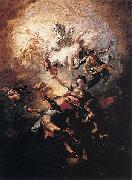 |
Franz Anton Maulbertsch
|
|
(June 7, 1724 -- August 8, 1796) was an Austrian painter and engraver, one of the most renowned exponents of roccoco painting in the German region.
Maulbertsch was born in Langenargen and studied in the Academy of Vienna. Through the knowledge of Paul Troger, he was influenced by the Venetian painters Piazzetta and Giovanni Battista Pittoni. He also studied the frescoes by Sebastiano Ricci in the Schönbrunn Palace in Vienna, and frequented Giambattista Tiepolo, who was active in Werzburg starting from 1750.
An appreciated frescoer, he received numerous commissions, mostly of ecclesiastical theme. He produced art for churches in Bicske, Kalocsa, Vienna's Michaelerkirche and Piaristenkirche Maria Treu. He also decorated the Porta Coeli in Moravia, the Kromeř Archbishop's Palace and the villa of Halbturn.
He also painted a portrait of Narcissus of Jerusalem
|
|
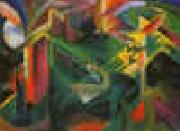 |
Franz Marc
|
|
1880-1916 German
Franz Marc Locations
Franz Marc was born in 1880, in the German town of Munich. His father, Wilhelm, was a professional landscape painter, and his mother Sophie was a strict Calvinist. He began study at the Academy of Fine Arts, Munich in 1900. In 1903 and 1907 he spent time in Paris and discovered a strong affinity for the work of Vincent van Gogh. Marc developed an important friendship with the artist August Macke in 1910. In 1911 he formed the Der Blaue Reiter artist circle with Macke, Wassily Kandinsky, and other artists who decided to split off from the Neue K??nstlervereinigung movement.
He showed several of his works in the first Der Blaue Reiter exhibition at the Thannhauser Galleries in Munich between December 1911 and January 1912. The exhibition was the apex of the German expressionist movement and also showed in Berlin, Köln, Hagen, and Frankfurt. In 1912, Marc also met Robert Delaunay, whose use of color and futurist method was a major influence on Marc's work. Marc became influenced by futurism and cubism, and his art became stark and abstract in nature.
His name was on a list of notable artists to be withdrawn from combat in World War I. Before the orders were carried out, he was struck in the head and killed instantly by a shell splinter during the Battle of Verdun (1916).
|
|
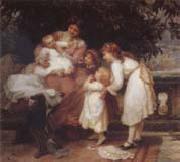 |
Fred Morgan
|
|
British
1856-1927
|
|
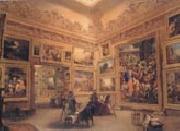 |
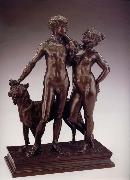
Frederick Mackenzie
|
|
watercolour painter and architectural draughtsman ,
ca.1787-1854
|
|
 |
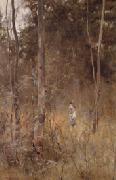
Frederick Macmonnies
|
|
American Sculpture 1863-1937,American sculptor and painter. During his apprenticeship in New York (1880-84) with Augustus Saint-Gaudens, who discovered and encouraged his talent, he rose from menial helper to assistant, studying in the evenings at Cooper Union and the National Academy of Design. Through Saint-Gaudens he met two architects who later became invaluable colleagues: Stanford White and Charles F. McKim, who lent him money in 1884 to go to Paris. He studied drawing at Colarossi's then went to Munich, attending drawing and portrait classes at the Akademie (1884-5) and worked for Saint-Gaudens again (1885-6). In Paris he studied sculpture with Alexandre Falguiere at the Ecole des Beaux-Arts,
|
|
 |
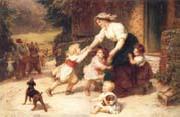
Frederick Mccubbin
|
|
Australian Painter, 1855-1917
By the early 1880s, his work began to attract considerable attention and won a number of prizes from the National Gallery, including a 30-pound first prize in 1883 in their annual student exhibition, and by the mid-1880s began to concentrate more on the works of the Australian bush which made him most famous. In 1883, he received first prize in the first annual Gallery students' exhibition, for best studies in colour and drawing. In 1888, he became instructor and master of the School of Design at the National Gallery. In this position he taught a number of students who themselves became prominent Australian artists, including Charles Conder and Arthur Streeton. He continued to paint through the first two decades of the 20th century, though by the beginning of World War I his health began to fail. He travelled to England in 1907 and visited Tasmania, but aside from these relatively short excursions lived most of his life in Melbourne. McCubbin married Annie Moriarty in March, 1889. They had seven children, of whom their son Louis also became an artist. In 1901 McCubbin and his family moved to Mount Macedon, where he was inspired by the surrounding bush and has experimented with the light and its effects on colour in nature. In 1912,
|
|
 |
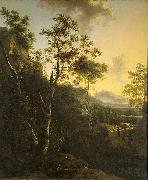
Frederick Morgan
|
|
English Painter 1856-1927
|
|
 |
Frederik de Moucheron
|
|
(1633-2 January 1686) was a Dutch Golden Age landscape painter.
Frederik de Moucheron was the son of the painter Balthazar de Moucheron and Cornelia van Brouckhoven. His father came from a wealthy family of wine traders and is portrayed as one of the younger sons in the Moucheron Family portrait, 1563. Frederik trained with Jan Asselijn and became a landscape painter. He set off at age 22 for Paris, where he spent 3 years and then after a tour of Antwerp, Paris. and Lyon, he settled in 1659 in Amsterdam. In the same year he married Mariecke de Jouderville there and they had 11 children. He is buried in Amsterdam.
He painted French, Italian, and Dutch landscapes. To finish these scenes, contemporaries specialized in painting figures collaborated with him, such as Adriaen van de Velde in Amsterdam, Theodor Helmbreker in Paris, and at times Johannes Lingelbach, and Nicolaes Pieterszoon Berchem.
|
|
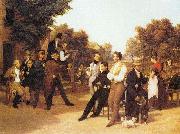 |
Friedrich Eduard Meyerheim
|
|
painted Die Kegelgesellschaft in 1834
|
|
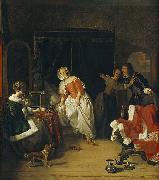 |
Gabrie Metsu
|
|
Gabriël Metsu (January 1629 - buried 24 October 1667) was a Dutch painter of history paintings, genre works and portraits.
Metsu was the son of the Flemish painter Jacques Metsu (c.1588-1629), who lived most of his days at Leiden, and Jacomijntje Garniers, his third wife, whom he married in 1625. Jacomijntje was the widow of a painter with three children of her own. Two months after Gabriël's birth, his father died.
According to Jacobus Houbraken, Metsu was taught by Gerard Dou, though his early works do not lend colour to this assertion. He was influenced by painters of Leiden such as Jan Steen, and later by Frans van Mieris the Elder.
Metsu was registered among the first members of the painters' corporation at Leiden; and the books of the guild also tell us that he remained a member in 1649. In Leiden, it was alleged that Metsu left a brothel at six in the morning and took a prostitute to the Academy. In 1650 he ceased to subscribe, and works bearing his name and the date of 1653 support the belief that he had moved. Metsu was trained in Utrecht by Jan Baptist Weenix and Nicolaus Knepfer.
The alley on Prinsengracht
In Amsterdam Metsu lived in an alley on Prinsengracht, where he kept chickens. He got into an argument with a neighbor and moved to a house on the canal side, where a daily vegetable market was held. In 1658 he married Isabella de Wolff, whose father was a potter and mother a painter. The Speed Art Museum has a portrait of the couple. Pieter de Grebber, a religious painter from Haarlem, was her uncle.
|
|
 |
Gabriel Metsu
|
|
1629-1667
Dutch
Gabriel Metsu Galleries
One of his earliest pictures is the "Lazarus" at the Strassburg Museum, painted under the influence of Jan Steen. In 1653 under the influence of Rembrandt he painted "Woman taken in Adultery," a large picture which is now in the Louvre. To the same period belong the "Departure of Hagar," formerly in the Thore collection, and the "Widow's Mite" at the Schwerin Gallery. But he probably observed that sacred art was ill suited to his temper, or he found the field too strongly occupied, and turned to other subjects for which he was better fitted. That at one time he was deeply impressed by the vivacity and bold technique of Frans Hals can be gathered from Lord Lonsdale's picture of "Women at a Fishmonger's Shop."
What Metsu undertook and carried out from the first with surprising success was the low life of the market and tavern, contrasted, with wonderful versatility, by incidents of high life and the drawing-room. In no single instance do the artistic lessons of Rembrandt appear to have been lost upon him. The same principles of light and shade which had marked his schoolwork in the "Woman taken in Adultery" were applied to subjects of quite a different kind. A group in a drawing-room, a series of groups in the market-place, or a single figure in the gloom of a tavern or parlour, was treated with the utmost felicity by fit concentration and gradation of light, a warm flush of tone pervading every part, and, with that, the study of texture in stuffs was carried as far as it had been by Ter Borch or Gerard Dou, if not with the finish or the brio of De Hooch.
One of the best pictures of Metsu's manhood is the "Market-place of Amsterdam," at the Louvre, respecting which it is difficult to distribute praise in fair proportions, so excellent are the various parts, the characteristic movement and action of the dramatis personae, the selection of faces, the expression and the gesture, and the texture of the things depicted. Equally fine, though earlier, are the "Sportsman" (dated 1661) and the "Tavern" (also 1661) at the Hague and Dresden Museums, and the "Game-Dealer's Shop," also at Dresden, with the painter's signature and 1662.
Gabriel Metsu, Man Writing a Letter (1662-1665), Oil on canvas, National Gallery of Ireland, DublinAmong the five examples of the painter in the Wallace Collection, are "The Tabby Cat," and "The Sleeping Sportsman," which cost Lord Hertford £ 3000, is an admirable example technically considered. Among his finest representations of home life are the "Repast" at the Hermitage in St Petersburg; the "Mother nursing her Sick Child" in the Rijksmuseum in Amsterdam; the "Amateur Musicians" at the Hague Gallery; the "Duet" and the "Music Lesson" at the National Gallery, London, and many more examples at nearly all the leading European galleries. Five of his painting are in Dresden, collected by August the Strong.
|
|
 |
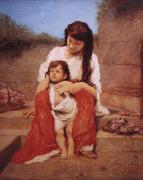
Gabriel Metsu
|
|
Gabriël Metsu
Gabriël Metsu (January 1629 - buried 24 October 1667) was a Dutch painter of history paintings, genre works and portraits.
Metsu was the son of the Flemish painter Jacques Metsu (c.1588-1629), who lived most of his days at Leiden, and Jacomijntje Garniers, his third wife, whom he married in 1625. Jacomijntje was the widow of a painter with three children of her own. Two months after Gabriël's birth, his father died.
According to Jacobus Houbraken, Metsu was taught by Gerard Dou, though his early works do not lend colour to this assertion. He was influenced by painters of Leiden such as Jan Steen, and later by Frans van Mieris the Elder.
Metsu was registered among the first members of the painters' corporation at Leiden; and the books of the guild also tell us that he remained a member in 1649. In Leiden, it was alleged that Metsu left a brothel at six in the morning and took a prostitute to the Academy. In 1650 he ceased to subscribe, and works bearing his name and the date of 1653 support the belief that he had moved. Metsu was trained in Utrecht by Jan Baptist Weenix and Nicolaus Knepfer.
In Amsterdam Metsu lived in an alley on Prinsengracht, where he kept chickens. He got into an argument with a neighbor and moved to a house on the canal side, where a daily vegetable market was held. In 1658 he married Isabella de Wolff, whose father was a potter and mother a painter. The Speed Art Museum has a portrait of the couple. Pieter de Grebber, a religious painter from Haarlem, was her uncle.
At the onset of the 1660s Metsu turned for inspiration to the art of the "fijnschilders" from his native Leiden. Metsu was responding to the market of Dou's paintings, who sold his paintings all over for exorbitant prices. Metsu may have also influenced Pieter de Hoogh. Around the year 1661, Metsu won the patronage of the Amsterdam cloth merchant Jan J. Hinlopen and painted his family more than once in a fashionable surrounding.
The Poultry-Seller, 1662
At least thirteen of paintings show carpets and he probably used the same model. He included several fine examples of minutely depicted floral and cloudband carpets in his works and even a silk Oriental rug, as well as so-called "Lotto" rugs which he for some reason, in contrast to his meticulous rendering of the floral carpets, depicted only in a very sketchy fashion. After Metsu died, his widow left for Enkhuizen, to live with her mother.
|
|
 |
Gabriel von Max
|
|
(August 23, 1840 - November 24, 1915) was a Prague-born Austrian painter.
He was born Gabriel Cornelius Max, the son of Czech sculptor Joseph Max and Anna Schumann. He studied between 1855 and 1858 at the Prague Academy of Arts with Eduard von Engerth. His studies included parapsychology (somnambulism, hypnotism, spiritism), Darwinism, Asiatic philosophy, the ideas of Schopenhauer, and various mystical traditions. The spiritual-mystical movement was emphasized by the writings of Carl du Prel, and the Munich painter Albert Keller was also an influence.
His first large canvas was painted in 1858 while he was a student at the Prague Academy. He continued his studies at the Viennese Academy of Art with Karl von Blaas, Karl Mayer, Christian Ruben and Carl Wurzinger. From 1863 to 1867 he studied at the Munich Academy with Karl Theodor von Piloty, and also Hans Makart and Franz Defregger. His first critical success was in 1867 with the painting "Martyr at the Cross": that painting transformed the "Ungl?-ksmalerei" (dark palette) of Piloty into a religious-mystical symbolism using a psychological rendering of its subject.
He continued to use the dark palette of the Piloty school well into the 1870s, later moving toward a more muted palette, using fewer,clearer colors. From 1869, Gabriel von Max had his studio in Munich; in the summer, he was in the Ammerland at Starnberger Lake. From 1879-1883, Gabriel Max was a professor of Historical Painting at the Munich Academy; he also became a Fellow of The Theosophical Society. In 1900 he was ennobled and became a Ritter. He died in Munich in 1915.
His interest in anthropological studies also showed in his work. He owned a large scientific collection of prehistoric ethnological and anthropological finds: the collection now resides in the Stadtischen Reiss Museum in Mannheim. At his residence in Starnberger Lake, Gabriel Max surrounded himself with a family of monkeys, which he painted often, sometimes portraying them as human. Max, along with his colleagues, often used photographs to guide painting. The great number of monkey photographs in his archive testify to their use as direct translation into his paintings. In 1908, his painting "The Lion's Bride" became celebrated, and was depicted in motion pictures as an hommage in the Gloria Swanson film, Male and Female, (1919), directed by Cecil B. de Mille.
Gabriel von Max was a significant artist to emerge from the Piloty School, because he abandoned the themes of the Grunderzeitliche (genre and history), in order to develop an allegorical-mystical pictorial language, which became typical of Secessionist Art. Characteristic of the ethereal style of Gabriel Max is "The Last Token" (in the Metropolitan Museum), and "Light" (in the Odessa Museum of Western and Eastern Art, Ukraine).
|
|
|
|
|
|
|
|
|
| Wholesale China Oil Painting Wholesale Oil Painting China Xiamen Portrait Reproduction on canvas Chinese Oil Painting Wholesale USA Oil Painting |
|
|
|
|


