|

|
|
| |
|
China Oil Painting Direct
|
|
100% hand painted, 100%
cotton canvas,
100% money back if not satisfaction.
|
|
|
|
ART WORKS
INDEX
A B C D E F G H I J K L M N O P Q R S T U V W X Y Z
|
|
ARTISTS
INDEX
A B C D E F G H I J K L M N O P Q R S T U V W X Y Z
|
|
|
|
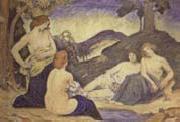 |
Jan Preisler 
|
|
Czechoslovakian, 1872-1918
Bohemian painter. He studied at the School of Applied Arts in Prague (1887-95). In 1906 he visited Belgium, the Netherlands and Paris. He taught at the Academy of Arts in Prague from 1913. He was a pioneer in modern Bohemian art, and his work developed from pure Art Nouveau and Symbolism towards Expressionism, in three phases. The period 1887-1900 is represented by the triptych Spring (1900; Prague, Trade Fair Pal.): with its lack of scales of tonal value or Impressionist instantaneousness, it is a skilful use of colour and composition. The figure of the boy with autobiographical features is symbolic of a whole generation. The period 1901-7 culminated in Painting from a Bigger Cycle (1901-2; Prague, Trade Fair Pal.), which balances vertical and horizontal lines and employs bright colour combinations. In Black Lake (1904; Prague, Trade Fair Pal.), which deals with the misery and excitement of first love, the contrast of black and white and the figure of the boy with a horse and a girl evoke the transitive moment between reality and dream. Spring (1906; Prague, Trade Fair Pal.), a testament to Preisler admiration for the work of Gauguin, develops the resonant contrast of green, yellow and white. In 1908-18 Preisler returned to monumental decoration: of the Palacky Room in the Municipal House in Prague, 1910-12, in the style of Puvis de Chavannes. At this time he was approaching the Expressionism of the younger generation from the Eight (ii), especially in the three versions of the painting Good Samaritan (1910-13; all priv. col., see Kotalok, pl. 41), which shows the influence of Daumier and Munch.
|
|
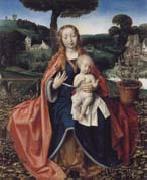 |
Jan provoost
|
|
Dutch, born circa 1465-1529,South Netherlandish painter. He probably came into contact with Simon Marmion, the renowned painter and book illuminator from Valenciennes, via Jacquemart Pilavaine, a publisher and illuminator in his native Bergen. Provoost married Marmion's widow, Jeanne de Quaroube, before 1491, and it is thus assumed that Marmion was his teacher. In 1493 Provoost moved to Antwerp, a promising town for artists, where he registered as a master in the Guild of St Luke, but in 1494 he travelled to Bruges. He became a citizen there and soon played an important part in the painters' guild. In 1506 Maximiliaen Frans (1490-1547) was his pupil. Provoost received commissions for decorative work from the town council and church authorities in 1509, 1513 and 1520, the year of the Triumphal Entry of Charles V into Bruges, for which he worked on the decorations. He returned to Antwerp the same year to meet Albrecht Derer, who may have drawn his portrait. Derer visited Bruges in April 1521 and was Provoost's guest. Of Jan Provoost's children, Adriaen Provoost (b 1508) became a painter and Thomas Provoost a glassmaker, both active in Bruges. Jan Provoost's time as a pupil in a northern French miniaturist's workshop was of decisive influence on his later oeuvre. His work radiates assurance, with its precise drawing, restrained expression and airy landscapes, and he was successful in Bruges, where there was little competition after Hans Memling's death in 1494.
|
|
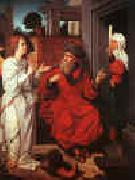 |
Jan Provost
|
|
1465-1529 Flemish Jan Provost Gallery
Jan Provoost, or Jan Provost (1462/5, Mons?CJanuary 1529, Bruges) was a Flemish painter. He was one of the most famous Netherlandish painters of his generation, a prolific master who left his early workshop in Valenciennes to run two workshops, one in Bruges, where he was made a burgher in 1494, the other simultaneously in Antwerp, which was the economic center of the Low Countries. Provoost was also a cartographer engineer and architect. He met Albrecht D??rer in Antwerp in 1520, and a D??rer portrait drawing at the National Gallery, London, is conjectured to be of Provoost. He married the widow of the miniaturist and painter Simon Marmion, after whose death he inherited the considerable Marmion estate.
The styles of Gerard David and Hans Memling can be detected in Provoost's religious paintings. The Last Judgement painted for the Bruges town hall in 1525 is the only painting for which documentary evidence identifies Provoost. Surprising discoveries can still be made: in 1971 an unknown and anonymous panoramic Crucifixion from the village church at Koolkerke was identified as Provoost's. It is on permanent loan to the Groeninge Museum, Bruges.
|
|
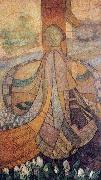 |
Jan Thorn-Prikker
|
|
(June 5, 1868, The Hague - March 5, 1932, Cologne) was a Dutch painter and designer in the Art Nouveau style. He was an important figure in religious art, best known for his stained glass windows. His most famous painting is the mystical The Bride (1893), in the Kroller-Muller Museum, Otterlo.
|
|
 |
Jean Paul Selinger
|
|
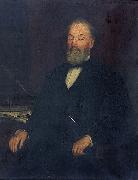
Jean Paul Selinger (1850-1909) and Emily Selinger (1848-1927), husband and wife, had summer art studios at the Glen House and the Crawford House. Born in Boston, Jean Paul studied at the Lowell Institute and in 1875 he went to Germany to study at the Munich Academy with Wilhelm Leibl. Upon returning, he opened an art studio in Providence, Rhode Island, and married Emily McGary, also an artist. The Selingers had a studio in Boston and a summer art studio at the Glen House, Pinkham Notch in the 1880s. In 1894 the Selingers moved into the former studio of Frank H. Shapleigh at the Crawford House. In August 1894 the Selingers accepted an invitation to serve on the board of judges for a North Conway Coaching Parade Committee. Jean Paul painted numerous portraits, still-life paintings, and White Mountain landscapes. Emily painted both watercolors and oils of local flora.
Jean Paul was a member of the Boston Art Club. He exhibited at the National Academy of Design in 1880 and the Paint and Clay Club in Boston in 1889.
|
|
 |
Jean Pierre Alexandre Antigna
|
|
1817-1878
French
Jean Pierre Alexandre Antigna Gallery
French painter. He was taught at the school of drawing in Orl?ans by a local painter, Fran?ois Salmon (1781-1855). On 9 October 1837 he entered the Ecole des Beaux-Arts in Paris, first in the atelier of Sebastien Norblin de la Gourdaine (1796-1884). A year later he became a pupil of Paul Delaroche, from whom he acquired his understanding of dramatic composition.
|
|
 |
Jean Pillement
|
|
French Rococo Era Painter ,
1728-1808
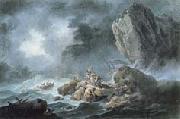
was a painter and designer, known for his exquisite and delicate landscapes, but whose importance lies primarily in the engravings done after his drawings and their influence in spreading the Rococo style, and particularly the taste for chinoiserie, throughout Europe. Pillement, born in Lyon, had an unusually cosmopolitan career. He moved from Paris, working for the Gobelin factory to Lisbon, where the need to rebuild after the disastrous 1755 earthquake had created many opportunities. There he was working in Queluz (Sintra) and for the Dutch consul, the known art collector Jan Gildemeester. Pillement spend eight years in England, fully exploiting the English taste for landscapes. There the paintings by Nicolaes Berchem inspired him. Pillement came acquainted with David Garrick, a famous actor, and his Austrian wife Eva Maria Weigel, collectors of his work in England. Pillement went to Vienna and in 1765 he went to Warsaw, decorating the Royal Castle in Warsaw and the Ujazdowski Castle, his largest project, commissioned by Stanisaw August Poniatowski. He also worked in Saint Petersburg, the Piedmont, Milan, Rome, Venice. Pillement travelled to Paris to work for Marie Antoinette in the Petit Trianon.
|
|
 |
Jean Portaels
|
|
Vilvorde, 1818 - Schaerbeek, 1895
was a Belgian orientalist painter and director of the Academy of Brussels. His father, a rich brewer, sent him to study at the Brussels Academy, whose Director, François Navez, took him on soon after in his own workshop. About 1841 Portaels went to Paris, where he was well received by Paul Delaroche. After his return to Belgium, he won the Grand Prix de Rome in 1842. He then travelled through Italy, Greece, Morocco, Algeria, Egypt, the Lebanon, Judaea, Spain, Hungary and Norway. On his return to Belgium in 1847 Portaels succeeded H. Vanderhaert as Director of the Academy in Ghent. In 1849 he married the daughter of his first teacher, Navez, and in 1850 he settled in Brussels; but when he did not get the post of Director of the Brussels academy, and wished, nevertheless, to carry on teaching as his father-in-law had done, he opened a private studio-school, which became one of great significance in the development of Belgian art. Once more he went on his travels, spending time in Morocco; he returned to Brussels in 1874, and in 1878 became Director of the Academy which had so long been the object of his ambition. Portaels was an extremely prolific artist. Huge oil paintings adorning the walls of St Jacques-sur-Caudenberg; biblical scenes, such as The Daughter of Sion Reviled, The Death of Judas, The Magi travelling to Bethlehem, Judiths Prayer, and The Drought in Judaea; genre pictures, such as A Box in the Theatre at Budapest , portraits of officials and of high society, Oriental scenes and, above all, pictures of exotic female figures and exotic life. "His work is usually marked by an easy grace, which he perhaps uses to excess", wrote Theophile Gautier. But his pleasing and abundant productions as a painter do not constitute Portaels' crowning merit.
|
|
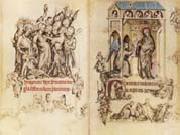 |
Jean Pucelle
|
|
French Gothic Era Manuscript Illuminator, ca.1300-1355
was a Parisian Gothic-era manuscript illuminator, active between 1320 and 1350. His style is characterized by delicate figures rendered in grisaille, accented with touches of color. Pucelle's most famous work is the The Hours of Jeanne d'Evreux, c. 1324-1328.
|
|
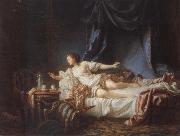 |
Jean-Baptiste Le Prince
|
|
French Painter, 1734-1781,French painter, draughtsman and printmaker. Born to a family of ornamental sculptors and gilders, he became famous for creating a new kind of genre picture, based on the direct observation of Russian subjects, and also for perfecting aquatint technique. Sometime around 1750 he became a pupil of Fran?ois Boucher, thanks to the protection of the Mar?chal de Belle-Isle (1684-1761), governor of Metz. Boucher's saturated brushwork, highly finished surfaces and incisive drawing had a decisive impact upon the young artist, as did, perhaps, the diversity of his output. He was also inspired by 17th-century Dutch and Flemish genre and landscape painters.
|
|
 |
Jean-Baptiste marie pierre
|
|
French Painter ,
b. 1713, Paris, d. 1789, Paris
|
|
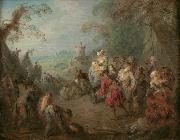 |
Jean-Baptiste Pater
|
|
Jean-Baptiste Pater (December 29, 1695 - July 25, 1736) was a French rococo painter.
Born in Valenciennes, Pater was the son of sculptor Antoine Pater and studied under him before becoming a student of painter Jean-Baptiste Guide. Pater then moved to Paris, briefly becoming a pupil of Antoine Watteau in 1713. Watteau, despite treating Pater badly, had a significant influence on him. However the two quarreled and Pater returned to Valenciennes, where he remained for two years. In 1721, Pater and the dying Watteau reconciled; subsequently Pater became a student of Watteau once again, although only for a month before the latter's death. Pater later claimed to have learnt everything he knew during those few weeks with Watteau. He was accepted into the Academie in 1728, presenting a large military work in the popular Watteau style - La Rejouissance des Soldats (Louvre).[1]
Pater adopted the popular Fete galante subject matter, heavily imitating his teacher Watteau, indeed he directly copied some of his figures. Pater used a traditional Rococo pastel palette. His most characteristic difference in style from other artists of the time surrounded his use of shimmering lines. His most prominent customer was Frederick the Great, who sat for two portraits in the "Turquerie" style: LeSultan au Harem and Le Sultan au Jardin. One of Pater's most renowned works is Landscape with a Cart (Schloss Charlottenburg), which is considered to display a feathery application of paint that anticipates Francesco Guardi. The delicately constructed subject matter and figures subordination to the buildings represent a movement away from fete galante, however this development was cut short by Pater's death in 1736.
|
|
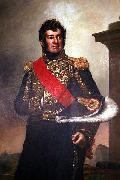 |
Jean-Baptiste Paulin Guerin
|
|
(March 25, 1783 - January 19, 1855), French painter, was born at Toulon, of poor parents.
As a young man, he learned his father's trade of locksmithing, whilst at the same time he followed the classes of the free school of art. Having sold some copies to a local amateur, Guerin started for Paris, where he came under the notice of Vincent, whose counsels were of material service.
In 1810 Guerin made his first appearance at the Salon with some portraits, which had a certain success. In 1812 he exhibited "Cain after the murder of Abel" (formerly in Luxembourg), and, on the return of the Bourbons, was much employed in works of restoration and decoration at Versailles.
|
|
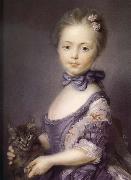 |
Jean-Baptiste Peronneau
|
|
French, 1715-1783
|
|
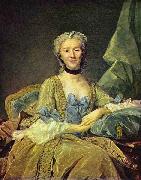 |
Jean-Baptiste Perronneau
|
|
(Paris, c. 1715 - Amsterdam, 19 November 1783) was a French painter who specialized in portraits executed in pastels.
Perronneau began his career as an engraver, apparently studying with Laurent Cars, whose portrait he drew, and working for the entrepreneurial printseller Gabriel Huquier, rue Saint-Jacques, Paris, making his first portraits in oils, and especially in pastels, in the 1740s. His career was much in the shadow of the master of the French pastel portrait, Maurice Quentin de La Tour. In the Salon of 1750, Perronneau exhibited his pastel portrait of Maurice-Quentin de la Tour, but found to his dismay that La Tour was exhibiting his own self portrait, perhaps a malicious confrontation to demonstrate his superiority in the technique.
He made his Salon debut with a pastel portrait in 1746 and received full membership in the Academie Royale de Peinture et de Sculpture in 1753, with portraits of fellow artist Jean-Baptiste Oudry and the sculptor Lambert-Sigisbert Adam, both now at the Louvre Museum. After 1779 he no longer exhibited in the Paris Salons, but the clientele in his portraits reveal how widely he travelled in the provinces of France, with a group of sitters connected with Orleans, but also in Toulouse, Bordeaux, Lyon. Farther afield he may have been in Turin and Rome, and in Spain, Hamburg, Poland, Russia and England.
He died in Amsterdam virtually unknown, according to his biographers.
|
|
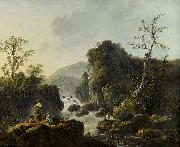 |
Jean-Baptiste Pillement
|
|
(Lyon, 24 May 1728 - Lyon, 26 April 1808) was a painter and designer, known for his exquisite and delicate landscapes, but whose importance lies primarily in the engravings done after his drawings, and their influence in spreading the Rococo style and particularly the taste for chinoiserie throughout Europe.
Pillement had an unusually cosmopolitan career. In 1743, at the age of 15, he moved from Lyon to Paris where he was employed as an apprentice designer at the Gobelin factory. In 1745 he left for Spain, where he remained for 5 years. There he found employment in various cities as both a designer and painter. A landscape dated 1748 reveals rustic themes he was to repeat often: sun bathed shepherds leading their goats and sheep to a cascading stream, a water mill, rocky elevations covered in lush vegetation, and the poeticized relics of an ancient bridge. In 1750, at the age of 22, he moved to Lisbon, where he enjoyed continuing success. The lure of travel compelled him to decline an offer to become First Painter to King Joseph of Portugal ?, and in 1754 he left Lisbon for London.
Pillement then spent eight years in England, fully exploiting the English taste for landscapes. There he was inspired by the paintings of, among others, Nicolaes Berchem. During this period he became acquainted with David Garrick, the famous actor, and his Austrian wife Eva Maria Weigel, who became avid collectors of his work. In 1763 Pillement then traveled to Vienna, where he was employed at the Imperial Court of Maria Theresa and Francis I. In 1765 he left Vienna for Warsaw, where his many projects included decorating the Royal Castle in Warsaw and the Ujazdowski Castle, his largest project, commissioned by Stanisław August Poniatowski. He also later worked in Saint Petersburg, the Piedmont, Milan, Rome and Venice. 1768-1780 Pillement again worked in France, where he was employed by Marie Antoinette in the Petit Trianon. 1780-1789 he was once again on the Iberian Peninsula, and in 1789 moved to Pezenas in the Languedoc. In 1800 he returned to Lyon, where he continued to paint while also designing for the silk industry and giving lessons in the Academy founded by Napoleon.
|
|
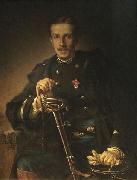 |
Jean-Francois Portaels
|
|
(3 April 1818 - 8 February 1895) was a Belgian orientalist painter and director of the Academie Royale des Beaux-Arts in Brussels.
Portaels was born in Vilvoorde. His father, a rich brewer, sent him to study at the Royal Academy, whose director, François Navez, took him on soon after in his own workshop. About 1841 Portaels went to Paris, where he was well received by Paul Delaroche.
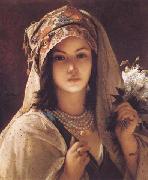
The Rose VendorAfter his return to Belgium, he won the Grand Prix de Rome in 1842. He then travelled through Italy, Greece, Morocco, Algeria, Egypt, the Lebanon, Judaea, Spain, Hungary and Norway. On his return to Belgium in 1847 Portaels succeeded H. Vanderhaert as Director of the Academy in Ghent. In 1849 he married the daughter of his first teacher, Navez, and in 1850 he settled in Brussels; but when he did not get the post of director of the Brussels academy, and wished, nevertheless, to carry on teaching as his father-in-law had done, he opened a private studio-school, which became one of great significance in the development of Belgian art. Once more he went on his travels, spending time in Morocco; he returned to Brussels in 1874, and in 1878 became Director of the Academie Royale des Beaux-Arts which had so long been the object of his ambition. He died in Schaerbeek.
|
|
|
|
Jean-Louis prevost le jeune
|
|
Noitel circa
1740-after 1810
|
|
 |
Jean-Paul Laurens
|
|
1838-1921
French
Jean Paul Laurens Gallery
was a French painter and sculptor, and one of the last major exponents of the French Academic style.
Born in Fourquevaux, he was a pupil of L??on Cogniet and Alexandre Bida. Strongly anti-clerical and republican, his work was often on historical and religious themes, through which he sought to convey a message of opposition to monarchical and clerical oppression. His erudition and technical mastery were much admired in his time, but in later years his hyper-realistic technique, coupled to a highly theatrical mise-en-sc??ne, came to be regarded as overly didactic and even involuntarily comical.
Laurens was commissioned to paint numerous public works by the French Third Republic, including the steel vault of the Paris city hall, the monumental series on the life of Saint Genevieve in the apse of the Panth??on, the decorated ceiling of the Od??on Theater, and the hall of distinguished citizens at the Toulouse capitol. He also provided illustrations for Augustin Thierry's R??cits des temps m??rovingiens ("Accounts of Merovingian Times").
Laurens was a professor at the École nationale sup??rieure des Beaux-Arts in Paris, where he taught Andr?? Dunoyer de Segonzac and George Barbier. Two of his sons, Paul Albert Laurens (1870-1934) and Jean-Pierre Laurens (1875-1932), became painters and teachers at the Acad??mie Julian. He died in Paris in 1921.
|
|
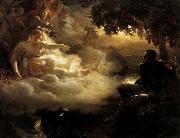 |
Jean-Pierre Franque
|
|
French, 1774-1860,French painter. He and his twin brother, Joseph-Boniface Franque (1774-1833), who was also a painter, were the sons of a modest farmer and, according to a local story, their youthful talent was such that the provincial government paid for them to study in Grenoble. They enrolled at the Ecole Gratuite in Grenoble and stayed for about two years (1786-8), training to become engravers. During the revolutionary period, the twins' education was taken over by the Departement de la Dreme. In 1792 their case was discussed at the National Assembly in Paris, which placed them in David's atelier and provided a pension for four years. David agreed to educate them but refused payment, writing to the President of the Assembly, 'I am overjoyed to be chosen to be the first teacher of these youths who could be called children of the nation since they owe everything to her.' The two brothers were considered very promising students, and David asked Jean-Pierre to assist him in the execution of the Intervention of the Sabine Women (1796-9; Paris, Louvre). Jean-Pierre also became involved with LES PRIMITIFS and the mysterious Maurice Quae (1779-1804), who reacted against Davidian principles and advocated a return to 'primitive' 15th-century Italian art. Franque demonstrated his independence from David in the selection of the subject for his 1806 Salon debut, the Dream of Love Induced by the Power of Harmony (destr.). In the spring of 1807 he was one of the 26 painters who entered a sketch (untraced) for the competition for a large painting representing Napoleon on the battlefield of Eylau, a competition won by Gros. In 1810 Franque produced Allegory of the Condition of France before the Return from Egypt (Paris, Louvre).
|
|
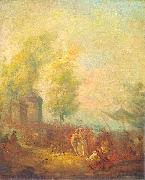 |
Jean-Pierre Norblin de La Gourdaine
|
|
(in Polish, Jan Piotr Norblin; 15 July 1745 - 23 February 1830) was a French-born painter, draughtsman, engraver, drawing artist and caricaturist. From 1774 to 1804 he resided in the Polish-Lithuanian Commonwealth, where he obtained citizenship.
He is considered one of the most important painters of the Polish Enlightenment. He achieved great success in Poland. Given many commissions from some of the most notable families of the Polish-Lithuanian Commonwealth, he stayed there for many years, not returning to Paris until the early 19th century. His style showed the influence of Antoine Watteau, and combined the Rococo tradition of charming fates galantes and fetes champetres with a panorama of daily life and current political events, captured with journalistic accuracy. He created a gallery of portraits of representatives of all social classes in the last years of the Polish-Lithuanian Commonwealth.
|
|
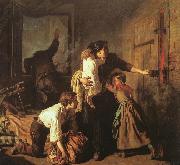 |
Jean-Pierre-Alexandre Antigna
|
|
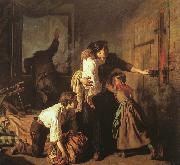
painted The Fire in 1850-51
|
|
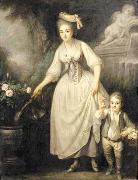 |
Jeanne-Philiberte Ledoux
|
|
painted Portrait of a lady, said to be the Duchesse de Choiseul in 18th century
|
|
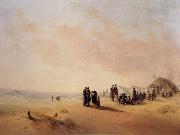 |
Jeanron Philippe Auguste
|
|
Boulogne-sur-Mer1809-Comborn 1877
|
|
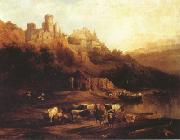 |
Jenaro Perez Villaamil
|
|
1807-1854
was born in Ferrol, Galicia. He was a remarkable painter and prime example of the Galician Romantic Movement. In his work, particularly in his landscapes, he shows an unmistakable taste for the English painters of the same period. Most of his paintings are exhibited at Museo del Prado in Madrid, the city where he died.
|
|
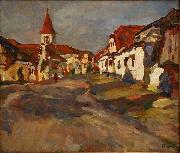 |
Jindrich Prucha
|
|
painted Village Green in 1910 - 1911
|
|
 |
Joachim Patenier
|
|
1480-1525
Flemish
Joachim Patenier Galleries
was a Flemish Northern Renaissance history and landscape painter. He was probably the uncle of Herri met de Bles, with whom he helped establish a distinct style of northern Renaissance landscapes.
|
|
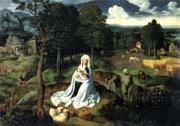 |
Joachim Patinir
|
|
Flemish Northern Renaissance Painter, ca.1485-1524
|
|
 |
Joel Pettersson
|
|
(June 8, 1892 - January 5, 1937) was a painter and writer on the Åland Islands, Finland. He remained an obscure figure during his lifetime; most of his works were unpublished for decades after his death.
Pettersson was born into poverty in Lemland, Åland. His parents were elderly peasants, Joel's father being well over 50 at the time of Joel's birth. Joel had a younger brother Karl, who died at sea in 1916.
Pettersson began writing and painting in his early school years, though much of his works from this period were not preserved.
In 1913, he had the opportunity to study at a drawing school in Turku. He stayed in Turku until 1915, when he decided to abort his studies and return to Åland. He painted for a few years, but he eventually tired of it and did not paint for many years.
Upon his return, Pettersson became active in the local youth organisation, for which he wrote plays and monologues. He also wrote prose which he read out loud during organisation meetings. Pettersson was most active as a writer following his return from Turku until 1921.
During the 1920s, Pettersson worked mostly on his parents' farm, only sporadically participating in the youth organisation's activities. His parents both died in 1928, leaving Pettersson to care for the farm. He sold all the animals and most of the property. He tried earning a living on his artistry, but was unsuccessful. He then tried raising hens, but this also proved to be an unsuccessful venture. He resumed painting in 1935, and some of his paintings were displayed during an exhibition the following year.
His constant economic difficulties and work load took their toll. In 1936, he suffered a nervous breakdown and was committed to Grelsby Asylum, where he remained until his death in early 1937.
|
|
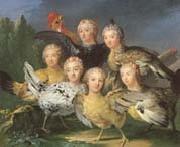 |
Johan Pasch
|
|
1706-1769
|
|
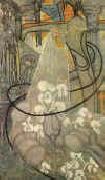 |
Johan Thorn Prikker
|
|
1868-1932 Dutch Johan Thorn Prikker Gallery
Dutch painter, printmaker, mosaicist and stained-glass artist. He attended the Koninklijke Academie van Beeldende Kunsten in The Hague (1881-8). During this period he painted mainly landscapes in the style of The Hague school. Until c. 1896 he produced Symbolist works, in which the emphatic line flow and the subtle colour shading are especially noticeable, for example The Bride (1893; Otterlo, Kr?ller-M?ller). From 1892 until 1897 he corresponded with Henri Borel, partly about his Symbolist work, often drawing in the letters. During this time he came into close contact with Belgian artists, in particular with Henry Van de Velde through whom he was able to exhibit with Les XX in Brussels. In summer he regularly stayed in Vise, where he produced pastel drawings in a rhythmic pointillism, a style with which he could achieve a form of abstraction.
|
|
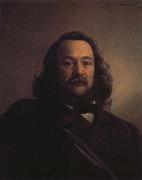 |
Johann Peter Hasenclever
|
|
1810 Remscheid-1853 Dusseldorf, German painter. His artistic talent was recognized in 1827, while he was at school in D?sseldorf. The same year he embarked on a course in architecture at the Akademie in D?sseldorf. In 1828 he turned to the study of history painting. After a difference of opinion over the theory of art with the Director of the Akademie, Wilhelm von Schadow, Hasenclever went home to Remscheid. There he taught himself portrait painting. An example of his work from this period is the portrait of Gertraude Scharff (1832-3; Remscheid, Dt. Werkzeugmus. & Heimatmus.). From 1832 to 1838 Hasenclever again studied at the Akademie in D?sseldorf in a painting class taught by Ferdinand Theodor Hildebrandt (1804-74). In portraits and humorous genre paintings Hasenclever found a field suited to his gifts. Pithy commentaries on the everyday life of the lower middle classes are present in all of Hasenclever's work. He was best known for subjects such as wine-tastings and cellar scenes, and he also made a series of Jobs pictures, humorous, ironic interpretations of popular life based on the poem 'Jobsiade', a grotesque and comic heroic epic written by Carl Arnold Kortum in 1784.
|
|
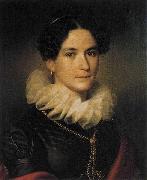 |
Johann Peter Krafft
|
|
(15 September 1780 - 28 October 1856) was a German-Austrian painter.
Krafft was born in Hanau, Hesse. At the age of ten, he began his art studies at the Hanau Akademie. In 1799, he moved to Vienna and studied at the Academy of Fine Arts for three years under the tutelage of Heinrich Feger. From 1802 to 1808, he studied in Paris, with Jacques-Louis David and François Gerard, and then in Rome. On his return to Vienna, he became a successful professional painter, producing numerous portraits.
In 1828, Krafft became director of the Imperial and Royal Picture Gallery in Belvedere Palace.
Johann Peter Krafft died at the age of 76 in Vienna, where he was buried at the Zentralfriedhof.
|
|
 |
Johann Wilhelm Preyer
|
|
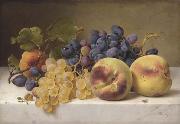
painted A Still Life with Peaches and Grapes on a Marble Ledge in 1803-1889
|
|
 |
John Ford Paterson
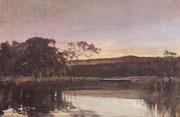
|
|
Australian, 1851-1912
|
|
 |
John Frederick Peto
|
|
1854-1907
John Frederick Peto Gallery
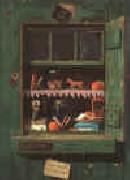
John Frederick Peto (May 21, 1854 ?C November 23, 1907) was an American trompe l'oeil ("fool the eye") painter who was long forgotten until his paintings were rediscovered along with those of fellow trompe l'oeil artist William Harnett.
Although Peto and the slightly older Harnett knew each other and painted similar subjects, their careers followed different paths. Peto was born in Philadelphia, Pennsylvania, and studied at the Pennsylvania Academy of the Fine Arts at the same time as Harnett.[1] Until he was in his mid-thirties, he submitted paintings regularly to the annual exhibitions at the Philadelphia Academy. In 1889, he moved to the resort town of Island Heights, New Jersey, where he worked in obscurity for the rest of his life. He and his wife took in seasonal boarders, he found work playing cornet at the town's camp revival meetings, and he supplemented his income by selling his paintings to tourists.[2] He never had a gallery exhibition in his lifetime.[3] Harnett, on the other hand, achieved success and had considerable influence on other artists painting in the trompe l'oeil genre, but even his paintings were given the snub by critics as mere novelty and trickery.
Both artists were masters of trompe l'oeil, a genre of still life that aims to deceive the viewer into mistaking painted objects for reality. Exploiting the fallibility of human perception, the trompe l'oeil painter depicts objects in accordance with a set of rules unique to the genre. For example, Peto and Harnett both represented the objects in their paintings at their actual size, and the objects rarely were cut off by the edge of the painting, as this would allow a visual cue to the viewer that the depiction was not real. But the main technical device was to arrange the subject matter in a shallow space, using the shadow of the objects to suggest depth without the eye seeing actual depth. Thus the term trompe l'oeil??"fool the eye." Both artists enthrall the viewer with a disturbing but pleasant sense of confusion.
Letter Rack by PetoPeto's paintings, generally considered less technically skilled than Harnett's,[4] are more abstract, use more unusual color, and often have a stronger emotional resonance. Peto's mature works have an opaque and powdery texture which is often compared to Chardin.[5]
The subject matter of Peto's paintings consisted of the most ordinary of things: pistols, horseshoes, bits of paper, keys, books, and the like. He frequently painted old time "letter racks," which were a kind of board that used ribbons tacked into a square that held notes, letters, pencils, and photographs. Many of Peto's paintings reinterpret themes Harnett had painted earlier,[6] but Peto's compositions are less formal and his objects are typically rustier, more worn, less expensive looking.[7]
Other artists who practiced trompe l'oeil in the late nineteenth century include John Haberle and Jefferson David Chalfant. Otis Kaye followed several decades later.
A pioneering study of Peto and Harnett is Alfred Frankenstein's After the Hunt, William Harnett and Other American Still Life Painters 1870-1900. Frankenstein's book itself is a fantastic tale of solving the mystery of why these artists were forgotten for much of the twentieth century.
|
|
 |
John Peter Russell
|
|
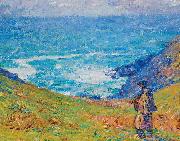
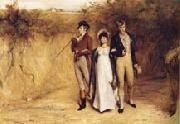
(16 June 1858 -22 April 1930) was an Australian impressionist painter.
John Peter Russell was born at the Sydney suburb of Darlinghurst, the eldest of four children of John Russell, a Scottish engineer, his wife Charlotte Elizabeth, nee Nicholl, from London. J. P. Russell was a nephew of Sir Peter Nicol Russell. After his father's death J. P. Russell enrolled at the Slade School of Fine Art, University College, London, on 5 January 1881 and studied under Alphonse Legros for three years.Russell then went to Paris to study painting under Fernand Cormon. (His fellow students there included Henri de Toulouse-Lautrec and Émile Bernard.) Russell was a man of means and having married a beautiful Italian, Mariana Antoinetta Matiocco, he settled at Belle Île off the coast of Brittany, where he established an artists' colony. He would have 11 children with Matiocco, of whom six survived.
John Peter Russell: Vincent van Gogh, 1886, Van Gogh Museum, AmsterdamRussell had met Vincent van Gogh in Paris and formed a friendship with him. Van Gogh spoke highly of Russell's work, and after his first summer in Arles in 1888 he sent twelve drawings of his paintings to Russell, to inform him about the progress of his work. Claude Monet often worked with Russell at Belle Île and influenced his style, though it has been said that Monet preferred some of Russell's Belle Île seascapes to his own.
|
|
 |
John Pettie
|
|
British Painter, 1839-1893
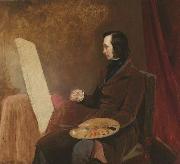
He was brought up in Edinburgh and East Lothian, and in 1855 he entered the schools of the Trustees' Academy, Edinburgh, sponsored by the history painter James Drummond (1816-77). He studied under Robert Scott Lauder, and among his fellow students were WILLIAM QUILLER ORCHARDSON, Thomas Graham (1840-1906), George Paul Chalmers (1833-78), John Burr (1831-93) and John MacWhirter, several of whom later became part of Pettie's circle of Scottish artist friends in London. Pettie first exhibited at the Royal Scottish Academy in 1858 with In Trabois House (untraced), a scene from Sir Walter Scott's The Fortunes of Nigel, and he began sending work to the Royal Academy in 1860. From 1858 he provided illustrations for the periodical Good Words, and, encouraged by the reviews received for his early Royal Academy exhibits, such as The Armourers (exh. RA 1860) and What D'Ye Lack' (exh. RA 1861), when Good Words transferred its headquarters, Pettie moved to London in 1862. He shared a studio in Fitzroy Square with Orchardson and Graham from 1863 until his marriage to Elizabeth Ann Bossom on 25 August 1865. He subsequently lived at various addresses, gravitating towards the wealthy artistic colony in St John's Wood, where in 1882, at 2 Fitzjohn's Avenue, he built a neo-Georgian house and studio, The Lothians (destr.). This reflected not only the professional circle in which Pettie moved but also the rapid financial success that he achieved in London. From the mid-1860s his most important patron was John Newton Mappin, founder of the Mappin Art Gallery,
|
|
 |
John Phillip
|
|
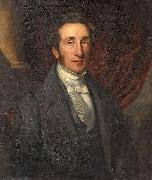
(April 19, 1817-1867) was a Victorian era painter best known for his portrayals of Spanish life. He was nicknamed "Spanish Phillip".
Born into a poor family in Aberdeen in Scotland, Phillip's artistic talent was recognised at an early age. His education at the Royal Academy of Arts was paid for by a wealthy patron. While at the academy Phillip became a member of The Clique a group of aspirant artists organised by Richard Dadd. The Clique considered themselves to be followers of Hogarth and Wilkie. Phillip's own career was to follow that of fellow-Scot Wilkie very closely, beginning with carefully detailed paintings depicting the lives of Scottish crofters, and moving on to much more broadly painted scenes of Spanish life influenced by Murillo and Velezquez.
Phillip's early works tended to depict pious Scots families, but in 1851, after he was advised to travel to southern Europe for his health he visited Spain. Thereafter he concentrated on Spanish subjects. The first of these, The Letter Writer, Seville indicated the influence of Pre-Raphaelitism, a movement he had previously opposed, along with most other members of The Clique, despite his friendship with Millais, one of its leaders. He was so influenced by his travels that he advised other artists to do the same. Some artists, such as Edwin Long, took this advice and were similarly inspired.
In the late 1850s and 1860s Phillip's style became much broader and more painterly, in line with Millais's late work. Phillip's two most important paintings in these years were The Early Career of Murillo (1864) and La Gloria (1865, National Gallery of Scotland). The first depicted the young Murillo drawing his art from Spanish street-life; the second portrayed a Spanish wake for a dead child.
Phillip married Richard Dadd's sister, but like her brother she became insane. Phillip died of a stroke while visiting William Powell Frith. Phillip's self-portrait, "The Evil Eye", commissioned by his close friend Patrick Allan-Fraser, is in Hospitalfield House in Arbroath along with portraits of other members of The Clique.
|
|
 |
John Ponsford
|
|
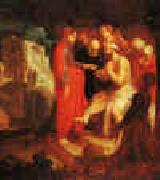
(1790- 1870 )
painted Portrait of a gentleman. Signed and dated Ponsford 1842
|
|
 |
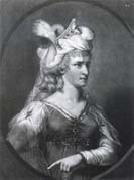
John Pynas
|
|
1583-1631 Dutch John Pynas Gallery
|
|
 |
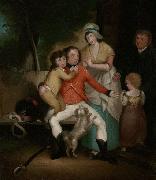
John Raphael Smith
|
|
English Painter, 1752-1812,English printmaker, publisher and painter. The youngest son of the landscape artist Thomas Smith of Derby (d Bristol, 12 Sept 1767), he was apprenticed to a linen draper at the age of ten and around 1767 became a linen draper's assistant in London. He seems to have taught himself to paint miniatures and produced his first mezzotint in 1769, from Henry Benbridge's portrait of General Pascal Paoli (San Francisco, CA Pal. Legion of Honor). Smith married and opened a draper's shop in Exeter Exchange; about 1773 he began to engrave professionally and sold prints from the same shop.
|
|
 |
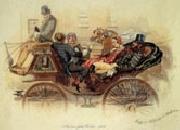
John Ritto Penniman
|
|
John Ritto Penniman (1782-1841) was a painter in Boston, Massachusetts, USA. He created portraits, landscapes, and allegorical paintings, as well as designs for engravings, such as the official seal of the city of Boston in 1822. He also worked as an assistant to Gilbert Stuart. Penniman died in 1841 in Baltimore.
|
|
 |
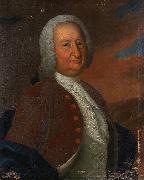
John Skinner Prout
|
|
(1805-76), nephew of the famous English watercolourist Samuel Prout (1783-1852)
|
|
 |
Jons Pilo
|
|
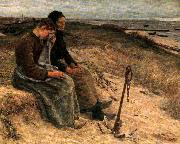
Jöns Pilo (1707-1750)Aliases: Jons O. Pijhlou; Jons O. Pijlou; Jons O. PiloProfessions: Painter
|
|
 |
Jose Julio Sousa Pinto
|
|
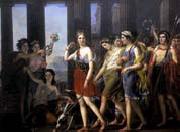
painted Barco desaparecido in 1890
|
|
 |
Joseph Paelinck
|
|
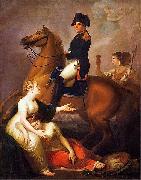
Belgian Painter, 1781-1839, Flemish painter. The son of a farmer, he studied at the Academie in Ghent. He exhibited for the first time in 1802 at the Ghent Salon, then left for Paris where he was admitted into Jacques-Louis David's studio. In 1804 his Judgement of Paris (Ghent, Mus. S. Kst.) obtained a prize at the Ghent Salon. The first of numerous commissions that followed was for St Colette (1806; Ghent, St Baaf), which was in keeping with the contemporary Historicist vogue. In 1808 he was commissioned to paint a portrait of the Empress Josephine (Ghent, Mus. S. Kst.), and in the same year the town of Ghent granted him an allowance for four years of study in Rome where, with other former pupils of David, he took part in the decoration of the Palazzo del Quirinale; his contribution, Augustus Ordering the Adornment of Rome, is untraced. While in Italy he also painted a Neo-classical Invention of the Cross (1812; Ghent, St Michel), inspired by Raphael. In 1812 he returned to Ghent and in 1815 moved to Brussels to paint the portrait of William, Prince of Orange (1818; Brussels, H?tel de Ville). He painted several religious subjects, including a Crucifixion (1817; Sleidinge, St Joris) and the Disciples at Emmaus (Everghem Church), which have links with the 17th-century French tradition. Among the portraits he executed in this period is the Snoy Family
|
|
 |
Jozef Peszka
|
|
(1767 in Krakew - 1831 in Krakew) was a Polish painter.
He studied painting in Warsaw under Franciszek Smuglewicz. From 1815 he was a professor of painting in Krakew Academy of Arts (Akademia Sztuk Pięknych w Krakowie).
He painted portraits and larger paintings with historical or mythological themes.
|
|
 |
Juan Leon Palliere
|
|
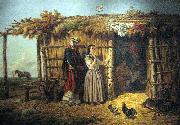
painted Idilio criollo in c. 1861
|
|
 |
Juan Pantoja de la Cruz
|
|
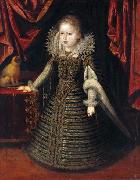
(Valladolid, 1553 - 26 October 1608, Madrid) Spanish painter, one of the best representatives of the Spanish school of court painters. He worked for Philip II and Philip III. The Museo del Prado contains examples of his severe portraiture style.
Juan Pantoja de La Cruz was, born 1553 in Valladolid. Very little is known of his formative years as a painter. He was a pupil of the court painter Alonso Senchez Coello in Madrid and he must have assisted his master in complying with his duties as painter of the Spanish King, Philip II. Pantoja probably continued to work in his master studio after completing his training. He married in 1585 beginning to paint for the court around that time. After Sanchez Coello's death in 1588, Pantoja took over his master workshop and became court painter to Philip II of Spain.
Pantoja kept working for the court and the nobility, painting portraits of Prince Philip, the future Philip III, in 1592 and 1594. Among his most well known works is the portrait of Philip II wearing a cape and hat all in black, painted around 1594 for the Escorial. This portrait is one of the best representations of the idea of Spanish majesty, based on the remoteness of the monarch. On Philip II's death in 1598, Philip III confirmed Pantoja's status as court painter. When the court settled in Valladolid in 1601, Pantoja moved to the new capital, remaining in this city, several years.
|
|
|
|
|
|
|
|
|
| Wholesale China Oil Painting Wholesale Oil Painting China Xiamen Portrait Reproduction on canvas Chinese Oil Painting Wholesale USA Oil Painting |
|
|
|
|


