|

|
|
| |
|
China Oil Painting Direct
|
|
100% hand painted, 100%
cotton canvas,
100% money back if not satisfaction.
|
|
|
|
ART WORKS
INDEX
A B C D E F G H I J K L M N O P Q R S T U V W X Y Z
|
|
ARTISTS
INDEX
A B C D E F G H I J K L M N O P Q R S T U V W X Y Z
|
|
|
|
 |
Alajos Gyorgyi Giergl 
|
|
1821-1863
Hungarian
Alajos Gyorgyi Giergl Gallery
|
|
 |
Andrei Ivanov
|
|
1775-1848
Russian
Andrei Ivanov Gallery
|
|
 |
Jules-Adolphe Goupil
|
|
1839-1883
French
Jules-Adolphe Goupil Gallery
|
|
 |
Philippe-Augustin Immenraet
|
|
1627-1679
Flemish
Philippe Augustin Immenraet Gallery
|
|
 |
A. Bryan Wall
|
|
American, 1872-1937
|
|
 |
a. jernberg
|
|
August Jernberg, född 16 september 1826 i Gävle, död 22 juni 1896 i Dusseldorf, var en svensk konstnär.
Han målade först porträtt och historiska, bibliska motiv, men blev på 1860-talet en genre- och även landskapsmålare. Bland de svenska Dusseldorfmålarna var han den främste koloristen.
Han studerade vid Konstakademien 1843-1846 och reste sedan till Paris, där han studerade under Thomas Couture 1847-1853. 1854 slog han sig ned i Dusseldorf och stannade där till sin död, men företog kortare studieresor. Han blev ledamot av Konstakademin 1865, men tillhörde 1885 opponenterna. Han var dessutom ledamot av Konstakademien i Dusseldorf.
Även hans son Olof Jernberg (1855-1935) var konstnär.
|
|
 |
A.K.Cabpacob
|
|
1830-1897
Russia Artist
|
|
 |
AACHEN, Hans von
|
|
German Mannerist Painter, 1552-1615
(b Cologne, 1552; d Prague, 4 March 1615). German painter and draughtsman, active also in Italy and Bohemia. One of the foremost painters of the circle gathered at the Prague court of Emperor Rudolf II.
|
|
 |
Aaron Harry Gorson
|
|
1872-1933
|
|
 |
Abanindranath Tagore
|
|
Indian, 1871-1951,Painter and writer, brother of Gaganendranath Tagore. Intermittently taught by two undistinguished European academicians, Olinto Ghilardy and Charles Palmer, in 1897 he came under the influence of Ernest Binfield Havell (see HAVELL,), art scholar and catalyst of indigenism. Impressed by Mughal and Persian miniatures and the work of the Japanese artists Taikan Yokoyama and Shunso Hishida, who visited India in 1903, Abanindranath discarded Western realism for the stylized naturalism of Japanese art, which suited his poetic temperament, and the general John Ruskin-William Morris thought axis of such early indigenist theorists as Havell and Ananda Kentish Coomaraswamy. His work until the Omar Khayyam illustrations (1906-10; Santiniketan, Nandan Mus.), with their revivalist nationalism and fin-de-siecle affectations, greatly influenced the Neo-Bengal art movement formed chiefly by his pupils at the Calcutta Art School, where he was Vice-principal from 1905 to 1915. His own later work developed an imagist focus. The Arabian Nights series (1930; Calcutta, Babindra-Bharati Soc.), his magnum opus, in which literary and visual antecedents give the image a cultural ambience without intruding on its independence, marks the beginning of modern Indian narrative painting. His aesthetic theories, formulated in lectures he gave as the Vageswari Professor of Art at Calcutta University (1921-9), stressed the role of individual sensibility and imagination in creativity. Induced by his uncle Rabindranath,
|
|
 |
ABBATE, Niccolo dell
|
|
Italian Mannerist Painter, ca.1512-1571
Italian painter. He was trained in Modena and developed his mature style under the influence of his contemporaries Correggio and Parmigianino in Bologna (1544 ?C 52). There he painted portraits and decorated palaces with frescoes of landscapes and figure compositions in the Mannerist style. In 1552 he was invited by Henry II of France to work under Primaticcio at the Palace of Fontainebleau, where he executed immense murals (most now lost). He remained in France the rest of his life. His mythological landscapes were a principal source of the French Classical landscape tradition, and he was a precursor of Claude Lorrain and Nicolas Poussin.
|
|
 |
Abbey, Edwin Austin
|
|
American Golden Age Illustrator and Muralist, 1852-1911
American painter and illustrator, active in England. He began his artistic training in 1866, studying drawing with the Philadelphia portrait and landscape painter Isaac L. Williams (1817-95). In 1868 he attended evening classes in drawing at the Pennsylvania Academy of the Fine Arts under Christian Schussele (1824-79). In the same year Abbey began to work as an illustrator for the Philadelphia publishers Van Ingen & Snyder. In 1870 Harper's Weekly published the Puritans' First Thanksgiving, and in 1871 Abbey moved to New York to join the staff of Harper & Brothers, thus inaugurating his most important professional relationship. Throughout the 1870s Abbey's reputation grew, both for his detailed exhibition watercolours and for his elegant line drawings, which, translated to wood-engravings in numerous periodicals, illustrated both factual and fictional events of the past and present. The influences on him were mainly English, in particular the works of the Pre-Raphaelite Brotherhood and illustrations in the English press, which he studied avidly. The success of his illustrations to some of Robert Herrick's poems, such as Corinna's Going A-Maying in Harper's New Monthly Magazine (May 1874), prompted Harper & Brothers in 1878 to send Abbey to England to do a complete series of drawings for an illustrated gift-book, Selections from the Poetry of Robert Herrick (New York, 1882).
|
|
 |
Abbot H Thayer
|
|
1849-1921
Abbot H Thayer Galleries
Abbott Handerson Thayer (August 12, 1849 ?C May 29, 1921) was an American artist, naturalist and teacher. As a painter of portraits, figures, animals and landscapes, he enjoyed a certain prominence during his lifetime, as shown by the fact that his paintings are in the most important U.S. art collections. In the last third of his life, he worked together with his son, Gerald Handerson Thayer, on a major book about protective coloration in nature, titled Concealing Coloration in the Animal Kingdom: An Exposition of the Laws of Disguise Through Color and Pattern; Being a Summary of Abbott H. Thayer??s Disclosures. First published by Macmillan in 1909, then reissued in 1918, it had a widespread impact on the use of military camouflage during World War I. He also influenced American art through his efforts as a teacher, taking on apprentices in his New Hampshire studio.
|
|
 |
Abbott Fuller Graves
|
|
1859-1936
|
|
 |
Abbott Handerson Thayer
|
|
American Painter, 1849-1921
American painter and naturalist. He spent his youth in rural New England, where his earliest paintings were wildlife subjects, reflecting his interest in hunting and fishing. While in his teens Thayer achieved some success doing portraits of family pets, which he continued after a move to New York. He attended classes at the Brooklyn Art School and National Academy of Design, but in 1875 he settled in Paris, studying under Henri Lehmann and Jean-L?on G?r?me at the Ecole des Beaux-Arts. While abroad he produced landscapes in the Barbizon style and genre scenes, but on his return to New York in 1879
|
|
 |
abel faivre
|
|
Il tudie trois ans l'École des beaux-arts de Lyon, puis a la Societe nationale et a l'Academie Julian de Paris aupres de Jules Lefebvre et Benjamin Constant.
Il a souvent expose a la societe des Artistes Francais et a ete medaille de 3e classe a l'Exposition de 1894. Medaille d'honneur a l'Exposition de Lyon, il aurait vecu et travaill?? a La Croix-Valmer (Var) ou un boulevard porte son nom.
Il est devenu celebre par ses affiches pour soutenir l'effort de guerre francais (1914-1918). Il a egalement travaille pour le journal humoristique Le Rire et pour Le Figaro. Ses caricatures sont visibles au Musee Jean Jaures a Castres.
À titre indicatif, un exemplaire original de son affiche Sports d'Hiver, Chamonix datant de 1905 etait estime a 6000 £ par une celebre salle de ventes en 2002. Une huile sur toile La Belle Odalisque (89x61 cm) se vendit 8 000 euros en 2006.
|
|
 |
Abel Grimmer
|
|
Flemish Baroque Era Painter, ca.1570-C.1619
|
|
 |
ABILDGAARD Nicolai
|
|
Nikolaj Abraham Abildgaard (September 11, 1743 - June 4, 1809), Danish artist, was born in Copenhagen, the son of Søren Abildgaard, an antiquarian draughtsman of repute, and Anne Margrethe Bastholm.
|
|
 |
Abraham Diepraam
|
|
1622-1670
Dutch
Abraham Diepraam Location
|
|
 |
Abraham Bloemaert
|
|
(1566, Gorinchem - 27 January 1651, Utrecht), was a Dutch painter and printmaker in etching and engraving. He was one of the "Haarlem Mannerists" from about 1585, but in the new century altered his style to fit new Baroque trends.
Bloemaert was the son of an architect, who moved his family to Utrecht in 1575, where Abraham was first a pupil of Gerrit Splinter (pupil of Frans Floris) and of Joos de Beer. He then spent three years in Paris, studying under several masters, and on his return to his native country received further training from Hieronymus Francken. In 1591 he went to Amsterdam, and four years later settled finally at Utrecht, where he became dean of the Guild of St. Luke.
He excelled more as a colourist than as a draughtsman, was extremely productive, and painted and etched historical and allegorical pictures, landscapes, still-life, animal pictures and flower pieces. In the first decade of the seventeenth-century, Bloemaert began formulating his landscape paintings to include pictoresque ruined cottagges and other pastoral elements. In these works, the religious or mythological figures play a subordinate role. Country life was to remain Bloemaert's favourite subject, which he depicted with increasing naturalism. He drew motifs such as peasant cottages, dovecotes and trees from life and then on his return to the studio, worked them up into complex imaginary scenes.
Among his pupils are his four sons, Hendrick, Frederick, Cornelis, and Adriaan (all of whom achieved considerable reputation as painters or engravers), the two Honthorsts, Ferdinand Bol and Jacob Gerritsz Cuyp.
|
|
 |
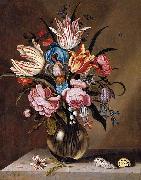
Abraham Bloemart
|
|
1564-1651
Dutch
Abraham Bloemart Locations
|
|
 |
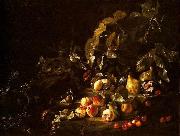
Abraham Bosschaert
|
|
(1612-1643) was a Dutch Golden Age painter.
Bosschaert was born in Middelburg. According to the RKD he was a member of the Bosschaert dynasty. Like his father Ambrosius Bosschaert and older brothers, he signed his works with a monogram; AB, but this was only discovered in 1992. His older brothers Ambrosius Bosschaert II and Johannes Bosschaert were his first teachers after the death of his father in 1623, but he also took lessons from his uncle Balthasar van der Ast in Utrecht from 1628-1637. In 1637 he moved to Amsterdam, but by 1643 he had returned to Utrecht, where he was buried on April 4th, 1643.
|
|
 |
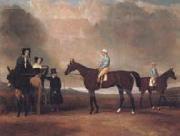
Abraham Brueghel
|
|
(1631-1690) was a Flemish painter from the famous family of artists. He was the son of Jan Brueghel the Younger, the grandson of Jan Brueghel the Elder and the great-grandson of Pieter Brueghel the Elder.
|
|
 |
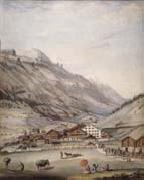
Abraham Cooper
|
|
British Painter, 1787-1868
English animal and battle painter, the son of a tobacconist, was born in London. At the age of thirteen he became an employee at Astley's Amphitheatre, and was afterwards groomed in the service of Sir Henry Meux. When he was twenty-two, wishing to possess a portrait of a favorite horse under his care, he bought a manual of painting, learned something of the use of oil-colours, and painted the picture on a canvas hung against the stable wall. His master bought it and encouraged him to continue in his efforts. He accordingly began to copy prints of horses, and was introduced to Benjamin Marshall, the animal painter, who took him into his studio, and seems to have introduced him to the Sporting Magazine, an illustrated periodical to which he was himself a contributor. In 1814 he exhibited his Tam O'Shanter, and in 1816 he won a prize for his Battle of Ligny. In 1817 he exhibited his Battle of Marston Moor and was made associate of the Academy, and in 1820 he was elected Academician. Cooper, although ill-educated, was a clever and conscientious artist; his coloring was somewhat flat and dead, but he was a master of equine portraiture and anatomy, and had some antiquarian knowledge.
|
|
 |
Abraham Evertsz. van Westerveld
|
|
painted Cornelis Tromp in Roman costume in 1650-1692
|
|
 |
Abraham Fischer
|
|
1850 ?C 1913,was the sole Prime Minister of the Orange River Colony in South Africa. He was originally a lawyer in Cape Colony, joining the bar in 1875. He became vice-president of the Orange Free State's volksraad in 1893 and a member of the executive council in 1896. During the Boer War he went to Europe to solicit support for the Boers, returning in 1903 to practice law in the newly-formed Orange River Colony. Continuing to promote the Boer cause, he helped form the Oranje Unie party in May 1906 and became its chairman; the party won the majority of seats in the colony's first elections that were held in November 1907. On November 27, he was chosen as Prime Minister, and stayed in that position until it ceased to exist with the union of May 31, 1910. He then joined the cabinet of the Union of South Africa.
|
|
 |
Abraham Govaerts
|
|
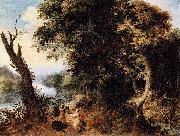
Abraham Govaerts (Antwerp, 1589 - 9 September 1626) was a Flemish Baroque painter who specialized in small cabinet-sized forest landscapes in the manner of Jan Brueghel the Elder and Gillis van Coninxloo.[1] He became a master in Antwerp's guild of St. Luke in 1607-1608, and subsequently trained several other painters in including Alexander Keirincx. Govaerts' paintings, such as A Forest View with the Sacrifice of Isaac (Alte Pinakothek, Munich), typically show diminutive history, mythological or biblical subjects within a Mannerist three-color universal landscape bracketed by repoussoir trees. The figures were often added by other artists, especially by members of the Francken family.
|
|
 |
Abraham Hendrickz van Beyeren
|
|
1621-1690
Dutch
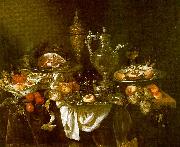
Abraham Hendrickz van Beyeren Location
|
|
 |
Abraham Hondius
|
|
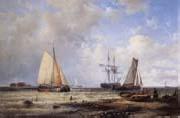
(1625 - 1691) was a Dutch Golden Age painter known his depictions of animals. He was the son of a city stonemason, Daniel Abramsz de Hondt.
Hondius was born in Rotterdam and trained under Pieter de Bloot ( 1601 - 1658) and Cornelis Saftleven.He lived in Rotterdam until 1659 and moved then to Amsterdam. He moved to London] in 1666, where he spent the rest of his life. Hondius combined throughout his career several stylistic influences and struggled to develop a style of his own. He however specialised somehow in animal pieces: more than two-thirds of his paintings, etchings and drawings are hunting scenes, animals fighting and animal studies. He also executed landscapes, genre and religious scenes.
Hondius most likely moved to London] (where he later died) in 1666 where he spent the rest of his life. He painted views of London such as The Frost Fair on the Thames at Temple Stairs and London Bridge. His last known work is "Ape and Cat Fighting over Dead Poultry," dated 1690.
|
|
 |
Abraham Hulk
|
|
1813-1897 Born in London, the senior member and best known of a family of painters, Abraham Hulk studied in Holland at the Amsterdam Academy under portrait painter Jean Augustin Daiwaille.
|
|
 |
Abraham Janssens
|
|
van Nuyssen (ca. 1567/1576 - 1632) was a Flemish Baroque painter.
He was born at Antwerp, in a year variously reported between 1567 and 1576. He studied under Jan Snellinck, was a master in 1602, and in 1607 was dean of the master-painters. He died in the city of his birth.
Till the appearance of Rubens he was considered perhaps the best historical painter of his time. The styles of the two artists are not unalike. In correctness of drawing Janssens excelled his great contemporary; in bold composition and in treatment of the nude he equalled him; but in faculty of color and in general freedom of disposition and touch he fell far short. A master of chiaroscuro, he gratified his taste for strong contrasts of light and shade in his torchlights and similar effects. Good examples of this master are to be seen in the Antwerp museum and the Vienna gallery. The stories of his jealousy of Rubens and of his dissolute life are quite unfounded.
His students include Gerard Seghers and Theodoor Rombouts.
|
|
 |
Abraham Jansz Van Diepenbeeck
|
|
1596-1675, Flemish glass-painter, draughtsman, painter and tapestry designer. His reputation rests primarily on his drawings and oil sketches, of which several hundred survive, intended mainly as designs for stained-glass windows and prints. He was strongly influenced by the work of other important Flemish artists of the late 16th century and early 17th, notably Rubens, whose motifs and stylistic elements he frequently reworked in his own compositions.
|
|
 |
Abraham jansz.begeyn
|
|
Dutch painter and draughtsman , 1637-1697
was a Dutch painter of landscapes and cattle in the manner of Nicolaes Pietersz Berchem. Begeyn's earliest known work is from 1653. In 1655 he joined the painter's guild of Leiden, where he staid until at least 1667. He was then active in Amsterdam and The Hague, before he took his residence in Berlin in 1688. There his works were greatly prized, and, according to Houbraken, he was principal painter to Frederick III, the elector of Brandenburg, afterwards king of Prussia. In many collections in the Netherlands, the pictures of Begeyn are placed amongst those of the most admired masters. His pencilling is light and free, and his colouring very agreeable. Many of his works are landscapes, with views of rivers, ruins, and pieces of architecture,
|
|
 |
Abraham Mignon
|
|
(Frankfurt, June 21, 1640 - Utrecht, March 27, 1679), was a Dutch golden age painter, specialized in flower bouquets.
His father, a Frankfurt merchant, placed him under the care of the still-life painter Jacob Marrel, when he was only seven years old. Marrel specialized in flower painting, and found him to be his best pupil. He accompanied Mignon when he moved to the Netherlands about 1660 to work under Jan Davidszoon de Heem at Utrecht. In 1675 he settled there for good when he married the daughter of the painter Cornelis Willaerts (granddaughter of Adam Willaerts).
Marrel's stepdaughter Maria Sibylla Merian (1647-1717), daughter of the engraver Matthew Merian, who lived with Marrel and thus studied with Mignon, achieved distinction as a flower painter
|
|
 |
abraham sehopfer
|
|
|
|
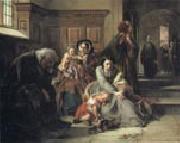 |
Abraham Solomon
|
|
English Painter, 1824-1862
|
|
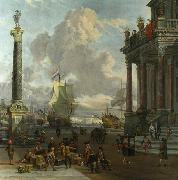 |
Abraham Storck
|
|
Abraham Storck (or Sturckenburch) (bapt. April 17, 1644 - buried April 8, 1708), was a Dutch landscape and maritime painter of the Baroque era.
Storck was born and died in Amsterdam, and came from a family of painters of the same name. He had a painter's studio in Amsterdam producing naval and harbor scenes as well as landscape paintings. He was influenced by the two Willem van de Veldes (the elder and the younger) and by Jan Abrahamsz Beerstraaten.
|
|
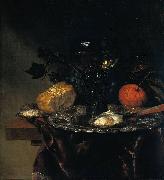 |
Abraham van Beijeren
|
|
(ca. 1620 - March 1690) was a Dutch Baroque era painter. He was little regarded in his day but is now considered one of the greatest of still-life painters. Van Beijeren (alternatively spelled "Beyeren") lived in a succession of Dutch towns. Born in The Hague, the artist also lived in Delft, Amsterdam, Alkmaar and Gouda. In 1678 he settled in Rotterdam, where he died in 1690.
|
|
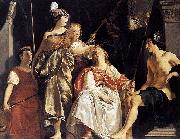 |
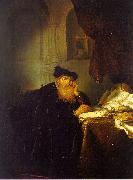
Abraham van den Tempel
|
|
(1622?C1672) was a Dutch Golden Age painter.
He probably learned painting from his father, also a painter, but who died when he was still quite young, in 1636. That is the same year that he moved to Amsterdam, where he stayed until 1647, whereupon he moved to Leiden. According to Houbraken he was the son of a Mennonite preacher in Leeuwarden who was a respected art teacher. His father was Lambert Jacobsz (or Jacobszoon), who had taught Govert Flinck and Jacob Adriaensz Backer in their youth, both of whom were artists from Mennonite families. Abraham took the name Tempel because when he studied in Leiden, he lived in a house there with a relief of a Tempel in the keystone. He became a pupil of Jacob Backer, and studied mathematics at Leiden University. He met with great success with the Leiden city council, earning several generous commissions, including a series of three large allegorical paintings on the cloth industry of Leiden for the Cloth Hall which still hang in their original place today in the Stedelijk Museum De Lakenhal.
Sir William Davidson of Curriehill, Conservator of the Cloth Staple at Veere (with his son Charles), 1664.He became master of the Guild of St. Luke in 1657 and in 1659 he was chartermaster. In 1660 he returned to Amsterdam. His pupils were Frans van Mieris the Elder, Carel de Moor, Michiel van Musscher, Ary de Vois, and Isaac Paling
|
|
 |
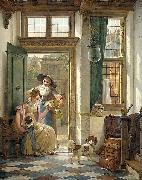
Abraham van der Hecken
|
|
Dutch Baroque Era Painter, active 1635-1655
|
|
 |
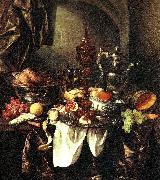
Abraham van Strij
|
|
painted Een kersenverkoopster aan de deur
in 1816
|
|
 |
abraham vav beyeren
|
|
Abraham Hendriksz van Beijeren (ca. 1620 The Hague - March 1690 Rotterdam) was a Dutch Baroque era painter. He was little regarded in his day but is now considered one of the greatest of still-life painters. Van Beijeren (alternatively spelled "Beyeren") lived in a succession of Dutch towns. Born in The Hague, the artist also lived in Delft, Amsterdam, Alkmaar and Gouda. In 1678 he settled in Rotterdam, where he died in 1690.
|
|
 |
Abraham Walkowitz
|
|
(March 28, 1878 - January 27, 1965) was an American painter grouped in with early American Modernists working in the Modernist style.
Walkowitz was born in Siberia and emigrated with his mother to the United States in his early childhood. He studied at the National Academy of Design in New York City and the Academie Julian in Paris under Jean-Paul Laurence. Walkowitz and his contemporaries later gravitated around photographer Alfred Stieglitz's 291 Gallery, originally titled the Little Galleries of the Photo-Secession, where the forerunners of modern art in America gathered and where many European artists were first exhibited in the United States. During the 291 years,
|
|
 |
Abraham Wuchters
|
|
Abraham Wuchters (1608 - 23 May 1682) was a Dutch-Danish painter and engraver. He was born in Antwerp but had most of his career in Denmark where he, along with Karel van Mander III, was the preferred painter of the Danish King, nobility and Bourgeoisie during his day, together they represent the main influence from the Dutch Golden Age on Danish Baroque art.
Wuchters was born in Antwerp in 1608. He arrived in Denmark in 1638 and was, the following year, employed as sketching master at Sorø Academy. Around the same time, he was summoned to Copenhagen where he painted several portraits of King Christian IV. In 1645 he returned to Copenhagen Castle to portray the King's children, including lrik Christian Gyldenløve (c. 1645, Danish National Gallery) and Duke Frederik (III) (c. 1645, Amalienborg Palace).
In two periods, between 1658 and 1662, he worked at the Royal Swedish Court in Stockholm where he portrayed Queen Consort Christina (1660, Uppsala University and 1661, Stockholm Castle), Charles X Gustav and Hedvig Eleonora.
Back in Denmark, Wuchters was engaged by Frederick III, who had instituted Denmark as an absolute monarchy in 1660, with responsibility for the maintenance of his paintings.
n 1671 the new king, Christian V, appointed him as official Painter to the Danish Coirt and in 1873 he was also made official Engraver to the Danish Court. It was, therefore, he alone who decided how the face of the absolutist King was to be represented.
|
|
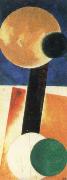 |
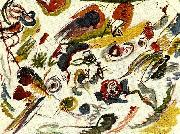
abstract composition
|
|
Russian painter, sculptor, designer and photographer. He was a central exponent of Russian Constructivism, owing much to the pre-Revolutionary work of Malevich and Tatlin, and he was closely involved in the cultural debates and experiments that followed the Revolution of 1917. In 1921 he denounced, on ideological grounds, easel painting and fine art, and he became an exponent of Productivism (see CONSTRUCTIVISM,
|
|
 |
abstrakt akvarell
|
|
Akvarell är en målningsteknik där färgen läggs på i transparenta skikt på ett tjockt, lätt sugande papper. Papper av högsta kvalitet är syrafritt och framställt av bomullslump. Det kan variera kraftigt i olika vithetstoner och tjocklek. Ytans ytstruktur kallas gräng och finns av flera slag.
Akvarellpapper levereras i block med limmade kanter runt om, så att papperet håller sig slätt, när det blir fuktigt av färgen. Lösa papper kan prepareras genom att fukta igenom det ordentligt med rent vatten och sen klistra/tejpa upp det på en styv skiva. När papperet torkat har inbyggda spänningar utjämnats, och det bubblar sig mindre, när akvarellfärgen läggs på.
Akvarell målas ofta med en tjock pensel som kan hålla mycket vätska, samtidigt som den kan formas till en mycket fin spets. Den finaste kvaliteten görs av mårdhår eller sobelhår. Mycket smala linjer kan göras med hjälp av tunna spetsiga penslar eller dragstift, som egentligen är avsedda för för tuschritning. Gamla tiders stålpennor för bläck duger också för detta ändamål.
|
|
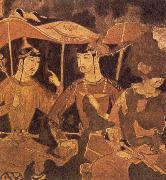 |
Abu l Faraj al Isfahani
|
|
Tenth century
|
|
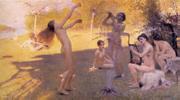 |
Aby Altson
|
|
Australian Classicist Painter,
1864-1949
|
|
 |
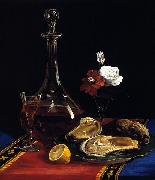
Achille-Etna Michallon
|
|
Paris 1796-1822
was a French painter. Michallon was the son of the sculptor Claude Michallon. He studied under Jacques-Louis David and Pierre-Henri de Valenciennes. In 1817, Michallon won the inaugural Prix de Rome for landscape painting. He travelled to Italy in 1818 and remained there for over two years. This trip had a profound influence on his work. Before he had much time to develop what he had learned however, he died at the age of 26 of pneumonia, a tragedy which cut short the life of a talented and well respected artist who could have gone on to win lasting fame. Though it is often disputed, it is thought that at one time, Corot was his pupil.
|
|
 |
Adalbert John Volck
|
|
Adalbert J. Volck (1828 - 1912) was a dentist, political cartoonist, and caricaturist born in Bavaria. He was known for supporting the Confederacy during the American Civil War, doing so through his political cartoons (below), smuggling items for the Confederate army, and personally assisting President Jefferson Davis by acting as a courier.
Volck was also known for his work on porcelain restoration techniques in dentistry.
|
|
|
|
|
|
|
|
|
| Wholesale China Oil Painting Wholesale Oil Painting China Xiamen Portrait Reproduction on canvas Chinese Oil Painting Wholesale USA Oil Painting |
|
|
|
|


