|

|
|
| |
|
China Oil Painting Direct
|
|
100% hand painted, 100%
cotton canvas,
100% money back if not satisfaction.
|
|
|
|
ART WORKS
INDEX
A B C D E F G H I J K L M N O P Q R S T U V W X Y Z
|
|
ARTISTS
INDEX
A B C D E F G H I J K L M N O P Q R S T U V W X Y Z
|
|
Prev 1 Next
|
|
 |
Adolf Ulrik Wertmuller 
|
|
(February 18, 1751 e October 5, 1811) was a Swedish painter whose notable works include Danaë receiving Jupiter in a Shower of Gold.
Wertmeller was born in Stockholm and studied art at home before moving to Paris in 1772 to study under his cousin Alexander Roslin and French painter Joseph-Marie Vien. On July 30, 1784, Wertmeller was elected to the Royal Academy of Painting and Sculpture.
Wertmeller was commissioned by Gustav III of Sweden for a portrait of Marie Antoinette, which is now in the Nationalmuseum at Stockholm. In 1787, he produced his masterpiece Danaë, a work which proved controversial as one of the earliest female nude paintings exhibited in America.
Wertmeller first emigrated to the United States in May 1794 and continued his portrait work, most notably of General George Washington, but in 1796 was called back to Sweden, eventually returning to Philadelphia in 1800. Elizabeth B. Johnston, in her book Original Portraits of Washington (Boston, 1882), speaks of five portraits of Washington by Wertmeller, of which one, executed in 1797, was purchased by the U. S. government in 1878, and another is owned by the Historical Society of Pennsylvania.
Wertmeller was married to Elizabeth Henderson, granddaughter of noted early American painter Gustavus Hesselius, on January 8, 1801, and two years later retired to a plantation in Claymont, Delaware, where he lived the final years of his life. He died near Marcus Hook, Pennsylvania, aged 60.
|
|
 |
Adolf-Ulrik Wertmuller
|
|
Swedish Painter, 1751-1811,was a Swedish painter whose notable works include Danaë receiving Jupiter in a Shower of Gold. Wertmuller was born in Stockholm and studied art at home before moving to Paris in 1772 to study under his cousin Alexander Roslin and French painter Joseph-Marie Vien. On July 30, 1784, Wertmuller was elected to the Royal Academy of Painting and Sculpture. Wertmuller was commissioned by Gustav III of Sweden for a portrait of Marie Antoinette, which is now in the Nationalmuseum at Stockholm. In 1787, he produced his masterpiece Danae, a work which proved controversial as one of the earliest female nude paintings exhibited in America. Wertmuller first emigrated to the United States in May 1794 and continued his portrait work, most notably of General Washington, but in 1796 was called back to Sweden, eventually returning to Philadelphia in 1800. Wertmuller was married to Elizabeth Henderson, granddaughter of noted early American painter Gustavus Hesselius, on January 8, 1801, and two years later retired to a plantation in Claymont, Delaware, where he lived the final years of his life.
|
|
 |
Adolfo Muller-Ury
|
|
(March 29, 1862 - July 6, 1947) was a Swiss-born American portrait painter and impressionistic painter of roses and still life.
He was born Felice Adolfo Meller on March 29, 1862 at Airolo, in the Ticino in Switzerland, into a prominent patrician family whose lineage descended from Alfred the Great, Charlemagne and Doge Pietro Orseolo of Venice, through the von Rechburg family (a lady from which family married a Meller) and by the 18th and 19th centuries included mercenaries, lawyers, hoteliers and businessmen. His father was lawyer Carl Alois Meller (1825 - 1887), Gerichtspräsident (Presiding Judge) of the Cantonal Courts, and his mother Genovefa Lombardi (1836 - 1920), daughter of Felice Lombardi who was Director of the Hospice on the St Gotthard Pass, which he took over from the Capuchin monks who had run this for centuries. Adolfo was their sixth of nineteen children, most of whom survived infancy. The family spoke Airolese mainly, a local dialect of Ticinese Italian, as well as Swiss-German. His family were Roman Catholic.
|
|
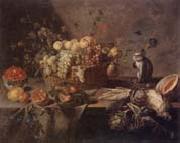 |
Adriaen Van Utrecht
|
|
Flemish Baroque Era Painter, 1599-1652
Flemish painter. He was apprenticed to Herman de Ryt in 1614 and later visited France, Italy and Germany before returning to Antwerp by 1625. He painted pantry scenes, farmyards with poultry, fish markets, game pieces, garlands and diverse still-lifes of fruit and vegetables. Game paintings are most frequent and reflect the influence of Frans Snyders. Adriaen adopted the same abundant displays of game, fruit and vegetables, usually set on a table parallel to the picture plane. Compositions typically fall in horizontal and vertical lines in contrast to the dynamic diagonals of Snyders. In large works, such as the Still-life with Game, Vegetables, Fruit and a Cockatoo (1650; Malibu, CA, Getty Mus.), Adriaen's accessories overflow the table on to the floor below. Baroque devices, such as a sweeping curtain and background window view, add movement and depth. Van Utrecht favoured warm earthen tones, especially grey-green, and a strong chiaroscuro light in his still-lifes; the latter may derive from his knowledge of Italian painting. The artist's style changed little during his career, save for the gradual elimination of figures in his paintings. The influence of Jan de Heem and Jan Fyt can also be seen in his later work.
|
|
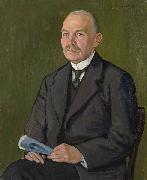 |
Aleksander Uurits
|
|
(May 12, 1888 - August 10, 1918) was an Estonian painter and graphic artist.
|
|
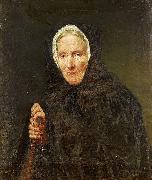 |
Carl d Unker
|
|
(3 February 1828 - 23 June 1866)was a Swedish artist. He was mostly known as a socially oriented genre painter whose works were contemporary subjects of his time, like waiting rooms at railway stations, and scenes from pawnshops for example.
D'Unkers father was a Norwegian military, his mother Swedish. He began his career as a military and had served at the Svea Life Guards for a short time, when he in 1848 volunteered in the First Schleswig War 1848-1849. Shortly after his return to Sweden he abandoned his military path and went to the arts. He moved to Desseldorf to study painting, there he got married to a wealthy Russian woman and could live a carefree life financially. He became a very popular artist on the continent. From 1861 he suffered from sickness in his right arm so he had to paint with his left arm. He made a brief visit to Sweden in 1865, and was appointed professor by Swedish king Charles XV. The following year he died.
|
|
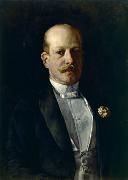 |
Charles Frederic Ulrich
|
|
Charles Frederic Ulrich (1858, New York City - 1908, Berlin), was an American painter.
According to the RKD he worked in the Netherlands ca. 1890. He attended the Royal Academy in Munich, Germany, as did William Merritt Chase, who like him, was influenced by Dutch Golden Age painting and who has been documented as painting his portrait. He was discovered by Thomas B. Clarke, a lace and linen manufacturer in New York who became a collector of contemporary American art. Ulrich painted his portrait in gratitude after his painting "In the Land of Promise, Castle Garden" was shown at the National Academy of Design, where it won the National Academy's first Thomas B. Clarke Prize for Best American Figure Composition.
|
|
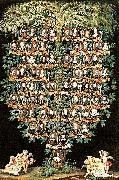 |
eric utterhielm
|
|
1662-1717
|
|
 |
F Usher De Voll
|
|
1873-1941
|
|
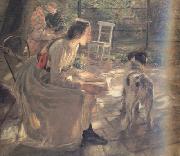 |
Fritz von Uhde
|
|
German, 1848-1911
was a German painter of genre and religious subjects. His style lay between Realism and .Uhde was born in Wolkenburg, Saxony. In 1866 he was admitted to the Academy of Fine Arts in Dresden, but later that year he left his studies for military service, and from 1867 to 1877 he was a professor of horsemanship to the regiment of the assembled guard. He moved to Munich in 1877 to attend the Academy of Fine Arts. In Munich he particularly admired the Dutch old masters, and in 1879 he travelled to Paris where his studies of the Dutch painters continued under Mihely Munkecsy's supervision. In 1882 a journey to Holland brought about a change in his style, as he abandoned the dark chiaroscuro he had learned in Munich in favor of a colorism informed by the works of the French Impressionists. His work was often rejected by the official art criticism, and by the public, because his representations of ordinary scenes were considered vulagar or ugly. The critic Otto Julius Bierbaum was more sympathetic; in 1893, he wrote, "As a painter of children, for example, Uhde is extraordinarily distinguished. He does not depict them as sweetly as used to be popular; in other words not as amusing or charming dolls, but with extreme, very strict naturalness." In about 1890, Uhde became a professor at the Academy of Fine Arts in Munich.
|
|
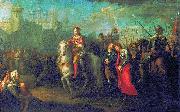 |
Grigoriy Ugryumov
|
|
painted Alexander Nevsky in Pskov, after they victory over the Germans in 1793.
|
|
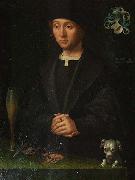 |
Jacob Claesz van Utrecht
|
|
also named by his signature Jacobus Traiectensis (born c. 1479 - dead after 1525) was a Flemish early Renaissance painter who worked in Antwerp and Lebeck.
Jacob van Utrecht's life is still very much in the dark. Research on this important Flemish artist did not start before the end of 19th century. He was probably born in Utrecht, although it is not certain. It is assumed that he became a citizen of Antwerp around 1500 and he is recorded as a "free master craftsman" of the Guild of St Luke there from 1506 to 1512.
From 1519 to 1525 he is recorded as a member of the Leonardsbruderschaft ("Leonard's Brotherhood"), a religious confraternity of merchants in Lebeck among whose ranks the leaders of the Protestant Reformation in the 1530s could be found.
From then on no traces of his life have been found.
|
|
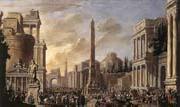 |
Jacob van der Ulft
|
|
Dutch Baroque Era Painter, 1627-1689
|
|
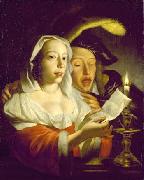 |
Jan Vermeer van Utrecht
|
|
(bapt. 16 February 1630, Schipluiden - c. 1696, Vreeswijk), was a Dutch Golden Age painter. Though he was born near Delft, there is no known relation between this painter and Johannes Vermeer.
His father died when he was 10 and he was raised by his step-grandfather in Rotterdam. According to Houbraken he travelled to Italy with Lieve Verschuier and became friends with Willem Drost and Johann Carl Loth.
He returned North in 1662, where he became member of the Utrecht Guild of St. Luke in 1663 and became deacon of the guild 1664-1666.Houbraken tells a curious story about Vermeer van Utrecht in his biography of Jan Davidsz de Heem. In this story, on his return from Italy, Vermeer marries a widow who owns a white lead factory. He is wealthy and has a carefree life until his wife dies and then his factory is burned by French soldiers. He manages to save a garland painting by De Heem that he once paid 2000 guilders for. This was an enormous sum of money, but Houbraken mentions that his grandfather had been a wealthy man, and until his factory was destroyed, Vermeer van Utrecht had been painting for pleasure, rather than professionally. The amount is meant as an indication of the fame and esteem of De Heem, rather than the wealth of Vermeer van Utrecht. Vermeer van Utrecht then applies to his benefactor, Frederick Nassau de Zuylestein, to give him a government post in return for this painting, which he offers to paint with the likeness of the young prince Willem III in the middle of the garland. The lord of Zuylestein was the governor of the young prince from 1659 to 1666, so this deal must have been done sometime between 1662 (Vermeer van Utrecht's return from Italy), and 1672 (the death of the lord of Zuylestein). Apparently, the deal is done, and several years pass, in which Vermeer van Utrecht did become an appointed member of the Utrecht regency (Vroedschap), but where he felt like a fifth wheel. In 1672 the Utrecht council takes pity on him, and gave him the post of Toll-collector and controller of the river lock at Vreeswijk, where he later remarried.
|
|
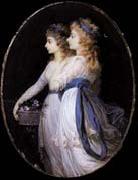 |
Jean Urbain Guerin
|
|
French, 1760-1836
|
|
 |
Johann Jakob Ulrich
|
|
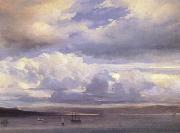
impression atist
28 Feb 1798 -- 17 March 1877.
Swiss painter. He first studied under his father and then in Paris in 1822 in the studio of Jean-Victor Bertin. As a student he concentrated on unusual lighting effects in his landscape paintings well before they became a hallmark of the precursors of the Impressionists. In 1824 at the Salon in Paris he first saw paintings by Constable. On a trip to Italy in 1828 he did studies en plein air as preliminary sketches for his studio paintings. His early paintings emphasize brilliant colour, low horizons and scientific observation of cloud formations in a manner similar to Constable's studies, which he actually saw on visits to England in 1832 and 1835. Like Eugene Boudin, Ulrich was interested in poetic evocations of sun, water and effects of atmosphere rather than in the precise delineations of topography typical of Swiss art of that period. From 1824 he showed regularly at the Salons in Paris and in 1837 he returned to Zurich. Because the Swiss public was reluctant to accept his freer,
|
|
 |
Karel du jardin
|
|
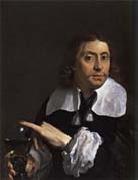
1626-78
Dutch painter, etcher and draughtsman. His father was Chaarles de Jardin (Gardyn; c. 1599-before 1650), a fat-renderer, and his mother was Catalyn Borchout (1588-before 1650). They had at least one other child, Herbert, who must have died by 1651
|
|
 |
Kitagawa Utamaro
|
|
Japanese
1753-1806
Kitagawa Utamaro Gallery
Biographical details for Utamaro are extremely limited, and each reference gives a substantially different account.
Various accounts claim that he was born in either Edo (present-day Tokyo), Kyoto, or Osaka (the three main cities of Japan), or a provincial town (no one is sure exactly which one) in around 1753; the exact date is also uncertain. Another long-standing tradition has is that he was born in Yoshiwara, the courtesan district of Edo, the son of a tea-house owner, but there is no evidence of this. His original name was Kitagawa Ichitaro.
It is generally agreed that he became a pupil of the painter Toriyama Sekien while he was still a child, and there are many authorities who believe that Utamaro was his son as well. He lived in Sekien's house while he was growing up, and the relationship continued until Sekien's death in 1788.
Sekien was originally trained in the aristocratic Kan?? school of painting, but in middle age he started to lean toward the popular (or ukiyo-e) school. Sekien is known to have had a number of other pupils, none of any distinction.
Utamaro, in common with other Japanese of the time, changed his name as he became mature, and also took the name Ichitaro Yusuke as he became older. He apparently also married, although little is known about his wife, and he apparently had no children.
His first major professional artistic work, at about the age of 22, in 1775, seems to have been the cover for a Kabuki playbook, under the g?? of Toyoaki. He then produced a number of actor and warrior prints, along with theatre programmes, and other such material. From the spring of 1781, he switched his g?? to Utamaro, and started painting and designing fairly forgettable woodblock prints of women.
At some point in the middle 1780s, probably 1783, he went to live with the young rising publisher Tsutaya J??zabur??, with whom he apparently lived for about 5 years. He seems to have become a principal artist for the Tsutaya firm. His output of prints for the next few years was sporadic, as he produced mostly illustrations for books of kyoka, literally 'crazy verse', a parody of the classical waka form. He seems to have produced nothing at all that has survived in the period 1790-1792.
In about 1791 Utamaro gave up designing prints for books and concentrated on making half-length single portraits of women, rather than the prints of women in groups favoured by other ukiyo-e artists. In 1793 he achieved recognition as an artist, and his semi-exclusive arrangement with the publisher Tsutaya J??zabur?? was terminated. He then went on to produce a number of very famous series, all featuring women of the Yoshiwara district.
Over the years, he also occupied himself with a number of volumes of nature studies and shunga, or erotica. In 1797, Tsutaya J??zabur?? died, and Utamaro apparently was very upset by the loss of his long-time friend and supporter. Some commentators feel that his work after this never reached the heights it did before.
In 1804, at the height of his success, he ran into legal trouble by publishing prints related to a banned historical novel. The prints, entitled Hideyoshi and his 5 Concubines, depicted the military ruler Toyotomi Hideyoshi's wife and concubines; Consequently, he was accused of insulting Hideyoshi's dignity. He was sentenced to be handcuffed for 50 days (some accounts say he was briefly imprisoned). According to some sources, the experience crushed him emotionally and ended his career as an artist.
He died two years later, on the 20th day of the 9th month, 1806, aged about fifty-three, in Edo.
|
|
 |
Kuhn Justus Engelhardt
|
|
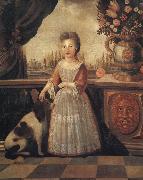
German artist
d.1717
|
|
 |
Lesser Ury
|
|
1861 - 1931
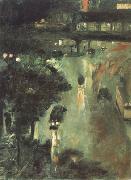
was a German Impressionist painter and printmaker. He was born Leo Lesser Ury in Birnbaum, the son of a baker whose death in 1872 was followed by the Ury family's move to Berlin. In 1878 Lesser left school to apprentice with a tradesman, and the next year he went to D??sseldorf to study painting at the Kunstakademie. Ury spent time in Brussels, Paris, Stuttgart, and other locations, before returning to Berlin in 1887. His first exhibition was in 1889 and met with a hostile reception, although he was championed by Adolph von Menzel whose influence induced the Academie to award Ury a prize. In 1893 he joined the Munich Secession, one of the several Secessions formed by progressive artists in Germany and Austria in the last years of the 19th century. In 1901 he returned to Berlin, where he exhibited with the Berlin Secession, first in 1915 and notably in 1922, when he had a major exhibition. By this time Ury's critical reputation had grown and his paintings and pastels were in demand. His subjects were landscapes, urban landscapes, and interior scenes, treated in an Impressionistic manner that ranged from the subdued tones of figures in a darkened interior to the effects of streetlights at night to the dazzling light of foliage against the summer sky. Ury is especially noted for his paintings of nocturnal cafe scenes and rainy streets. He developed a habit of repeating these compositions in order to sell them while retaining the originals, and these quickly made and inferior copies have harmed his reputation.
|
|
 |
Lucas van Uden
|
|
(18 October 1595 - 4 November 1672) was a Flemish Baroque painter specializing in landscapes.
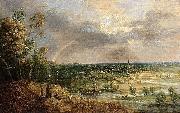
Lucas van Uden was born in Antwerp, where he entered the guild of St. Luke in 1626-27. Although he was never part of Peter Paul Rubens's studio, his works are partly indebted to that master. Van Uden even made copies of Rubens's works on several occasions. His technique, however, owes as much to earlier painters like Joos de Momper and Jan Brueghel the Elder. General characteristics are a tonally-green recessive view punctuated by slender trees and populated by incidental pastoral and peasant figures. Many of Van Uden's figures were either copied from Rubens or painted by David Teniers the Younger. He is often associated with fellow landscape painter Jan Wildens.
|
|
 |
Master of the Saint Ursula Legend
|
|
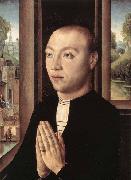
Flemish Northern Renaissance Painter, active 1475-1500
|
|
 |
Maurice Utrillo
|
|
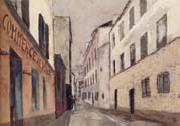
French Painter, 1883-1955,French painter, son of SUZANNE VALADON. He was entrusted to his grandmother while his mother posed as a model for such painters as Renoir and Puvis de Chavannes before discovering her own talent for drawing and painting. His father, the Spanish painter Miguel Utrillo (1862-1934), only admitted paternity eight years after Maurice's birth. Maurice Utrillo had no predisposition for art, but when he was 19 his mother took medical advice and urged him to adopt drawing and painting as a distraction from his need for alcohol. In search of a suitable subject, he went to the countryside around Montmagny, a village to the north of Paris, where, between the autumn of 1903 and the winter of 1904, he completed almost 150 paintings, sombre, heavily impasted landscapes, such as the Roofs of Montmagny (Paris, Pompidou). By 1906 the doctor felt that Utrillo could return to Montmartre. His pictures of the streets and suburbs were painted with a less heavy impasto and with lighter tones.
|
|
 |
Max Uth
|
|
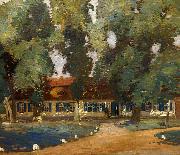
painted Landsitz in der Mark in 1900
|
|
 |
Modest Urgell
|
|
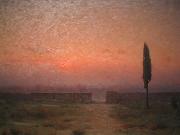
Modest Urgell (1839-1919) was a Spanish Catalan painter, illustrator, and playwright of comedies. He was educated at the Llotja School, in Barcelona, with Ramon Marte i Alsina and knew Gustave Courbet after a visit to Paris. Though he painted portraits, his prolific body of work is dominated by Neo-romantic landscapes, such as Fields of Loneliness (Campos de Soledad) (1894). He also acted and wrote such works for the theatre as Far from the Eyes, Close to the Heart (Lejos de los Ojos, Cerca del Corazon) (1898).
In 1910 he taught at the School of Industrial and Fine Arts in Barcelona. Whilst he was there he worked with Josep Pasce and he taught the young Joan Miro.
|
|
 |
Paolo di Dono called Uccello
|
|
Florence 1397-1475
|
|
 |
paolo uccello
|
|
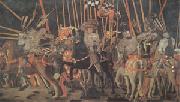
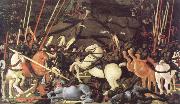
(b Florence, c. 1397; d Florence, 10 Dec 1475). Italian painter, draughtsman, mosaicist and designer of stained glass. His work vividly illustrates the principal issues of Florentine art during the first half of the 15th century. Trained within the tradition of the Late Gothic style, he eventually became a leading exponent of the application of linear perspective based on the mathematical system established by Filippo Brunelleschi and Leon Battista Alberti. It is the merging of these two diametrically opposed tendencies that forms the basis of Uccello's style. As well as painting on panel and in fresco (many of his works in this medium have been severely damaged), he was also a master mosaicist and produced designs for stained glass.
|
|
 |
Paolo Ucello
|
|
1395-1475
Italian Paolo Ucello Gallery
|
|
 |
Simon Ushakov
|
|
1626 - 1686) was a leading Russian graphic artist of the late 17th-century. Together with Fyodor Zubov and Fyodor Rozhnov, he is associated with the comprehensive reform of the Russian Orthodox Church undertaken by Patriarch Nikon.
We know almost nothing about the early years of Simon Ushakov. His birth date is deduced from his inscription on one of the icons: In the year 7166 painted this icon Simon Ushakov son, being 32 years of age.
At 22 he became a paid artist of the Silver Chamber, affiliated with the Armory Prikaz. The bright, fresh colours and exquisite, curving lines of his proto-baroque icons caught the eye of Patriarch Nikon, who introduced Simon to the tsar Alexei Mikhailovich. He became a great favourite with the royal family and was eventually (1664) assigned to the Kremlin Armoury, run by an educated boyar Bogdan Khitrovo.
|
|
 |
Stefano Ussi
|
|
Italian, 1822-1901,Italian painter. He received his formal training at the Accademia delle Belle Arti in Florence (1837-50, expelled 1838-40) under Tommaso Gazzarini (1790-1853), Pietro Benvenuti and Giuseppe Bezzuoli. In 1854 he won a scholarship to study in Rome and for several years worked on the large-scale painting that established his reputation, the Expulsion of the Duke of Athens from Florence
|
|
 |
Thomas Uwins
|
|
English Painter, 1782-1857
English painter and illustrator. He was apprenticed to the line-engraver Benjamin Smith (d 1833) in 1797, but his greater interest in portrait painting led him to take life classes at the Royal Academy, London; he exhibited portraits there from 1799. Versatile and industrious, he painted miniature likenesses, taught drawing, designed and engraved illustrations for books in French, Portuguese and English, and wrote for and illustrated Rudolph Ackermann's Repository. His half-a-crown watercolours, known as 'pretty faces', were particularly popular, and he found employment as an assiduous copyist. In 1809 he was elected to the Society of Painters in Water-Colours and for the next nine years exhibited careful and colourful images of the countryside that provided views of the year's harvest. In 1817 Uwins travelled to France to record the Burgundian grape harvest, identifying the labour force more obviously as peasants than their English counterparts. In debt, he moved in 1820 to Edinburgh, where he illustrated books by Walter Scott and painted portraits. In 1824, his debt paid, he left for Italy, where he spent seven years; he sent highly valued copies of Italian works back to England (to Thomas Lawrence among others) and made studies of life in and around Rome and Naples, from which his later successes at the Royal Academy derived. An immodest Protestant, Uwins deplored but revelled in the 'polluted streams' of Catholic Italy, and provided London with oils renowned for their clarity and colour. A Neapolitan Saint Manufactory (exh. RA 1832; Leicester, Mus. & A.G.) shows monks haggling, women gazing and children playing amid carved and painted icons.
|
|
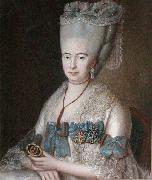 |
U.F. Beenfeldt
|
|
painted Margrethe Holck in 1777
|
|
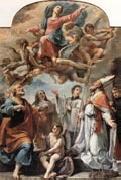 |
Ubaldo Gandolfi
|
|
Italian Painter, San Matteo della Decima, 1728 - Ravenna, 1781
was an Italian painter of the late-Baroque period, mainly active in and near Bologna. He was born in San Matteo della Decima and enrolled by the age of 17 at the Clementine Academy, where he apprenticed with Ercole Graziani the Younger, Felice Torelli, and Ercole Lelli. He was from a large family of prolific artists, including his sons Giovanni Battista and Ubaldo Lorenzo, as well as his brother Gaetano and nephews Mauro, Democrito (who became a pupil of Antonio Canova), and niece Clementina. Together, they are considered the last representative of the grand manner of painting characteristic of the Bolognese school, that had risen to prominence nearly two centuries earlier with the Carracci. Gandolfi's work ranges from Baroque to Neoclassic styles, and specifically recalls the style of Ludovico Carracci. He completed, in 1770-75, a series of canvases on mythological narratives for the Palazzo Marescalchi in Bologna (two are now in Museum of North Carolina ). He died in Ravenna in 1781.
|
|
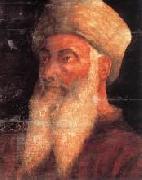 |
UCCELLO, Paolo
|
|
Italian Early Renaissance Painter, 1397-1475
Italian painter, draughtsman, mosaicist and designer of stained glass. His work vividly illustrates the principal issues of Florentine art during the first half of the 15th century. Trained within the tradition of the Late Gothic style, he eventually became a leading exponent of the application of linear perspective based on the mathematical system established by Filippo Brunelleschi and Leon Battista Alberti. It is the merging of these two diametrically opposed tendencies that forms the basis of Uccello's style. As well as painting on panel and in fresco
|
|
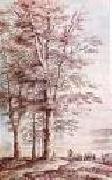 |
UDEN, Lucas van
|
|
Flemish painter (b. 1595, Antwerpen, d. 1672, Antwerpen).
Flemish painter, draughtsman and engraver. He was the son of Artus van Uden (b 1544), town painter of Antwerp, and grandson of Pieter van Uden (i) ( fl 1553), founder of a noted tapestry and silk factory in the city. Lucas was probably trained by his father and in 1626-7 was enrolled in the Antwerp Guild of St Luke as a 'master's son'. On 14 February 1627 he married Anna van Woelput (d 1667). On 31 December 1649 he was registered as no longer living in the city,
|
|
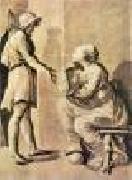 |
UGO DA CARPI
|
|
Italian painter/woodcutter (c. 1480-c. 1523).
|
|
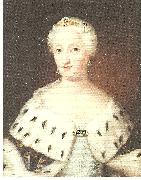 |
ulrica fredrica pasch
|
|
Ulrika Fredrika Pasch, född 10 juli 1735 i Stockholm, död 2 april 1796, var en svensk konstnär. Hon var dotter till konstnären Lorens Pasch d.ä. och Anna Helena Beckamn, syster till konstnären Lorens Pasch d.y. och brorsdotter till konstnären Johan Pasch.
Ulrika Pasch började måla 1756 men hade tidigt tillsammans med sin bror fått undervisning av fadern. Hon blev hushållerska åt en släkting, men målade på fritiden. Under en tioårsperiod försörjde hon sin pappa och syster som professionell porträttmålare i Stockholm innan hennes bror återvände från sina studier utomlands 1766, då de började arbeta tillsammans. Deras samarbete beskrivs som harmoniskt och de valdes båda in i konstakademien 1773. Hon var inte den första kvinnan som valdes in i akademin, men hon var den första kvinnliga yrkeskonstnären som blev vald. Hon ska ha målat detaljerna på broderns tavlor, som klädesdetaljer och liknande. Ulrika hade en framgångsrik karriär och målade ofta porträtt av kungafamiljen och hovet. Hon ansökte dock upprepade gånger förgäves för en pension. Systern Helena Lovisa (1744-96) hushållade åt sina syskon.
Trots att det sägs att hon själv var en ödmjuk person som aldrig framhävde sitt arbete, så är hon en av få kända självförsörjande kvinnliga yrkeskonstnärer i Skandinavien före artonhundratalet.
|
|
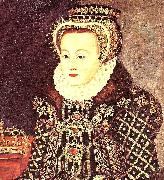 |
ulrica pasch
|
|
Ulrika Pasch började måla 1756 men hade tidigt tillsammans med sin bror fått undervisning av fadern. Hon blev hushållerska åt en släkting, men målade på fritiden. Under en tioårsperiod försörjde hon sin pappa och syster som professionell porträttmålare i Stockholm innan hennes bror återvände från sina studier utomlands 1766, då de började arbeta tillsammans. Deras samarbete beskrivs som harmoniskt och de valdes båda in i konstakademien 1773. Hon var inte den första kvinnan som valdes in i akademin, men hon var den första kvinnliga yrkeskonstnären som blev vald. Hon ska ha målat detaljerna på broderns tavlor, som klädesdetaljer och liknande. Ulrika hade en framgångsrik karriär och målade ofta porträtt av kungafamiljen och hovet. Hon ansökte dock upprepade gånger förgäves för en pension. Systern Helena Lovisa (1744-96) hushållade åt sina syskon.
Trots att det sägs att hon själv var en ödmjuk person som aldrig framhävde sitt arbete, så är hon en av få kända självförsörjande kvinnliga yrkeskonstnärer i Skandinavien före artonhundratalet.
|
|
 |
Ulrich apt the Elder
|
|
Augsburg 1455/60-1532
|
|
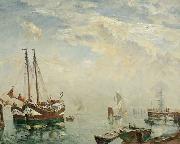 |
Ulrich Hubner
|
|
(17 June 1872 Berlin - 29 April 1932 Neubabelsberg) was a German painter.
He was born into a family of artists, his academic training he received in 1892 in Karlsruhe with Robert Poetzelberger, Gustav Schönleber, and Carlos Grethe. He then studied at the private art school in Munich Friedrich Fehr. In 1899, he was a member of the Berlin Secession, and in 1906 and 1907 was on the board.
In 1899, he won the prize for advertising designs for cooperative advertising by Ludwig and Otto Stollwerck Henkell.
He painted in Berlin, Havel, and in the summers in Hamburg, Lebeck, Rostock and Travemende (where he had his principal residence from 1909 to 1912), and in particular, many harbor scenes.
He showed at Kunstverein in Hamburg in 1910. Some of his works are in the Behnhaus Museum, in Lebeck, and Los Angeles County Museum of Art.
|
|
 |
ulrika eleonora
|
|
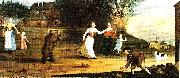
Ulrika Eleonora d.y., född 23 januari 1688, död 24 november 1741, var regerande drottning av Sverige 1719-1720, dotter till Karl XI och Ulrika Eleonora av Danmark, syster till Karl XII samt kusin till August den starke, Fredrik IV av Danmark och Fredrik IV av Holstein-Gottorp.
Hon gifte sig 24 mars 1715 med Fredrik av Hessen, den blivande Fredrik I, men förblev barnlös.
Ulrika Eleonora föddes den 23 januari 1688 på Stockholms slott som dotter till kung Karl XI och Ulrika Eleonora d.ä. Under barndomen förbisågs hon av alla för sin äldre, livligare och mera begåvade syster Hedvig Sofia.
Så snart hon blivit giftasvuxen fick hon många friare, bland andra blivande Georg II av Storbritannien och arvprins Fredrik av Hessen-Kassel. Redan 1710 begärde denne hennes hand, men deras trolovning tillkännagavs inte förrän den 23 januari 1714. Bilägret firades den 24 mars 1715.
Under Karl XII:s vistelse utomlands var hon, efter Hedvig Sofias död (1708), den enda myndiga medlemmen av kungahuset inom riket om man borträknar hennes åldriga farmor (Hedvig Eleonora).
I slutet av 1712 eller början av 1713 hade Karl XII tankar om att göra sin syster Ulrika Eleonora till regent, men fullföljde inte denna plan. Det kungliga rådet däremot övertalade henne att bevista dess sammanträden för att i henne erhålla ett stöd. Första gången hon infann sig i rådet, 2 november 1713, beslöts också om sammankallande av en riksdag. Det s.k. rörelsepartiet vid denna riksdag ville att prinsessan i kungens frånvaro skulle göras till riksföreståndarinna "såsom närmaste arvinge till kronan och regementet". Detta förslag motarbetades av Arvid Horn och rådet, som fruktade att svårigheterna för en ändring av regeringssättet därigenom skulle ökas. Prinsessan visade emellertid ständerna stort intresse för landets angelägenheter. I sina brev till kungen uppmanade hon honom att återvända hem och varnade honom för möjliga följder av hans frånvaro. Med hans samtycke undertecknade hon under den följande tiden alla rådets skrivelser, utom dem som var ställda till honom, för i sin egenskap av vice regent var hon ett med kungen enligt dennes uppfattning. Mera sällan deltog hon i rådets förhandlingar.
|
|
 |
ulrika melin
|
|
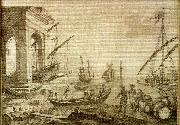
Ulrika Drufva, född 1767, död 1834, var en svensk textilkonstnär, ledamot av Fria konsternas Akademi.
Ulrika Melin var dotter till major Lars Melin, syster till generalmajor Henrik Georg Melin och från 1788 gift med ståthållaren på Västerås slott Peter Thure Gerhard Drufva. Melin var konstnär och "egde en ovanlig skicklighet uti att sy landskap". Hon invaldes i akademin år 1784 för ett arbete i vit satin, inspirerad av Claude Lorrain.
|
|
 |
Ulrika Pasch
|
|
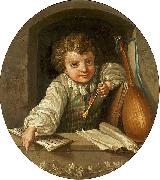
(10 July 1735 - 2 April 1796), also known as Ulla Pasch, was a Swedish painter and miniaturist. She was one of few female artists known in Scandinavia before the 19th century. She was a member of the Royal Swedish Academy of Arts (1773).
Ulrika Pasch was born in an artistic family, daughter of the painter Lorens Pasch the Elder, and sister of the future painter Lorens Pasch the Younger. Her uncle, Johan Pasch, was also a painter.
In the 1750s, when her brother was studying art abroad, her father's career declined severely, and Ulrika was forced to become a housekeeper in the home of her maternal aunt's widower. Her uncle however allowed her to spend a lot of time developing her artistic talent, and from 1756, she had become a professional portrait painter and was able to support her father and her sister in this way. After her father's death, she lived with her sister and set up her own studio.
When her brother returned to Sweden in 1766, she had been a professional artist for ten years and her clientele had moved from the middle class to the upper classes and the aristocracy. Ulrika Pasch and her brother then worked together as professional artists, shared their studio and guided each other in their work; their collaboration was one of mutual respect and harmony, and she is known to have helped him painting the textiles and costumes, a work he found tiring. Their baby-sister Helena Sofia (1744-96) took care of their household; she is described as somewhat talented in art as well, but she spent her life as her siblings "dutiful" house-keeper, and is said to have been deeply devoted to especially Ulrika.
|
|
 |
Umberto Boccioni
|
|
1882-1916
Italian
Umberto Boccioni Locations
Italian sculptor, painter, printmaker and writer. As one of the principal figures of FUTURISM, he helped shape the movements revolutionary aesthetic as a theorist as well as through his art. In spite of the brevity of his life, his concern with dynamism of form and with the breakdown of solid mass in his sculpture continued to influence other artists long after his death.
|
|
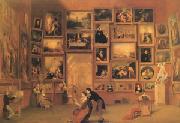 |
unknow artist
|
|
|
|
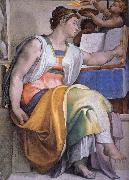 |
UNTERBERGER, Michelangelo
|
|
Austrian painter (b. 1695, Cavalese, d. 1758, Wien).
|
|
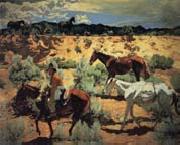 |
Walter Ufer
|
|
American Painter, 1876-1936,was an American artist based in Taos, New Mexico. His most notable work focuses on scenes of Native American life, particularly of the Pueblo Indians. Walter was born of German immigrant parents and raised in Kentucky. After an apprenticeship as a lithographer, he went to Europe where he was a traveling journeyman. When he returned to America, he worked as a printer in Chicago and taught school, and later took classes in fine arts. After a brief time in Chicago, he returned to Europe for further study as an artist.
|
|
|
|
Prev 1 Next
|
|
|
|
|
| Wholesale China Oil Painting Wholesale Oil Painting China Xiamen Portrait Reproduction on canvas Chinese Oil Painting Wholesale USA Oil Painting |
|
|
|
|


