|

|
|
| |
|
China Oil Painting Direct
|
|
100% hand painted, 100%
cotton canvas,
100% money back if not satisfaction.
|
|
|
|
ART WORKS
INDEX
A B C D E F G H I J K L M N O P Q R S T U V W X Y Z
|
|
ARTISTS
INDEX
A B C D E F G H I J K L M N O P Q R S T U V W X Y Z
|
|
|
|
 |
Gian Battista Viola 
|
|
Italian Baroque Era Painter, 1576-1622
|
|
 |
Louis Leopold Boilly
|
|
b.July 5, 1761, La Bass??e, France
d. Jan. 4, 1845, Paris
French
Louis Leopold Boilly Location
|
|
 |
A. Bryan Wall
|
|
American, 1872-1937
|
|
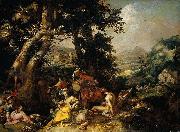 |
Abraham Bloemaert
|
|
(1566, Gorinchem - 27 January 1651, Utrecht), was a Dutch painter and printmaker in etching and engraving. He was one of the "Haarlem Mannerists" from about 1585, but in the new century altered his style to fit new Baroque trends.
Bloemaert was the son of an architect, who moved his family to Utrecht in 1575, where Abraham was first a pupil of Gerrit Splinter (pupil of Frans Floris) and of Joos de Beer. He then spent three years in Paris, studying under several masters, and on his return to his native country received further training from Hieronymus Francken. In 1591 he went to Amsterdam, and four years later settled finally at Utrecht, where he became dean of the Guild of St. Luke.
He excelled more as a colourist than as a draughtsman, was extremely productive, and painted and etched historical and allegorical pictures, landscapes, still-life, animal pictures and flower pieces. In the first decade of the seventeenth-century, Bloemaert began formulating his landscape paintings to include pictoresque ruined cottagges and other pastoral elements. In these works, the religious or mythological figures play a subordinate role. Country life was to remain Bloemaert's favourite subject, which he depicted with increasing naturalism. He drew motifs such as peasant cottages, dovecotes and trees from life and then on his return to the studio, worked them up into complex imaginary scenes.
Among his pupils are his four sons, Hendrick, Frederick, Cornelis, and Adriaan (all of whom achieved considerable reputation as painters or engravers), the two Honthorsts, Ferdinand Bol and Jacob Gerritsz Cuyp.
|
|
 |
Abraham Bloemart
|
|
1564-1651
Dutch
Abraham Bloemart Locations
|
|
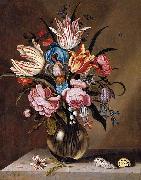 |
Abraham Bosschaert
|
|
(1612-1643) was a Dutch Golden Age painter.
Bosschaert was born in Middelburg. According to the RKD he was a member of the Bosschaert dynasty. Like his father Ambrosius Bosschaert and older brothers, he signed his works with a monogram; AB, but this was only discovered in 1992. His older brothers Ambrosius Bosschaert II and Johannes Bosschaert were his first teachers after the death of his father in 1623, but he also took lessons from his uncle Balthasar van der Ast in Utrecht from 1628-1637. In 1637 he moved to Amsterdam, but by 1643 he had returned to Utrecht, where he was buried on April 4th, 1643.
|
|
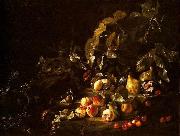 |
Abraham Brueghel
|
|
(1631-1690) was a Flemish painter from the famous family of artists. He was the son of Jan Brueghel the Younger, the grandson of Jan Brueghel the Elder and the great-grandson of Pieter Brueghel the Elder.
|
|
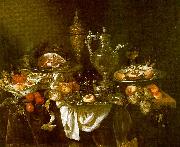 |
Abraham Hendrickz van Beyeren
|
|
1621-1690
Dutch
Abraham Hendrickz van Beyeren Location
|
|
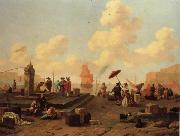 |
Abraham jansz.begeyn
|
|
Dutch painter and draughtsman , 1637-1697
was a Dutch painter of landscapes and cattle in the manner of Nicolaes Pietersz Berchem. Begeyn's earliest known work is from 1653. In 1655 he joined the painter's guild of Leiden, where he staid until at least 1667. He was then active in Amsterdam and The Hague, before he took his residence in Berlin in 1688. There his works were greatly prized, and, according to Houbraken, he was principal painter to Frederick III, the elector of Brandenburg, afterwards king of Prussia. In many collections in the Netherlands, the pictures of Begeyn are placed amongst those of the most admired masters. His pencilling is light and free, and his colouring very agreeable. Many of his works are landscapes, with views of rivers, ruins, and pieces of architecture,
|
|
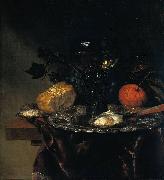 |
Abraham van Beijeren
|
|
(ca. 1620 - March 1690) was a Dutch Baroque era painter. He was little regarded in his day but is now considered one of the greatest of still-life painters. Van Beijeren (alternatively spelled "Beyeren") lived in a succession of Dutch towns. Born in The Hague, the artist also lived in Delft, Amsterdam, Alkmaar and Gouda. In 1678 he settled in Rotterdam, where he died in 1690.
|
|
 |
Adolf Bohm
|
|
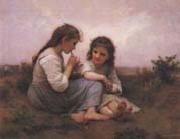
Adolf Böhm
Austria (1861-1927 ) - Painter
|
|
 |
Adolphe Bouguereau
|
|
French
1825-1905
French painter. From 1838 to 1841 he took drawing lessons from Louis Sage, a pupil of Ingres, while attending the coll?ge at Pons. In 1841 the family moved to Bordeaux where in 1842 his father allowed him to attend the Ecole Municipale de Dessin et de Peinture part-time, under Jean-Paul Alaux. In 1844 he won the first prize for figure painting, which confirmed his desire to become a painter. As there were insufficient family funds to send him straight to Paris he painted portraits of the local gentry from 1845 to 1846 to earn money. In 1846 he enrolled at the Ecole des Beaux-Arts, Paris, in the studio of Fran?ois-Edouard Picot. This was the beginning of the standard academic training of which he became so ardent a defender later in life. Such early works as Equality (1848; priv. col., see 1984-5 exh. cat., p. 141) reveal the technical proficiency he had attained even while still training. In 1850 he was awarded one of the two Premier Grand Prix de Rome for Zenobia Discovered by Shepherds on the Bank of the River Araxes (1850; Paris, Ecole N. Sup. B.-A.). In December 1850 he left for Rome where he remained at the Villa Medici until 1854, working under Victor Schnetz and Jean Alaux (1786-1864). During this period he made an extensive study of Giotto's work at Assisi and Padua and was also impressed by the works of other Renaissance masters and by Classical art. On his return to France he exhibited the Triumph of the Martyr (1853; Lun?ville, Mus. Lun?ville; see fig. 1) at the Salon of 1854. It depicted St Cecilia's body being carried to the catacombs, and its high finish, restrained colour and classical poses were to be constant features of his painting thereafter. All his works were executed in several stages involving an initial oil sketch followed by numerous pencil drawings taken from life.
|
|
 |
Adolphe William Bouguereau
|
|
Bouguereau made more than seven hundred finished works. French painter. From 1838 to 1841 he took drawing lessons from Louis Sage, a pupil of Ingres, while attending the coll?ge at Pons. In 1841 the family moved to Bordeaux where in 1842 his father allowed him to attend the Ecole Municipale de Dessin et de Peinture part-time, under Jean-Paul Alaux. In 1844 he won the first prize for figure painting, which confirmed his desire to become a painter. As there were insufficient family funds to send him straight to Paris he painted portraits of the local gentry from 1845 to 1846 to earn money. In 1846 he enrolled at the Ecole des Beaux-Arts, Paris, in the studio of Francois-Edouard Picot. This was the beginning of the standard academic training of which he became so ardent a defender later in life. Such early works as Equality reveal the technical proficiency he had attained even while still training. In 1850 he was awarded one of the two Premier Grand Prix de Rome for Zenobia Discovered by Shepherds on the Bank of the River Araxes (1850; Paris, Ecole N. Sup. B.-A.). In December 1850 he left for Rome where he remained at the Villa Medici until 1854, working under Victor Schnetz and Jean Alaux (1786-1864). During this period he made an extensive study of Giotto's work at Assisi and Padua and was also impressed by the works of other Renaissance masters and by Classical art. On his return to France he exhibited the Triumph of the Martyr (1853; Luneville, Mus. Luneville; ) at the Salon of 1854. It depicted St Cecilia's body being carried to the catacombs, and its high finish, restrained colour and classical poses were to be constant features of his painting thereafter. All his works were executed in several stages involving an initial oil sketch followed by numerous pencil drawings taken from life. Though he generally restricted himself to classical, religious and genre subjects, he was commissioned by the state to paint Napoleon III Visiting the Flood Victims of Tarascon in 1856
|
|
 |
adriaen backer
|
|
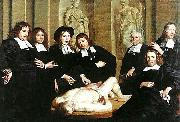
the anatomy lesson of dr frederick ruysch,
1670. amsterdams historisch museum
|
|
 |
Adriaen Brouwer
|
|
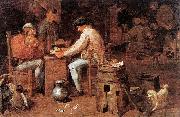
(1605 - January 1638) was a Flemish genre painter active in Flanders and the Dutch Republic in the seventeenth century.
At a young age Brouwer, probably born as Adriaen de Brauwer in Oudenaarde, moved perhaps via Antwerp to Haarlem, where he became a student of Frans Hals alongside Adriaen van Ostade. He also was active in stage acting and poetry. He stayed in Haarlem and Amsterdam until 1631, when he moved back to Antwerp in the Spanish Netherlands. There, he became a member of the Guild of St. Luke in 1631-1632, as well as the rhetoricians's chamber De Violieren.
Tradition has it that Brouwer himself spent much time in the alehouses of Flanders and Holland. His works are typically detailed and small, and often adopt themes of debauchery, drunkenness and foolishness in order to explore human emotions, expressions and responses to pain, fear and the senses. The Bitter Tonic is an example of the type of work that depicts such responses, in this case the sense of taste. His work was well liked, to the point that forgeries were sold in his own time. Both Rubens and Rembrandt owned a number of his works. Nevertheless, Brouwer appeared in financial trouble throughout his life.
He died at the early age of 32 in Antwerp, where he was first buried in a common grave.
|
|
 |
Adriaen Frans Boudewijns
|
|
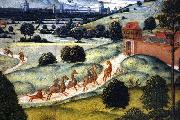
Adriaan Frans Boudewyns, not Anton Frans (Bauduins, or Baudouin), (3 October 1644 - 3 December 1719) was a Flemish Baroque landscape painter.
He was born at Brussels and learned to paint under a landscape painter named Ignatius van der Stock, and was received into the Guild there in 1665. He then travelled to Paris in 1666 and studied under A. F. van der Meulen for three years, and whose daughter Barbara he married 12 January 1670. In 1674 his wife died and in 1681 he moved back to Brussels where he married again. According to Houbraken he was a good landscape painter who encourage Gerard Hoet to stay in Brussels for 8 months in the 1680s. His son Frans Boudewijns (1682-1767) also became a successful painter. He was ruined in the bombardment of Brussels in 1695.
Adriaen Fransz. Boudewijns, Adriaen Frans Boudewyns, Adriaen Frans Baudewijns, Adriaen Frans Baudewyns, Anton Frans Baudouin, Adriaen Frans Bauduins, Adrien François Bauduins, Monogrammist AFB
|
|
 |
Aelbrecht Bouts
|
|
( 1450s, Leuven - March 1549, Leuven) was a Netherlandish painter. His first name is sometimes spelled eAlberte, eAelberte or eAlbrechte. He was born into a family of painters. Aelbrechtes father was Dieric Bouts the Elder (ca.1415-1475), and his brother was Dieric Bouts the Younger (ca.1448-1490). Jan Bouts (ca.1478-ca. 1530), son of Dieric Bouts the Younger, also became a painter. Dieric Bouts the Younger inherited his fatheres shop in 1475, while Aelbrecht established his own workshop, also in Leuven. Whereas Dieric the Younger continued in his father's style, Aelbrecht developed his own unmistakable style with strong colors, rich texture and fine details.
Bob Jones University Museum and Gallery (Greenville, South Carolina), the Cleveland Museum of Art, the Fitzwilliam Museum (Cambridge), Harvard University Art Museums, The Honolulu Academy of Arts, the Hood Museum of Art (Hanover, New Hampshire), the Norton Simon Museum (Pasadena, California), the Royal Museums of Fine Arts of Belgium, the Czartoryski Museum and the Staatsgalerie Stuttgart are among the public collections having paintings by Aelbrecht Bouts.
|
|
 |
After Jan de Baen
|
|
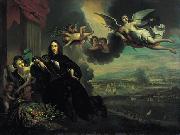
Jan de Baen (20 February 1633 - 1702) was a Dutch portrait painter who lived during the Dutch Golden Age. He was a pupil of the painter Jacob Adriaensz Backer in Amsterdam from 1645 to 1648. He worked for Charles II of England in his Dutch exile, and from 1660 until his death he lived and worked in The Hague. His portraits were popular in his day, and he painted the most distinguished people of his time.
|
|
 |
Agnolo Bronzino
|
|
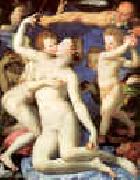
Italian Mannerist Painter, 1503-1572
Agnolo di Cosimo (November 17, 1503 ?C November 23,1572), usually known as Il Bronzino, or Agnolo Bronzino (mistaken attempts also have been made in the past to assert his name was Agnolo Tori and even Angelo (Agnolo) Allori), was an Italian Mannerist painter from Florence. The origin of his nickname, Bronzino is unknown, but could derive from his dark complexion, or from that he gave many of his portrait subjects. It has been claimed by some that he had dark skin as a symptom of Addison disease, a condition which affects the adrenal glands and often causes excessive pigmentation of the skin.
|
|
 |
Agostino Brunias
|
|
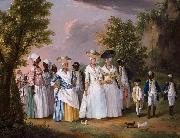
Agostino Brunias (c. 1730 - April 2, 1796) was a London-based Italian painter from Rome. Strongly associated with West Indian art, he left England at the height of his career to chronicle Dominica and the neighboring islands of the West Indies. Painted in the tradition of verite ethnographique, his art was as escapist as it was romantic.
Brunias was born in Rome c. 1730; the exact date is uncertain. His first name has been spelled in various ways including Abraham, Alexander, August, or Austin, while his surname has been recorded as Brunais and Brunyas. Brunias was a student at the Accademia di San Luca, Rome, where he won Third Prize in the Second Class for painting in 1754. An early oil painting of his was exhibited in Rome two years earlier.
|
|
 |
Albert Baertsoen
|
|
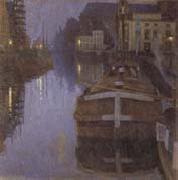
Belgian, 1866-1922.Belgian painter and etcher. The son of a successful mill-owner and an excellent musician, he was a pupil and friend of Gustave Den Duyts (1850-97), and later, at the Ghent Acad?mie, of Jean Delvin (1853-1922). He was involved in the exhibiting society LEssor in Brussels as well as the triennial salons held in Brussels, Antwerp and Ghent in rotation. Among his earliest important works are The Scheldt at Dendermonde (1887; Ghent, Mus. S. Kst.), which he painted beside Isidore Meyers (1836-1917) and Franz Courtens in a Realist style characteristic of the Dendermonde school. In 1889-90 he attended the studio of Alfred Roll in Paris, where he met Jacques-Emile Blanche and Charles Cottet, and became particularly closely associated with Frits Thaulow, Emile-Ren? M?nard and Edmond Aman-Jean. He exhibited regularly at the Salon in Paris. Although Baertsoen is considered to be one of the first Belgian Impressionists, he belonged to no particular school. He was more than a descriptive landscape painter, for he sought to evoke through the depiction of the natural world a mood of melancholy and resignation. He painted silent streets, rocks, rivers and canals in Bruges, Li?ge, Nieuwpoort, Diksmuide and in London, where he stayed during World War I. His most important paintings, however, were inspired by his native town, Ghent, of which he built up a remarkable portrait over the years in such works as Barges in the Snow (1901) and Ghent in the Evening (1903; both Brussels, Mus. A. Mod.). A broad, spontaneous technique, great delicacy of nuance, deep sincerity as well as a certain meditative quality characterize his work, which is limited in quantity. Baertsoen played an important role in Belgian cultural life of his period and was elected to the Acad?mie Royale des Beaux-Arts in 1919.
|
|
 |
Albert Besnard
|
|
1849-1934
French
Albert Besnard Art Locations
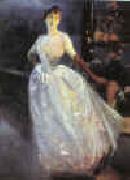
(b Paris, 2 June 1849; d Paris, 4 Dec 1936). French painter, printmaker and designer. He was born to an artistic family and was precociously talented. In 1866 he entered the Ecole des Beaux-Arts, where he studied under Jean Franois Brmond (1807-68) and Alexandre Cabanel. His Salon dbut in 1868 and his subsequent entries were well received, and in 1874 he won the Prix de Rome with the Death of Timophanes, Tyrant of Corinth (Paris, Ecole N. Sup. B.-A.). Remaining in Italy for five years, Besnard worked in an academic style influenced by Pietro da Cortona and Michelangelo.
|
|
 |
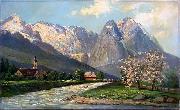
Albert Bierdstadt
|
|
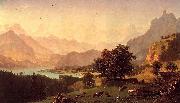
painted Bernese Alps in 1859
|
|
 |
Albert Bierstadt
|
|
German-born American Hudson River School Painter, 1830-1902
Bierstadt was born in Solingen, Germany. His family moved to New Bedford, Massachusetts, in 1833. He studied painting with the members of the D??sseldorf School in D??sseldorf, Germany from 1853 to 1857. He taught drawing and painting briefly before devoting himself to painting.
Bierstadt began making paintings in New England and upstate New York. In 1859, he traveled westward in the company of a Land Surveyor for the U.S. government, returning with sketches that would result in numerous finished paintings. In 1863 he returned west again, in the company of the author Fitz Hugh Ludlow, whose wife he would later marry. He continued to visit the American West throughout his career.
Though his paintings sold for princely sums, Bierstadt was not held in particularly high esteem by critics of his day. His use of uncommonly large canvases was thought to be an egotistical indulgence, as his paintings would invariably dwarf those of his contemporaries when they were displayed together. The romanticism evident in his choices of subject and in his use of light was felt to be excessive by contemporary critics. His paintings emphasized atmospheric elements like fog, clouds and mist to accentuate and complement the feel of his work. Bierstadt sometimes changed details of the landscape to inspire awe. The colors he used are also not always true. He painted what he believed is the way things should be: water is ultramarine, vegetation is lush and green, etc. The shift from foreground to background was very dramatic and there was almost no middle distance
Nonetheless, his paintings remain popular. He was a prolific artist, having completed over 500 (possibly as many as 4000) paintings during his lifetime, most of which have survived. Many are scattered through museums around the United States. Prints are available commercially for many. Original paintings themselves do occasionally come up for sale, at ever increasing prices.
|
|
 |
Albert Blaetter
|
|
(1878 -1935 ) - Painter
|
|
 |
Albert de Balleroy
|
|
(1828 -1873 ) - Painter
|
|
 |
Albert Fitch Bellows
|
|
Nov.29.1829-Nov.24.1883, American landscape painter of the Hudson River School, was born at Milford, Massachusetts. He first studied architecture and opened his own architectural firm in 1849, but quickly turned to painting. From 1850 to 1856 he taught at the New England School of Design in Boston. He resigned his post to travel and study abroad, and spent time in Paris and at the Royal Academy at Antwerp as well as in England. He exhibited his first work at the National Academy of Design in 1857, becoming a full member in 1861, and he settled in New York City in 1858 on his return to America. Bellows spent most of his remaining career in New York, though he briefly moved to Boston. He visited Europe again in 1867. In New York he kept a studio in the same building as many of the notable Hudson River School artists of the time. His landscape work of the 1860s is fully in the late Hudson River School tradition, though Bellows depicted people more prominently in his landscapes than most other artists. He excelled at figurative scenes. Bellows also differed from most Hudson River School artists in that he became skilled at watercolor, and authored a respected book on the subject titled "Water-Color Painting: Some Facts and Authorities in Relation to Its Durability". He eventually maintained two studios, one for oil paintings and one for watercolor. He was a member of the American Watercolor Society, and an honorary member of the Royal Belgian Society of Water-Colorists. Bellows also mastered etching??along with Samuel Colman he was possibly the only other Hudson River School artist to do so??and became a member of the New York Etching Club, the Philadelphia Society of Etchers and the Royal Society of Painter-Etchers and Engravers in London, England, an esteemed professional organization whose members included James McNeil Whistler and Francis Seymour Haden. He died in Auburndale,
|
|
 |
Albertus Del Orient Browere
|
|
American, 1814-1887
|
|
 |
Alessandro Bonvicino
|
|
(c. 1498 - December 22, 1554), more commonly known as Il Moretto da Brescia, was an Italian Renaissance painter of Brescia and Venice.
He was born at Rovato, in Brescian territory, and studied first under Fioravante Ferramola. Others state he trained with Vincenzo Foppa. His brothers Pietro and Jacopo were also painters. The 1911 Britannica claims he apprenticed with Titian in Venice and that Moretto modelled his earlier portrait-painting style on the Venetian style. On the other hand, the style also resembles that of Giorgione or late Bellini. The 1911 Britannica also states that he conceived a great enthusiasm for Raphael, though he never traveled to Rome; on the other hand, his classical serenity resembles that shown by Leonardo and his followers in Lombardy such as, for example, Bramantino. He may have consulted with his contemporary Girolamo Savoldo.
Moretto excelled more in sedate altarpieces than in narrative action, and more in oil-painting than in fresco, although he painted fine frescoes depicting the lollygagging daughters of Count Martinengo in one of the palaces near Brescia. In 1521, he worked with Girolamo Romanino in the Cappella del Sacramento in the old cathedral of Brescia, where Moretto completed a Last Supper, Elijah in the Desert, and a Fall of Manna.He was active during 1522-24 in Padua.
He painted alongside with Lorenzo Lotto at Santa Maria Maggiore in Brescia. Also in Brescia, he completed a Five Virgin Martyrs and his masterpiece, the Assumption of the Madonna for the church of San Clemente; a Coronation of the Madonna with four saints (c. 1525) for the church of Santi Nazaro e Celso; a St. Joseph for Santa Maria della Grazie; and a St Nicholas of Ban for Santa Maria de Miracoli. He collaborated with Floriano Ferramola in the decoration of the dome of the cathedral in Brescia.
|
|
 |
Alessandro Botticelli
|
|
Florence ca.1445-1510
Italian painter and draughtsman. In his lifetime he was one of the most esteemed painters in Italy, enjoying the patronage of the leading families of Florence, in particular the Medici and their banking clients. He was summoned to take part in the decoration of the Sistine Chapel in Rome, was highly commended by diplomatic agents to Ludovico Sforza in Milan and Isabella d'Este in Mantua and also received enthusiastic praise from the famous mathematician Luca Pacioli and the humanist poet Ugolino Verino. By the time of his death, however, Botticelli's reputation was already waning. He was overshadowed first by the advent of what Vasari called the maniera devota, a new style by Perugino, Francesco Francia and the young Raphael, whose new and humanly affective sentiment, infused atmospheric effects and sweet colourism took Italy by storm;
|
|
 |
Alessandro Filipepe called botticelli
|
|
Florence ca 1445-1510
|
|
 |
Alessio Baldovinetti
|
|
Florence ca 1425-1499
|
|
 |
Alesso Baldovinetti
|
|
(October 14, 1427??August 29, 1499) was an Italian early Renaissance painter.
Baldovinetti was born in Florence to a family of a rich merchant. In 1448 he was registered as a member of the Guild of St. Luke: "Alesso di Baldovinetti, dipintore."
He was a follower of the group of scientific realists and naturalists in art which included Andrea del Castagno, Paolo Uccello and Domenico Veneziano. Tradition says that he assisted in the decorations of the church of S. Egidio, however no records confirm this. These decoration were carried out during the years 1441 - 1451 by Domenico Veneziano and in conjunction with Andrea del Castagno. That he was commissioned to complete the series at a later date (1460) is certain.
In 1462 Alesso was employed to paint the great fresco of the Annunciation in the cloister of the Annunziata basilica. The remains as we see them give evidence of the artist's power both of imitating natural detail with minute fidelity and of spacing his figures in a landscape with a large sense of air and distance; and they amply verify two separate statements of Vasari concerning him: that "he delighted in drawing landscapes from nature exactly as they are, whence we see in his paintings rivers; bridges, rocks, plants, fruits, roads, fields, cities, exercise grounds, and an infinity of other such things," and that he was an inveterate experimentalist in technical matters.
His favourite method in wall-painting was to lay in his compositions in fresco and finish them a secco with a mixture of yolk of egg and liquid varnish. This, says Vasari, was with the view of protecting the painting from damp; but in course of time the parts executed with this vehicle scaled away, so that the great secret he hoped to have discovered turned out a failure. In 1463 he furnished a cartoon of the Nativity, which was executed in tarsia by Giuliano de Maiano in the sacristy of the cathedral and still exists. From 1466 date the groups of four Evangelists and four Fathers of the Church in fresco, together with the Annunciation on an oblong panel, which still decorate the Portuguese chapel in the basilica of San Miniato, and are given in error by Vasari to Piero Pollaiuolo. A fresco of the risen Christ between angels inside a Holy Sepulchre in the chapel of the Rucellai family, also still existing, belongs to 1467.
In 1471 Alesso undertook important works for tile church of Santa Tr??nita on the commission of Bongianni Gianfigliazzi. First, to paint an altar-piece of the Virgin and Child with six saints; this was finished in 1472: next, a series of frescoes from the Old Testament which was to be completed according to contract within five years, but actually remained on hand for fully sixteen. In 1497 the finished series, which contained many portraits of leading Florentine citizens, was valued at a thousand gold forms by a committee consisting of Cosimo Rosselli, Benozzo Gozzoli, Perugino and Filippino Lippi; only some defaced fragments of it now remain.
|
|
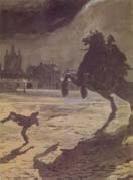 |
Alexander Benois
|
|
1856-1933
|
|
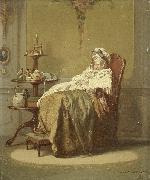 |
Alexander Hugo Bakker Korff
|
|
painted An Afternoon Nap in 1866
|
|
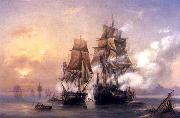 |
Alexey Bogolyubov
|
|
16 March 1824 - 3 February 1896) was a Russian landscape painter.
Bogolyubov was born in the Pomeranian village of Novgorod Gubernia. His father was retired colonel Pyotr Gavriilovich Bogolyubov. Bogolyubov's maternal grandfather was the well-known philosopher and social critic Alexander Radishchev.
In 1841, Alexey graduated from military school, serving in the Russian Navy and travelling with the fleet to many countries. In 1849, he started to attend classes of the Saint Petersburg Academy of Arts, where he studied under Maxim Vorobiev. The young painter was greatly influenced by Ivan Ayvazovsky. In 1853, he finished the Academy with a major Gold medal. He retired as a navy officer and was appointed an artist to the Navy headquarters.
From 1854 to 1860, he travelled around Europe and worked prolifically. In Rome, he was acquainted with Alexander Ivanov, who convinced Bogolyubov to focus more on drawing. In Desseldorf, Bogolyubov took classes from the painter Andreas Achenbach. In Paris, he admired the artists of the Barbizon School. French painters Camille Corot and Charles François Daubigny were good friends and collaborators with Bogolyubov.
Bogolyubov returned to Russia in 1860. He exhibited his works in the Academy and received the title of professor. For some time, he taught in the Academy. In the 1860s, he traveled along the Volga. His paintings lost all traces of Romanticism, replacing that element with staunch realism of the natural. In 1871 he was elected to the Imperial Academy of Arts.
Sailing ships, 1860From 1870, he became close to the The Wanderers art movement, participated in all their exhibitions. He became a member of their board. Much older than most of the other members of the movement, he had reservations on their social ideas. In 1873, Bogolyubov left the ? in solidarity with his fellow Itinerants. He even tried to create an alternative Russian Academy of Arts in Rome.
|
|
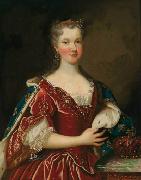 |
Alexis Simon Belle
|
|
(12 January 1674 - 21 November 1734) was a French portrait painter, known for his portraits of the French and Jacobite nobility.
Belle was born in Paris, the second child and only son of Jean-Baptiste Belle (born before 1642, died 1703), also a painter, and of Anne his wife (died 1705).
Belle's birth and baptism are recorded in the parish register of the church of Saint-Sulpice, Paris, and quoted in Eugene Piot's Le Cabinet de l'amateur for the years 1861 and 1862
|
|
 |
Alfred Bastien
|
|
(16 September 1873e7 June 1955) was a Belgian artist, academic and soldier.
He attended the Academie Royale des Beaux-Arts in Ghent, where he studied with Jean Delvin. He then enrolled in the Academie Royale des Beaux-Arts in Brussels, where he studied with Jean-François Portaels. He won the Prix Godecharle there in 1897. He traveled to Paris, where he enrolled in the Ecole des Beaux-Arts in Paris. He was in Paris when hostilities broke out in what would become the First World War.
|
|
 |
Alfred de breanski
|
|
1852-1928
|
|
 |
Alfred Thompson Bricher
|
|
1837-1908
Alfred Thompson Bricher (born in Portsmouth, New Hampshire on April 10, 1837; died in Staten Island, New York on September 30, 1908) was a painter associated with White Mountain art and the Hudson River School.
He began as a businessman in Boston, Massachusetts before becoming a professional painter. He studied at the Lowell Institute when not working. He also studied with Albert Bierstadt, William Morris Hunt, and others In 1868 he moved to New York City and in the 1870s primarily did maritime themed paintings.
|
|
 |
Alonso Berruguete
|
|
(Alonso Berruguete) (c. 1488 - 1561) was a Spanish painter, sculptor and architect. He is considered to be the most important sculptor of the Spanish Renaissance, and is known for his emotive sculptures depicting religious ecstasy or torment.
Born in the town of Paredes de Nava, Berrugete studied art under the tutelage of his father, the painter Pedro Berruguete. Following his father's death in 1504, Berruguete travelled to Italy to continue with his study of art, spending most of his time in Florence and Rome. It is here that he studied sculpture under the Italian Master, Michelangelo. His paintings produced in Italy showed a mannerist influence, with his art being compared with contemporaries such as Jacopo Pontormo and Rosso Fiorentino.
Berruguete returned to Spain in 1517, and in 1518, was appointed to the position of court painter and sculptor by Charles V of Spain. From this point in his career forward, Berruguete concentrated on sculpture. Works of his include an altar piece at the Irish college in Salamanca (1529-1533), choir stalls at the Cathedral of Toledo (1539-1543) and a tomb for the Archbishop of Toledo Juan de Tavera at the hospital that Tavera founded, the hospital of St. John the Baptist in Toledo (1552-1561).
|
|
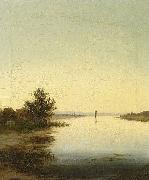 |
Amalia del Pilar de Borbon
|
|
painted Abendliche Chiemseelandschaft in
|
|
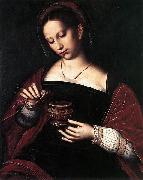 |
Ambrosius Benson
|
|
(c.1495/1500, Ferrara or Milan - 1550, Flanders) was an Italian painter who became a part of the Northern Renaissance.
While many surviving paintings have been attributed, there is very little known of him from records, and he tended not to sign his work. He is believed to be responsible for mainly religious art, but also painted portraits on commission. He sometime painted from classical sources, often setting the figures in modern-dress, or a contemporary domestic setting. In his lifetime he was successful; he had a large workshop, his work was sold internationally and he was especially popular in Spain.
Benson became popular as a source for pastiche with 19th century painters, who are sometimes known as the "followers of Benson". In particular his many variations of the Magdalen and Sibilla Persica, were further copied and became popular with contemporary buyers. Many have retained their relative value and held in the National Gallery, London and command high prices at Sotheby's
|
|
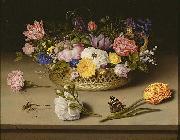 |
Ambrosius Bosschaert
|
|
(Antwerp, January 18, 1573?CThe Hague, 1621) was a still life painter of the Dutch Golden Age.He started his career in Antwerp, but spend most of it in Middelburg (1593?C1613), where he became dean of the painters' guild. He later worked in Amsterdam (1614), Bergen op Zoom (1615?C1616), Utrecht (1616?C1619), and Breda (1619). He specialised in painting still lifes with flowers. In 1587, Ambrosius Bosschaert moved from Antwerp to Middelburg with his family because of the threat of religious persecution. At the age of twenty-one, he joined the cityes Guild of Saint Luke. Not long after, Bosschaert had established himself as a leading figure in the fashionable floral painting genre.
|
|
 |
AMMANATI, Bartolomeo
|
|
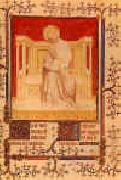
Italian Mannerist Sculptor, 1511-1592
Italian sculptor and architect. He was a major figure in Italian art in the second and third quarters of the 16th century. His extensive travels in north and central Italy gave him an unequalled understanding of developments in architecture and sculpture in the era of Mannerism. His style was based inevitably on the example of Michelangelo but was modified by the suaver work of Jacopo Sansovino. In both sculpture and architecture Ammanati was a highly competent craftsman, and his masterpieces, the tombs of Marco Mantova Benavides and two members of the del Monte family, the Fountains of Juno and Neptune and the courtyard of the Palazzo Pitti, are among the finest works of the period.
|
|
 |
Andre Beauneveu
|
|
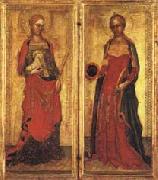
Netherlandish Gothic Era Painter and Sculptor, 1335-ca.1401
Andre Beauneveu was born in Valenciennes. Little is known about his early life and he is first documented in 1360. Four years later, he commissioned to create a collection of royal tombs in Paris for King Charles V. In 1366, Beauneveau left Paris and began working for the Count of Flanders in Courtrai beginning in 1374. Then in 1386, he began working for Jean, Duc de Berry and served him for the rest of his life. Beauneveau was primarily a sculptor, but also produced illuminated manuscripts and stained glass windows. His work was integral to the development of naturalism in the 15th century.
|
|
 |
Andrea Bonaiuti
|
|
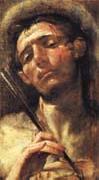
(c. 1343-1377) Italian painter
|
|
 |
Andrea Boscoli
|
|
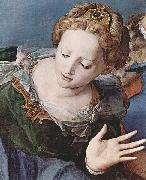
Italian, ca.1560-1607
|
|
 |
Angelo Bronzino
|
|
(November 17, 1503 - November 23, 1572), usually known as Il Bronzino, or Agnolo Bronzino (mistaken attempts also have been made in the past to assert his name was Agnolo Tori and even Angelo (Agnolo) Allori), was an Italian Mannerist painter from Florence. The origin of his nickname, Bronzino is unknown, but could derive from his dark complexion, or from that he gave many of his portrait subjects.
Bronzino was born in Florence. According to his contemporary Vasari, Bronzino was a pupil first of Raffaellino del Garbo, and then of Pontormo. The latter was ultimately the primary influence on Bronzino's developing style and the young artist remained devoted to his eccentric teacher.
|
|
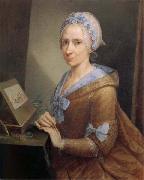 |
Anna Bacherini Piattoli
|
|
1720-80
|
|
|
|
|
|
|
|
|
| Wholesale China Oil Painting Wholesale Oil Painting China Xiamen Portrait Reproduction on canvas Chinese Oil Painting Wholesale USA Oil Painting |
|
|
|
|


