|

|
|
| |
|
China Oil Painting Direct
|
|
100% hand painted, 100%
cotton canvas,
100% money back if not satisfaction.
|
|
|
|
ART WORKS
INDEX
A B C D E F G H I J K L M N O P Q R S T U V W X Y Z
|
|
ARTISTS
INDEX
A B C D E F G H I J K L M N O P Q R S T U V W X Y Z
|
|
|
|
 |
Louis Leopold Boilly 
|
|
b.July 5, 1761, La Bass??e, France
d. Jan. 4, 1845, Paris
French
Louis Leopold Boilly Location
|
|
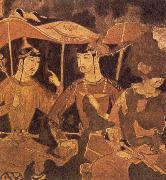 |
Abu l Faraj al Isfahani
|
|
Tenth century
|
|
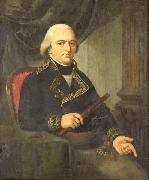 |
Adriaan de Lelie
|
|
was born at Tilburg in 1755, and was a scholar of Peeters, a painter of tapestries and ornaments, and afterwards of Quertenmont at Antwerp. He made copies of many of the portraits by Rubens and Van Dyck at Desseldorf, and also of historical pictures by Italian and Dutch masters. By the advice of Professor Camper, he established himself at Amsterdam, where he painted a great number of portraits and cabinet pictures; among the latter is one of the celebrated amateur Jan Gildemeester showing his collection to a party of ladies and gentlemen, in which the principal pictures are readily recognised. One of his best works is that representing the 'Drawing Academy' of the Felix Meritis Society at Amsterdam. His pictures are highly esteemed in Holland and Germany, where they are to be met with in the best collections. He died at Amsterdam in 1820.
|
|
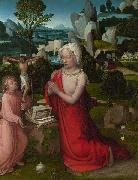 |
Adriaen Isenbrant
|
|
(between 1480 and 1490 - Bruges, July 1551), was a Flemish Northern Renaissance painter, who from documentary evidence was clearly a significant artist of his period, but to whom no specific works can be clearly documented. As hypothesised by art historians, he ran a large workshop specializing in religious subjects and devotional paintings, painting conservatively in the tradition of Early Netherlandish painting. He is believed by some to be the anonymous Master of the Seven Sorrows of the Virgin. Other art historians doubt that any works can be reliably attributed to him, and the number of paintings attributed to him by major museums has been in decline for many decades.
There are only a few documentary records of his life, and some mentions in literature from his lifetime or soon after, but he cannot be documented as the creator of any surviving work; everything else consists of hypothesis. It is possible that he was born in Haarlem or even in Antwerp about 1490. It is not known where or with which painter he served his apprenticeship.
He is named for the first time in 1510, when he came to Bruges and bought his burghership. In November of the same year he already became master in the painterse Guild of St. Luke and the goldsmithse guild of St. Elooi. He was later elected nine time a deacon (in Old Dutch : vinder) and twice the governor (in Old Dutch : gouverneur = treasurer) of the guild.
Soon he had an important workshop, probably in the Korte Vlaminckstraat in Bruges. This was close to the workshop of Gerard David, at the Vlamijncbrugghe and the former workshop of Hans Memling. Bruges, at that time, was one of the richest towns in Europe. Rich traders and merchants ordered diptychs and portraits for personal use. Isenbrandt painted mainly for private clients. However, there were some paintings that were created without any particular commission. He had enough work to even put out work to other painters in Bruges, as a legal suit from 1534 by Isenbrandt against Jan van Eyck (not the famous one) for non-delivery of paintings he had ordered, demonstrates. He was also appointed the agent in Bruges of the painter Adriaan Provoost (son of Jan Provoost), who had moved to Antwerp in 1530. Contemporary sources therefore mention Isenbrandt as a famous and well-to-do painter.
He married twice, the first time with Maria Grandeel, daughter of the painter Peter Grandeel. They had one child. After her death in 1537, he married again in 1547 with Clementine de Haerne. This second marriage resulted in two daughters and a son. He also had an extramarital daughter with the innkeeper Katelijne van Brandenburch (who was at the same the mistress of his friend Ambrosius Benson).
When he died in 1551, he was buried alongside his first wife at the cemetery of the St. Jacob church in Bruges; his children inherited no less than four houses with surrounding property.
|
|
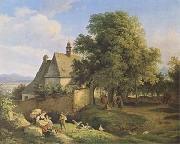 |
Adrian Ludwig Richter
|
|
German, 1803-1884
German painter, printmaker and illustrator. He ranks with Moritz von Schwind as the most important representative of late Romantic painting and printmaking in Germany. In contrast to the work of such leading masters of early Romanticism as Philipp Otto Runge and Caspar David Friedrich, which was ambitious in content and innovative in form, Richter's art was more modest in its aims, in line with the restrained intellectual climate of the Biedermeier period.
|
|
 |
Adrien Lavieille
|
|
(March 29, 1848, Montmartre - February 5, 1920, Chartres) was a French painter.
Portrait of Adrien Lavieille in 1879, by his wife, Marie Adrien Lavieille.
Oil on canvas (private collection).Son of the landscape painter Eugene Lavieille, and nephew of the wood engraver Jacques Adrien Lavieille, he was a painter of the country : near Paris, in Brittany, near Cancale and on the riverside of the Vilaine in the south of Rennes, in Touraine, at Saint-Jean-de-Monts in Vendee, where he was invited by a friend, the painter and engraver Auguste Lepere, around Vendôme where he sojourned in the home of his daughter, Andree Lavieille, so a painter, and of his son-in-law, the man of letters, Paul Tuffrau.
He also painted in Montmartre, where he lived during his youthful days, and, as his father, at Moret-sur-Loing, near Fontainebleau.
Parallelly to his painter's activities, Adrien Lavieille executed, during his life, for money's reasons, works of restoration and decoration : basilica Saint-Martin in Tours (where he worked with the painter Pierre Fritel), Palais de Justice of Rennes, Château de Vaux-le-Vicomte, Hôtel de Lauzun, quai d'Anjou in Paris.
In 1878, he married the painter Marie Petit.
|
|
 |
Agasse, Jacques-Laurent
|
|
Swiss Painter, 1767-1849 Specializes in AnimalsEnglish painter of Swiss birth. Born into a wealthy and politically influential Huguenot family, Agasse spent his early childhood at the country estate of Cr?vin, where he may have developed the interest in animals and natural history that was to guide his later career as an artist in England. Agasse trained first at the Ecole du Colibri in Geneva and subsequently in Paris under Jacques-Louis David (beginning in 1787) and possibly under Horace Vernet. His early artistic output consisted chiefly of unpretentious silhouette 'cut-outs' in the style of Jean-Daniel Huber.
|
|
 |
Albert Lebourg
|
|
Montfort-sur-Risle 1849-Rouen 1928
French painter. He had an early interest in architecture and studied under the architect Drouin at the Ecole Municipale de Dessin in Rouen. He became increasingly interested in art and through Drouin met the landscape painter Victor Delamarre (1811-68) who advised and taught him. Giving up architecture altogether, he then attended the Ecole Municipale de Peinture et de Dessin in Rouen under Gustave Morin (1809-86). In 1871 he met the collector Laperlier through whom he obtained the post of professor of drawing at the Societe des Beaux-Arts in Algiers. He remained there from 1872 to 1877, producing works such as Street in Algiers (1875; Rouen, Mus. B.-A.). He also experimented with depicting a single site in a variety of different lights, in a manner similar to the late works of Monet. After giving up his teaching post in Algeria in 1877 he returned to Paris where he attended Jean-Paul Laurens's studio from 1878 to 1880. It was at this point that he became aware of Impressionism; later he became friendly with Degas, Monet and Sisley. He first exhibited at the Salon de la Societe des Artistes Franeais in 1883 and again in 1886,
|
|
 |
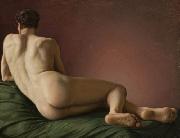
Albin Egger Lienz
|
|
Albin Egger-Lienz (29 January 1868 - 4 November 1926) was an Austrian painter.
He was born in Dölsach-Stribach near Lienz, in what was the county of Tyrol. As an artist, he had a special preference for rustic genre and historical paintings; under the influence of Ferdinand Hodler, Egger-Lienz abstracted his formal language into monumental expressiveness.
He trained first under his father (a church painter), later he studied at the Academy in Munich where he was influenced by Franz Defregger and French painter Jean-François Millet. In 1899 he moved to Vienna. During 1911 and 1912 he was professor at the Weimar School of Fine Arts and he served as war painter during World War I. In 1918, he turned down a professorship at the Vienna Academy and settled in South Tyrol. Egger-Lienz died on 4 November 1926 in St. Justina-Rentsch, Bolzano, Italy.
|
|
 |
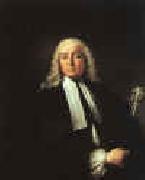
Aleksander Lesser
|
|
(May 13, 1814 - March 13, 1884) was a Polish painter and art critic of Jewish descent. Lesser specialized in Polish historic and contemporary themes. He was a member of Krakew Academy of Learning and co-founder of Warsaw's Zachęta, the Society for Encouragement of the Fine Arts.
Lesser studied painting at Warsaw University's department of fine arts, as well as at art schools in Dresden and Munich. He was a founder of the history-painting movement in Poland, which is considered a part of the "archeological trend" that existed before Jan Matejko. The trend's purpose was to portray the entire history of Poland in works of art.
|
|
 |
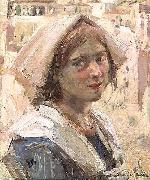
Alessandro Longhi
|
|
1733-1813
Italian
Alessandro Longhi Gallery
Alessandro Longhi (1733-1813) was a Venetian portrait painter and printmaker in etching (mostly reproductions of paintings). He is known best for his oil portraits of Venetian nobles of state. His father was the famed genre painter Pietro Longhi. He trained under his father and Giuseppe Nogari (1609-1763). Like Sebastiano Bombelli in the prior century, Alessandro Longhi is noted for his zealous full-length depicitions of robes and emblems of office. His "tumultuous and unusual (etching) technique shows first-hand knowledge of Rembrandt's etchings", according to Olimpia Theodoli.
|
|
 |
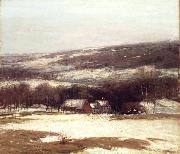
Alexander Ignatius Roche
|
|
painted Italian Peasant Girl in 1861-1921
|
|
 |
Alexander Theobald Van Laer
|
|
Alexander Theobald Van Laer (1857-1920) was an American painter, born at Auburn, New York.
He studied at the Art Students League of New York
|
|
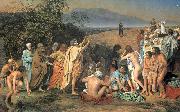 |
Alexandr Andreevich Ivanov
|
|
painted Appearance of Christ to the People in 1837
|
|
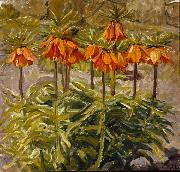 |
Alhed Larsen
|
|
Alhed Maria Larsen nee Warberg (7 April 1872, Heden near Faaborg - 31 August 1927, Odense), the wife of Johannes Larsen, was one of the Fynboerne or "Funen Artists" who lived and worked on the Danish island of Funen.
Alhed Larsen was the daughter of Albrecht Christoffer Warberg, who managed the Erikshåb estate in the south of Funen. The estate became an early meeting place for the artists who later became known as the Fynboerne. As early as 1885, Larsen began to have painting lessons with Fritz Syberg and she became a friend of Johannes Larsen, whom she married in 1898, and of Peter Hansen. Anna Syberg, Hansen's sister, Marie Schou and Christine Swane, Johannes Larsen's sister, became lifelong companions. Ahled Larsen appears to have been a central figure for the Funen Painters, frequently acting as hostess.
Alhed Larsen had also had drawing lessons from her uncle Ludvig Brandstrup with whom she stayed in Copenhagen where she worked as a porcelain decorator at the Royal Copenhagen factory from 1890 to 1893.
When she finally married Johannes Larsen in 1898, the couple moved to Kerteminde in north-east Funen where they soon built their new home, Mollebakken, on the outskirts of the town. The house was extended on several occasions, becoming one of the most beautiful artists' homes in the country. With its 16 bedrooms, it served as a central meeting place for the Funen Painters and their friends, in the caring hands of Alhed Larsen.
|
|
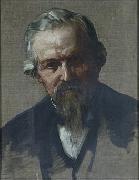 |
Alphonse Legros
|
|
Alphonse Legros (8 May 1837 - 8 December 1911), painter, etcher and sculptor was born in Dijon. His father was an accountant, and came from the neighbouring village of Veronnes. Young Legros frequently visited the farms of his relatives, and the peasants and landscapes of that part of France are the subjects of many of his pictures and etchings. He was sent to the art school at Dijon with a view to qualifying for a trade, and was apprenticed to Maître Nicolardo, house decorator and painter of images. In 1851 Legros left for Paris to take another situation; but passing through Lyon he worked for six months as journeyman wall-painter under the decorator Beuchot, who was painting the chapel of Cardinal Bonald in the cathedral.
|
|
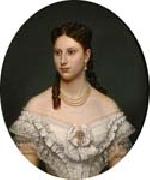 |
Amalia Lindegren
|
|
(22 May 1814 in Stockholm, died 27 December 1891 in Stockholm, was a Swedish artist and painter, from 1856 a member of the Royal Swedish Academy of Arts.
At the age of three, she was left an orphan after her mothers death and adopted by the widow of her alleged biological father, Benjamin Sandel. Her position as a child was somewhat humiliating, as a form of charity object for the upper classes, and in her later work, her paintings of sad little girls is believed to be inspired by her childhood.
Her drawings made the artist and art teacher Carl Gustaf Qvarnström include her as one of the four women accepted as students at the academy in 1849, and in 1850, she became the first woman given an art scholarship from the academy to study art in Paris, which she did at the studies of Coignet and Tissier; she also studied in D??sseldorf and Menich before she returned to Sweden in 1856, were she was elected to the academy
|
|
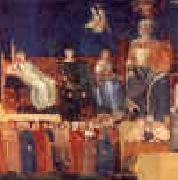 |
Ambrogio Lorenzetti
|
|
Italian Byzantine Style Painter, ca.1290-1348
Ambrogio Lorenzetti (or Ambruogio Laurati; c. 1290 ?C June 9, 1348) was an Italian painter of the Sienese school. He was active between approximately from 1317 to 1348. His elder brother was the painter Pietro Lorenzetti.
His work shows the influence of Simone Martini, although more naturalistic. The earliest dated work of the Sienese painter is a Madonna and Child (1319, Museo Diocesano, San Casciano). His presence was documented in Florentine up until 1321. He would return there after spending a number of years in Siena.
The frescoes on the walls of the Hall of the Nine (Sala dei Nove) or Hall of the Peace (Sala della Pace) in the Palazzo Pubblico of Siena are one of the masterworks of early renaissance secular painting. The "nine" was the oligarchal assembly of guild and monetary interests that governed the republic. Three walls are painted with frescoes consisting of a large assembly of allegorical figures of virtues in the Allegory of Good Government . In the other two facing panels, Ambrogio weaves panoramic visions of Effects of Good Government on Town and Country, and Allegory of Bad Government and its Effects on Town and Country (also called "Ill-governed Town and Country"). The better preserved "well-governed town and country" is an unrivaled pictorial encyclopedia of incidents in a peaceful medieval "borgo" and countryside.
The first evidence of the existence of the hourglass can be found in one of his paintings.
Like his brother, he is believed to have died of bubonic plague 1348. Giorgio Vasari includes a biography of Lorenzetti in his Lives.
|
|
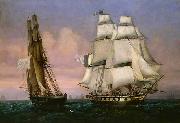 |
Ambroise-Louis Garneray
|
|
(19 February 1783 - 11 September 1857) was a French corsair, painter and writer. He served under Robert Surcouf and Jean-Marie Dutertre, and was held prisoner by the British for eight years.
Garneray was born in Paris (on Rue Saint-Andre-des-arts, in the Latin Quarter) on 19 February 1783. He was the elder son of Jean-François Garneray (1755-1837), painter of the king, who was pupil of Jacques-Louis David. At thirteen, he joined the Navy as a seaman, encouraged by his cousin, Beaulieu-Leloup, commander of the frigate Forte ("the Stout one"). Garneray sailed from Rochefort to the Indian Ocean with the frigate division under Sercey, to which the Forte belonged.
Garneray took part in the various campaigns of Sercey division and witnessed the hardship it met in the battle against Arrogant and Victorious. He then served in 1798 on the corvette Brûle Gueule ("Mouth burner"), which patrolled with the frigate Preneuse ("the Taker"). Returning from this campaign, the Brûle Gueule and Preneuse were chased by a British squadron comprising two ships of the line, one frigate and one corvette; the French flew into a creek near Black River whose shallow waters prevented the British from pursuing. The next day, the British squadron attacked; the French had established strong defensive positions by installing the unusable batteries of their ships ashore, and repelled the British squadron.
In 1799, Garneray was promoted to quartermaster and "first painter of the edge" on the Preneuse under captain Jean-Marthe-Adrien l'Hermite. The frigate was the last French official force in the Indian Ocean. This patrol went into trouble, in spite of an exceptional combat against the British ship of the line the Jupiter. Returning to Mauritius, her crew suffered from scurvy, and the Preneuse had to be kept quarantined and had to return to the British forces making the blockade of the island. Garneray escaped captivity by regaining the coast with the stroke. In spite of the disaster, Garneray kept longstanding admiration and friendship for to Lhermitte, whom he would continue to visit until his death 1826.
Garneray: Capture of Kent by SurcoufFor lack of official ships, Garneray joined the Confiance ("the Trust") of Robert Surcouf as an ensign, from April at December 1800. He took part in the capturing and boarding the Kent in October 1800. It was the only time where Garneray made money as a sailor. Upon returning from patrol, he invested his share in a slave trading ship, l'Union, on which he was a first mate.
He sailed on various trading ships during the peace of Amiens, after which he served aboard the Pinson ("the Finch"), a cutter based in Île Bourbon. He replaced the commander when he died, and was shipwrecked shortly thereafter. He then served on the corsair Tigre du Bengale and eventually on the frigate Atalante attached to the squadron of Linois. He later served on the Belle Poule ("beautiful chick"), and was aboard when she was captured by the British in March 1806. Wounded, Garneray was led in England and spent the eight following years on prison hulks off Portsmouth (on the Protee, the Couronne ("Crown") and the Vengeance. He was able to improve his standard of living by selling paintings to a British merchant.
A statement attributed to him goes: "But for piracy, I believe that I practiced about all kinds of navigation".
|
|
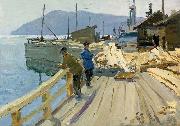 |
Anatoli Ilych Vasiliev
|
|
Anatoli Ilych Vasiliev (Russian: 18 March 1917, Petrograd (former Saint Petersburg), Russian Empire e June 4, 1994, Saint Petersburg, Russian Federation) was a Russian and Soviet realist painter, who lived and worked in Leningrad. He was a member of the Saint Petersburg Union of Artists (before 1992 named as the Leningrad branch of Union of Artists of Russian Federation), and regarded as one of the representatives of the Leningrad school of painting, most famous for his historical paintings and etudes done from nature.
|
|
 |
Anders Lunde
|
|
(1809- 1886 )
painted Italiensk Bjerglandskab. Parti fra omegnen af Subiaco
Anders Christian Lunde
|
|
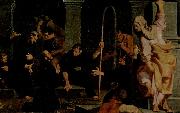 |
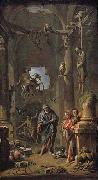
Andrea Lilio
|
|
Andrea Lilio (1555/1570 - after 1639) was an Italian painter born in Fano, not far from Ancona, hence he also is known as L'Anconitano.
Die Geschichte des Hl. NikolausHe painted mainly in his native city, as well as in Rome, where he was active from the beginning of the 17th century until around 1640. He was employed by Pope Sixtus V in the decoration of the library of the Vatican and in the decoration of the Scala Santa in San Giovanni Laterano. In the latter, he painted, Moses striking the Rock and Moses with the Brazen Serpent.
Said to have been a pupil of Federico Barocci, he painted in a Mannerist style, already outdated in Baroque Rome at the time. Nevertheless, Lilio created a popular niche for himself by painting allegories for aristocratic audiences. In fact, it is altogether possible that Lilio collaborated for the illustrations of Cesare Ripa's Iconologia, which was a popular source for such motifs for a very long time. He died at Ascoli Piceno.
In a chapel of the Chiesa Nuova, he painted The Archangel Michael driving fallen angels from Heaven. He continued to ornament churches and convents of Rome during the reign of Pope Clement VIII.
One of his masterpieces, the Martyrdom of Saint Lawrence, was painted for Santa Caterina in Ancona. He painted the Christ Washing the Feet of His Disciples for the nave of Santa Maria Maggiore in Rome. He also was part of the team active in the painting of the Sistine chapel (chapel of Nativity) in Santa Maria Maggiore. For the cathedral of Fano, he painted a picture of All Saints.
|
|
 |
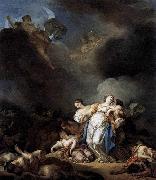
Andrea Locatelli
|
|
was an Italian painter of landscapes (vedute). 1695-1741
Born in Rome, he was the son and pupil of the painter Piero Locatelli, who had studied with the Florentine Ciro Ferri. He next apprenticed under Paolo Anesi, although his style and thematic is akin to that of Claude Lorrain, and depicts small mythologic figures although within a wild environment more similar to those of Salvator Rosa. He is also known as Andrea Lucatelli. Andrea excelled in painting vedute in a style reminiscent of Jan Frans van Bloemen, one of the Bamboccianti. One of his pupils was Joseph Vernet.
|
|
 |
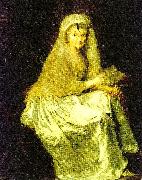
Anicet-Charles-Gabriel Lemonnier
|
|
French Painter, 1743-1824
|
|
 |
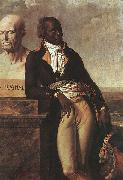
anna dorothea lisiewska therbusch
|
|
Lisiewski, Anna Dorothea (von) / Lisiewska-Therbusch, Anna Dorothea / Liszeswka, Anna Dorothea.
Anna Dorothea Therbusch (somtetimes Anna Dorothea Therbusch-Lisiewska, or Lisiervska/Lisziewska/Liesiewka (1721-1782) was a German painter.
|
|
 |
Anna Lea Merritt
|
|
American Pre-Raphaelite Painter, 1844-1930
English painter, muralist and printmaker of American birth. She is best known for her Victorian portraits, allegorical and religious paintings, landscapes and floral scenes and was successful in spite of the difficulties that she encountered as a professional woman artist working in Victorian England. After brief artistic tours to Florence, Dresden and Paris, where she studied in L?on Cogniet's atelier, she began intensive instruction in 1870 from Henry Merritt (1822-77), an Englishman who restored works of art from important collections and wrote on art, exhibitions and conservation. Anna Lea and Henry Merritt were married in July 1877; three months later he died. Love Locked out (1889; London, Tate), depicting love at the door of a tomb, was painted as a memorial to her husband.
|
|
 |
Anne-Louis Girodet de Roussy-Trioson
|
|
(also given as Anne-Louis Girodet de Roucy-Triosson, Anne-Louis Girodet-Trioson) January 5, 1767 - December 9, 1824), was a French painter and pupil of Jacques-Louis David, who was part of the beginning of the Romantic movement by adding elements of eroticism through his paintings. Girodet is remembered for his precise and clear style and for his paintings of members of the Napoleonic family.
|
|
 |
Anne-Louis Girodet-Trioson
|
|
1767-1824
French
Anne Louis Girodet Trioson Galleries
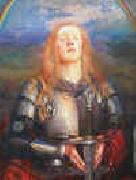
Girodet was born at Montargis. He lost his parents in early youth and the care of his inheritance and education fell to his guardian, M. Trioson, "medecin-de-mesdames," by whom he was in later life adopted and whose surname he took in 1812. He started in school by studying architecture and pursuing a military career. He later changed to the study of painting under a painter named Luquin, before entering the school of David. From 1789 to 1793 he lived in Italy where, at the age of twenty-two, he successfully competed for the Prix de Rome thus making a name for himself for his painting of the Story of Joseph and his Brethren. At Rome he painted his Hippocrate refusant les presents d'Artaxerxes and Endymion-dormant (presently held in the Louvre), work which was praised at the Salon of 1793.
|
|
 |
Annie Louise Swynnerton
|
|
British
1844-1933
|
|
 |
Anthonie Leemans
|
|
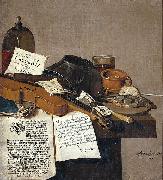
(1631, The Hague - 1673, Amsterdam), was a Dutch Golden Age painter.
According to Houbraken, who did not specify which brother he meant, he made a profitable living making trompe l'oeil paintings of hunting paraphernalia, birdcages, and weaponry.
According to the RKD he was the older brother of the painter Johannes Leemans, and both are known for still life paintings of hunting paraphernalia and vanitas pieces that became an influence on Christoffel Pierson for their popularity. Anthonie also painted a few Italianate landscapes with soldiers.
|
|
 |
Antoine Le Nain
|
|
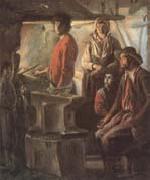
French Baroque Era Painter, ca.1600-1648,The three were born in Laon (Mathieu in 1607; Antoine and Louis were originally believed to have been born in 1588 and 1593, respectively, but those dates have since been disputed: they may have instead been born just before and just after 1600), and by 1630, all three lived in Paris. Because of the remarkable similarity of their styles of painting and the difficulty of distinguishing works by each brother (they signed their paintings only with their surname, and many may have been collaborations), they are commonly referred to as a single entity, Le Nain. Louis is usually credited with the best-known of their paintings, a series of scenes depicting peasant life. These genre paintings are often noted for being remarkably literal, yet sympathetic; the subjects are never grotesque or seem ridiculed. There remains some question, however, as to whether some of the assumed "peasants" were truly from the rural class--many seem to be simply the bourgeois at leisure in the country. The brothers also produced miniatures (mainly attributed to Antoine) and portraits (attributed to Mathieu). Mathieu became the official painter of Paris in 1633, and was made a chevalier. Antoine and Louis died in 1648. Mathieu lived until 1677. The Le Nain paintings had a revival in the 1840s and, thanks to the exertions of Champfleury, made their appearance on the walls of the Louvre in 1848.
|
|
 |
Antoine Leon Morel-Fatio
|
|
French, 1810-1871
|
|
 |
Antoine louis barye
|
|
French Romantic Sculptor and Painter, ca.1795-1875, He was a French sculptor most famous for his work as an animalier. Born in Paris, Barye began his career as a goldsmith, like many sculptors of the Romantic Period. After studying under sculptor Francois-Joseph Bosio and painter Baron Antoine-Jean Gros he was in 1818 admitted to the Ecole des Beaux Arts. But it was not until 1823, while working for Fauconnier, the goldsmith, that he discovered his true predilection from watching the wild beasts in the Jardin des Plantes, making vigorous studies of them in pencil drawings comparable to those of Delacroix, then modelling them in sculpture on a large or small scale. In 1831 he exhibited his "Tiger devouring a Crocodile", and in 1832 had mastered a style of his own in the "Lion and Snake." Thenceforward Barye, though engaged in a perpetual struggle with want, exhibited year after year these studies of animals--admirable groups which reveal him as inspired by a spirit of true romance and a feeling for the beauty of the antique, as in "Theseus and the Minotaur" (1847), "Lapitha and Centaur" (1848),
|
|
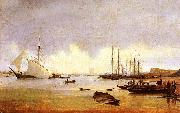 |
Anton Ivanov
|
|
painted Fishing Vessels off a Jetty in 1839
|
|
 |
Antoni Lange
|
|
(1863 - 17 March 1929) was a Polish poet, philosopher, polyglot (15 languages), writer, novelist, science-writer, reporter and translator. A representative of Polish Parnassianism and symbolism, he is also regarded as belonging to the Decadent movement. He was an expert on Romanticism, French literature and a popularizer of culture of Eastern cultures. He is famous for his novel Miranda.
He translated English, French, Hungarian, Italian, Spanish, Indian, American, Serbian, Egyptian and Oriental writers into Polish and Polish poets into French and English. He was also one of the most original poets of the Young Poland movement. His work is often compared to Stephane Mallarme and Charles Marie Rene Leconte de Lisle.
|
|
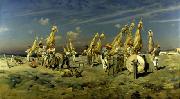 |
Antonino Leto
|
|
painted I Funari di Torre del Greco in 1883
|
|
 |
Antwerp of Leiden
|
|
ca.1500/50
|
|
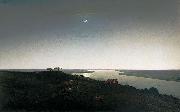 |
Archip Iwanowitsch Kuindshi
|
|
painted Nacht in ca. 1905e1908
|
|
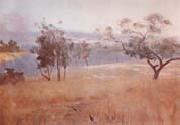 |
Arthur Loureiro
|
|
Australian, 1853-1932,Portuguese painter. He was a naturalist painter. His early training was at the Academia de Belas-Artes, Oporto, and in 1876 he went to Rome where he became a pupil of Francisco Pradilla Ortiz. In Italy he devoted himself to landscape painting. He exhibited in Paris at the Exposition Universelle (1878) and in the Sociedade Promotora de Belas-Artes in Lisbon (1880). In 1879 he was given a scholarship to go to Paris, where he stayed from 1880 to 1883.
|
|
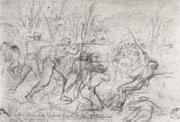 |
Arthur Lumley
|
|
1837-1912
|
|
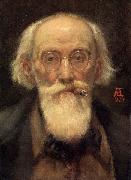 |
Artur Loureiro
|
|
painted Auto-Retrato in 1925
|
|
 |
August Ludwig Erhard Boll
|
|
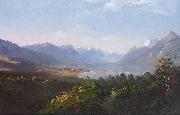
painted Blick auf den Genfer See in 1852
|
|
 |
Auguste Leveque
|
|
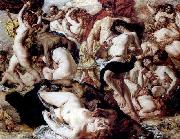
(b. Nivelles, Walloon Brabant 1866 - d. Saint-Josse-ten-Noode, 1921) is a Belgian painter influenced both by realism and symbolism. Leveque was also a sculptor, poet and art theoretician.
He studied under Jean-François Portaels at the Academie Royale des Beaux-Arts in Brussels, and received the Prix Godecharle for his painting Job in 1890.
Leveque was a member of the "Salon d'Art Idealiste", formed by Jean Delville in Brussels in 1896, which is considered the Belgian equivalent to the Parisian Rose & Cross Salon. Other members of the group were Leon Frederic, Albert Ciamberlani, Constant Montald, Emile Motte, Victor Rousseau, Armand Point and Alexandre Seon. The Salon was abandoned in 1898.
|
|
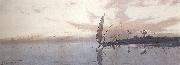 |
augustus osborne lamplough,r.w.s
|
|
1877-1930
|
|
 |
Axel Lindman
|
|
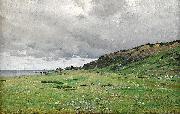
painted Coastal Landscape, Normandie in 1877
|
|
 |
B. Le Coffre
|
|
|
|
 |
BACKHUYSEN, Ludolf
|
|
Dutch Baroque Era Painter, ca.1631-1708
Ludolf Backhuysen (or Bakhuizen) (Dec 28, 1630 - Nov 17, 1708) was a Dutch painter, born in Emden, Hanover.
Bakhuysen started his career as a bookkeeper. He had a very nice handwriting and loved arithmetic. Working for a wealthy merchant at Amsterdam, he discovered so strong a genius for painting that he relinquished the business and devoted himself to art. He studied first under Allart van Everdingen and then under Hendrik Dubbels, two eminent masters of the time, and soon became celebrated for his sea-pieces.
He was an ardent student of nature, and frequently exposed himself on the sea in an open boat in order to study the effects of storms. His compositions, which are numerous, are nearly all variations of one subject, the sea, and in a style peculiarly his own, marked by intense realism or faithful imitation of nature. In his later years Backhuysen employed his skills in etching and calligraphy.
During his life Backhuysen was visited by Cosimo III de' Medici and Peter the Great. In 1699 he opened a gallery on the topfloor of the famous Amsterdam townhall. After a visit to England he died in Amsterdam on November 17, 1708.
|
|
 |
BASSANO, Leandro
|
|
Italian Mannerist Painter, 1557-1622
Son of Jacopo Bassano. He entered the workshop of his father when very young and soon developed a style of painting strongly based on drawing. Leandro used fine brushwork, with cool, light colours, smoothly applied in well-defined areas, unlike his father, who painted with dense and robust brushstrokes. From 1575 Leandro's participation in the workshop increased, and he became his father's principal assistant after Francesco Bassano il giovane moved to Venice in 1578.
|
|
 |
BASTIANI, Lazzaro
|
|
Italian painter, Venetian school (b. 1449, Venezia, d. 1512, Venezia)
Italian painter. He is first recorded in 1449, as a painter in Venice and in 1460 he was paid for an altarpiece in S Samuele there. Although no extant work is securely documented, several are signed and two are dated. The influence of Andrea del Castagno is clear in his early works, of the 1460s: the signed mosaic of St Sergius (Venice, S Marco), the Archangel Gabriel (Padua, Mus. Civ.) and the signed Piet? (Venice, S Antonino). Also assigned to this period are the Adoration of the Magi (New York, Frick), the polyptych of St Francis (Matera, S Francesco), the St Jerome.
|
|
 |
BAUGIN, Lubin
|
|
French painter. He became a master in the painters' guild of Saint-Germain-des-Pr?s in 1629. From c. 1636 he was in Italy, but he is known to have been in Paris again in 1641; in 1645 he became a member of the Acad?mie de St Luc, and in 1651 he was also a member of the Acad?mie Royale after the temporary amalgamation of the two institutions. Like many of his generation he was deeply influenced by the art of the Fontainebleau school. The Mannerist tendency of his style
|
|
|
|
|
|
|
|
|
| Wholesale China Oil Painting Wholesale Oil Painting China Xiamen Portrait Reproduction on canvas Chinese Oil Painting Wholesale USA Oil Painting |
|
|
|
|


