|

|
|
| |
|
China Oil Painting Direct
|
|
100% hand painted, 100%
cotton canvas,
100% money back if not satisfaction.
|
|
|
|
ART WORKS
INDEX
A B C D E F G H I J K L M N O P Q R S T U V W X Y Z
|
|
ARTISTS
INDEX
A B C D E F G H I J K L M N O P Q R S T U V W X Y Z
|
|
|
|
 |
ABBATE, Niccolo dell 
|
|
Italian Mannerist Painter, ca.1512-1571
Italian painter. He was trained in Modena and developed his mature style under the influence of his contemporaries Correggio and Parmigianino in Bologna (1544 ?C 52). There he painted portraits and decorated palaces with frescoes of landscapes and figure compositions in the Mannerist style. In 1552 he was invited by Henry II of France to work under Primaticcio at the Palace of Fontainebleau, where he executed immense murals (most now lost). He remained in France the rest of his life. His mythological landscapes were a principal source of the French Classical landscape tradition, and he was a precursor of Claude Lorrain and Nicolas Poussin.
|
|
 |
Abraham Diepraam
|
|
1622-1670
Dutch
Abraham Diepraam Location
|
|
 |
Abraham Jansz Van Diepenbeeck
|
|
1596-1675, Flemish glass-painter, draughtsman, painter and tapestry designer. His reputation rests primarily on his drawings and oil sketches, of which several hundred survive, intended mainly as designs for stained-glass windows and prints. He was strongly influenced by the work of other important Flemish artists of the late 16th century and early 17th, notably Rubens, whose motifs and stylistic elements he frequently reworked in his own compositions.
|
|
 |
Abraham van den Tempel
|
|
(1622?C1672) was a Dutch Golden Age painter.
He probably learned painting from his father, also a painter, but who died when he was still quite young, in 1636. That is the same year that he moved to Amsterdam, where he stayed until 1647, whereupon he moved to Leiden. According to Houbraken he was the son of a Mennonite preacher in Leeuwarden who was a respected art teacher. His father was Lambert Jacobsz (or Jacobszoon), who had taught Govert Flinck and Jacob Adriaensz Backer in their youth, both of whom were artists from Mennonite families. Abraham took the name Tempel because when he studied in Leiden, he lived in a house there with a relief of a Tempel in the keystone. He became a pupil of Jacob Backer, and studied mathematics at Leiden University. He met with great success with the Leiden city council, earning several generous commissions, including a series of three large allegorical paintings on the cloth industry of Leiden for the Cloth Hall which still hang in their original place today in the Stedelijk Museum De Lakenhal.
Sir William Davidson of Curriehill, Conservator of the Cloth Staple at Veere (with his son Charles), 1664.He became master of the Guild of St. Luke in 1657 and in 1659 he was chartermaster. In 1660 he returned to Amsterdam. His pupils were Frans van Mieris the Elder, Carel de Moor, Michiel van Musscher, Ary de Vois, and Isaac Paling
|
|
 |
Adam Elsheimer
|
|
1578-1610
German
Adam Elsheimer Locations
German painter, printmaker and draughtsman, active in Italy. His small paintings on copper established him after his brief life as the most singular and influential German artist to follow Derer. Their grand conception in terms of monumental figures and poetic landscape and their meticulous, miniature-like execution were admired by Rubens and came to influence many 17th-century artists, including Rembrandt. Most were produced in Rome after 1600: the limits of this oeuvre and its chronology are extremely hard to establish.
|
|
 |
Adam Frans van der Meulen
|
|
painted Louis XIV before Strasbourg in 1682
|
|
 |
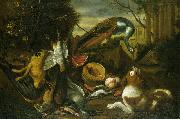
Adriaan de Lelie
|
|
was born at Tilburg in 1755, and was a scholar of Peeters, a painter of tapestries and ornaments, and afterwards of Quertenmont at Antwerp. He made copies of many of the portraits by Rubens and Van Dyck at Desseldorf, and also of historical pictures by Italian and Dutch masters. By the advice of Professor Camper, he established himself at Amsterdam, where he painted a great number of portraits and cabinet pictures; among the latter is one of the celebrated amateur Jan Gildemeester showing his collection to a party of ladies and gentlemen, in which the principal pictures are readily recognised. One of his best works is that representing the 'Drawing Academy' of the Felix Meritis Society at Amsterdam. His pictures are highly esteemed in Holland and Germany, where they are to be met with in the best collections. He died at Amsterdam in 1820.
|
|
 |
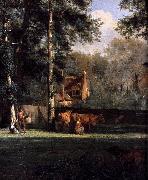
Adriaen de Gryef
|
|
Belgium (1670-1715 ) - Painter
|
|
 |
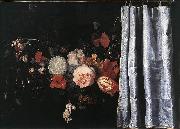
Adriaen van de Velde
|
|
(bapt. 30 November 1636, Amsterdam - bur. 21 January 1672, Amsterdam), was a Dutch animal and landscape painter, son of Willem van de Velde the Elder and brother of Willem van de Velde the Younger, the marine painter.
Adriaen did not want to become a marine painter so he was trained in the studio of Jan Wynants, the landscape painter. There he made the acquaintance of Philip Wouwerman, who is believed to have aided him in his studies of animals, and to have exercised a powerful and beneficial influence upon his art. Having made exceptionally rapid progress, he was soon employed by his master to introduce figures into his landscape compositions, and he rendered a similar service to Hobbema, Ruysdael, Verboom and other contemporary artists. According to Houbraken, he died while in collaboration with Jan van der Heyden and Frederik de Moucheron, painting animals on their paintings.[1]
His favourite subjects were scenes of open pasture land, with sheep, cattle and goats, which he executed with dexterity, with much precision of touch and truth of draughtsmanship, and with clear silvery colouring. He painted a few small winter scenes with skaters, and several religious subjects, such as the Descent from the Cross, for a Roman Catholic hidden church in Amsterdam.
In addition to his paintings, of which nearly two hundred have been catalogued, he executed about twenty etchings, several of which appear from their dates to have been done in his fourteenth year. They are distinguished by directness of method and by delicacy and certainty of touch. Van de Velde lived in Kalverstraat, near the Regulierspoort.
|
|
 |
Adriaen van der Spelt
|
|
Adriaen van der Spelt (ca. 1630, Leiden - 1673, Gouda), was a Dutch Golden Age flower painter.
According to Houbraken, whose comments were based on the Gouda stories by Ignatius Walvis, he was an excellent flower painter born in Leiden, but his parentage was from Gouda. He spent many years at the court of Brandenburg working for Frederick William I, Elector of Brandenburg, but moved to Gouda to marry a third time with a nasty wife from Groningen who drove him to his grave.
According to the RKD he was a flower painter who spent the years 1664-1670 at the court of Brandenburg.
|
|
 |
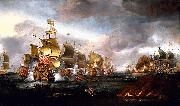
Adriaen van der werff
|
|
Dutch Baroque Era Painter, 1659-1722
Dutch painter and draughtsman. He was apprenticed to the portrait painter Cornelis Picolet (1626-79) from 1668 to 1670 and then from c.1671 to 1676 to Eglon van der Neer in Rotterdam. From 1676 van der Werff produced small portraits and genre paintings as an independent master; the Cook and Hunter at a Window (1678; New York, priv. col.; see Gaethgens, no. 2) and Man and Woman Seated at a Table (1678; St Petersburg, Hermitage) perpetuate the thematic and stylistic traditions of Gerrit Dou, Gabriel Metsu, Frans van Mieris and Gerard ter Borch (ii) but are distinguished by their greater elegance and richness of costume and interior. Van der Werff's portraits date mainly from the years 1680-95 (e.g. Two Children with a Guinea-pig and a Kitten (1681; London, Buckingham Pal., Royal Col.)). The motif of children with animals recalls van der Neer, while the careful depiction of fabrics recalls the Leiden school of 'Fine' painters. His Portrait of a Man in a Quilted Gown (1685; London, N.G.) resembles compositions by Caspar Netscher and Nicolaes Maes: a figure leaning against a balustrade, before a landscape. Van der Werff's work is, however, more elegant, in part because of the depiction of fabrics
|
|
 |
Adriaen Van Diest
|
|
was born at the Hague in 1655. He was the son of Jeronymus van Diest, a painter of sea-pieces, by whom he was instructed in the art. When he was seventeen years of age he came to London, and was employed by Granville, Earl of Bath, for whom he painted several views and ruins in the west of England. He also painted portraits, but did not meet with much encouragement, although his pictures, particularly his landscapes, possess considerable merit; as a proof of which Horace Walpole states that there were seven pictures by Van Diest in Sir Peter Lely's collection. He etched several landscapes from his own designs, in a slight, masterly style. Van Diest died in London in 1704. Unfortunately for his reputation, he is generally known by his worst pictures, which are frequently found in old houses, on wainscots, or over doors, and are executed in a hasty manner, with much mountainous background. His better pictures have changed their name.
|
|
 |
Adrien Dauzats
|
|
French Academic Painter, 1804-1868,French painter, illustrator and writer. His early training was as a theatrical scene painter and a designer of lithographic illustrations. In Bordeaux he studied with Pierre Lacour (ii) (1778-1859) and worked with Thomas Olivier (1772-1839), chief scene designer at the Grand-Thetre. He subsequently studied in Paris in the studio of the landscape and history painter Julien-Michel Gue (1789-1843) and worked for the decorators of the Thetre Italien.
|
|
 |
Aert de Gelder
|
|
Dutch
1645-1727
Dutch painter and draughtsman. He was the son of a wealthy Dordrecht family and probably became a pupil of Samuel van Hoogstraten in 1660. Apparently on the advice of van Hoogstraten, de Gelder moved to Amsterdam and entered Rembrandt workshop, possibly c. 1661. It is commonly assumed that he stayed there about two years. He was Rembrandt last pupil. After completing his apprenticeship, de Gelder returned to Dordrecht, where he worked for the rest of his long career. Considering that de Gelder was active for more than half a century, his output of just over 100 paintings seems low, probably because he was financially independent. Of those paintings accepted as by him, only 22 are dated, creating considerable problems in establishing a chronology.
|
|
 |
Aert van der Neer
|
|
1603-1677
Dutch
Although generally known by the name of Aert, he usually signed himself Aernout. According to Houbraken, van der Neer spent his youth in Arkel near Gorinchem (Gorkum), a town on the river Waal, east of Dordrecht, where he worked as a majoor (steward) for the lords of Arkel. He became an amateur painter, possibly as a result of his contact with the Camphuyzen brothers Rafael Govertsz. (1597/8-1657) and Jochem Govertsz. (1601/2-59). Aert married Lysbeth Govertsdr (Liedtke) who was almost certainly Rafael and Jochem sister. Rafael acted as witness at the baptism of their daughter Cornelia in 1642. Around 1632 van der Neer and his wife moved to Amsterdam where, in about 1634, their eldest son, Eglon, was born.
|
|
 |
After Jan de Baen
|
|
Jan de Baen (20 February 1633 - 1702) was a Dutch portrait painter who lived during the Dutch Golden Age. He was a pupil of the painter Jacob Adriaensz Backer in Amsterdam from 1645 to 1648. He worked for Charles II of England in his Dutch exile, and from 1660 until his death he lived and worked in The Hague. His portraits were popular in his day, and he painted the most distinguished people of his time.
|
|
 |
Agustin Riancho Y Gomez De Porras
|
|
Spanish , Entrambasmestas, Cantabria 1841 - Ontaneda, Cantabria 1929.
|
|
 |
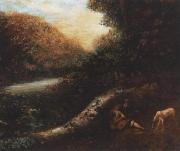
Akfred Diwning Fripp,RWS
|
|
1822-1895
|
|
 |
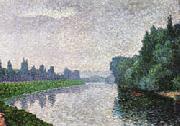
Albert de Balleroy
|
|
(1828 -1873 ) - Painter
|
|
 |
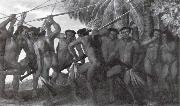
Albert Dubois-Pillet
|
|
French, 1846-1890.was a French painter and army officer. He graduated from the École Imp??riale Militaire at Saint-Cyr in 1867. He fought the Franco-Prussian War, during which he was made prisoner by the Germans. He started painting after the war, inspired by the Neoimpressionists.
|
|
 |
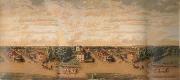
Albert van der Eeckhout
|
|
Dutch, born circa 1610-1666
|
|
 |
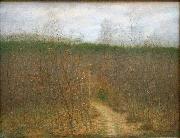
Albertus Del Orient Browere
|
|
American, 1814-1887
|
|
 |
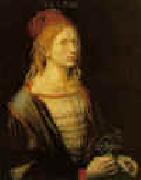
Albijn Van den Abeele
|
|
painted Coppice at Sint-Martens-Latem in 1898
|
|
 |
Albrecht Durer
|
|
b.May 21, 1471, Imperial Free City of Nernberg [Germany]
d.April 6, 1528, Nernberg
Albrecht Durer (May 21, 1471 ?C April 6, 1528) was a German painter, printmaker and theorist from Nuremberg. His still-famous works include the Apocalypse woodcuts, Knight, Death, and the Devil (1513), Saint Jerome in his Study (1514) and Melencolia I (1514), which has been the subject of extensive analysis and interpretation. His watercolours mark him as one of the first European landscape artists, while his ambitious woodcuts revolutionized the potential of that medium. D??rer introduction of classical motifs into Northern art, through his knowledge of Italian artists and German humanists, have secured his reputation as one of the most important figures of the Northern Renaissance. This is reinforced by his theoretical treatise which involve principles of mathematics, perspective and ideal proportions.
His prints established his reputation across Europe when he was still in his twenties, and he has been conventionally regarded as the greatest artist of the Renaissance in Northern Europe ever since.
|
|
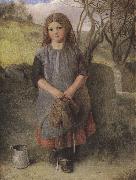 |
Alexander Davis cooper
|
|
fl.1837-1888
|
|
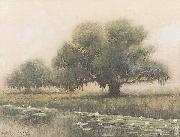 |
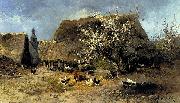
Alexander John Drysdale
|
|
painted Louisiana Live Oaks Audubon Park in
|
|
 |
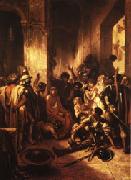
Alexandre Defaux
|
|
(1826-1900) was a French artist. He was born in Bercy and studied under Jean-Baptiste Camille Corot. He was a member of the Barbizon School.
|
|
 |
Alexandre Gabriel Decamps
|
|
French Romantic Painter, 1803-1860.
Studied under Abel de Pujol.
Specializes in Orientalism.
Studied under Abel de Pujol. Specializes in Orientalism. French genre and historical painter, engraver, and lithographer. First known for his caricatures and illustrations, he turned to painting in thick impasto and strong color. One of his richest sources was the Middle East, which he depicted in vivid detail.
|
|
 |
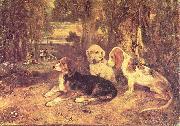
Alexandre-Denis Abel de Pujol
|
|
French, 1787-1861
|
|
 |
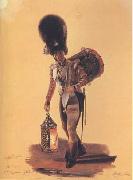
Alexandre-Gabriel Decamps
|
|
(March 3, 1803 - August 22, 1860) was a French painter.
He was born in Paris. In his youth he travelled in the East, and reproduced Oriental life and scenery with a bold fidelity to nature that puzzled conventional critics. His powers, however, soon came to be recognized, and he was ranked along with Delacroix and Vernet as one of the leaders of the French school. At the Paris Exhibition of 1855 he received the grand or council medal. Most of his life was passed in the neighborhood of Paris. He was fond of animals, especially dogs, and indulged in all kinds of field sports. He died in 1860 in consequence of being thrown from a horse while hunting at Fontainebleau.
Decamps' style was characteristically and intensely French. It was marked by vivid dramatic conception, bold and even rough brushstrokes, and startling contrasts of color and of light and shade. His subjects embraced an unusually wide range. He availed himself of his travels in the East in dealing with scenes from Scripture history, which he was probably the first of European painters to represent with their true and natural local background. Of this class were his Joseph sold by his Brethren, Moses taken from the Nile, and his scenes from the life of Samson, nine vigorous sketches in charcoal and white.
Perhaps the most impressive of his historical pictures is Defeat of the Cimbri, representing the conflict between a horde of barbarians and a disciplined army. Decamps produced a number of genre pictures, chiefly scenes from French and Algerian domestic life, the most marked feature of which is humour. The same characteristic attaches to many of his numerous animal paintings; Decamps was especially fond of painting monkeys. His well-known painting The Monkey Connoisseurs satirizes the jury of the French Academy of Painting, which had rejected several of his earlier works on account of their divergence from any known standard.
|
|
 |
Alexandre-Jean Dubois
|
|
1694 - 1763
|
|
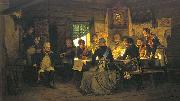 |
Alexey Danilovich Kivshenko
|
|
painted Michail Illarionovich Kutuzov in 1880
|
|
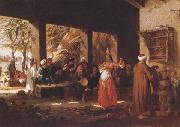 |
Alfred Darjou
|
|
1832-1874
|
|
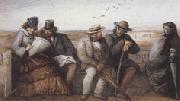 |
Alfred de breanski
|
|
1852-1928
|
|
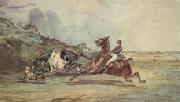 |
Alfred de Dreux
|
|
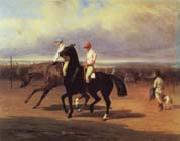
1810 - 1860
|
|
 |
Alfred Dedreux
|
|
1810-1860,French painter and draughtsman. His father was the architect Pierre-Anne Dedreux (1788-1849); Alfred's sister, Louise-Marie Becq de Fouqui?res (1825-92), was also an artist. His uncle, Pierre-Joseph Dedreux-Dorcy (1789-1874), a painter and intimate friend of Gericault, took Dedreux frequently to the atelier of Gericault whose choice of subjects, especially horses, had a lasting influence on him. During the 1820s he studied with L?on Cogniet, although his early style was more influenced by the work of Stubbs, Morland, Constable and Landseer, exposure to which probably came through Gericault and the painter Eugene Lami who lived in London in the mid-1820s.
|
|
 |
Alfred Dehodencq
|
|
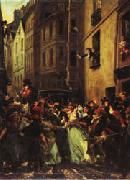
French Painter. Paris 1822 - Paris 1882. Specializes in Orientalism. French painter born in Paris. Well known for his vivid oil paintings depicting slices of life in the world around him. During his early years , Dehodencq studied in Paris at the Ecole des Beaux Arts under the tutelage of famous French artist Leon Cogniet. Following the French revolution of 1848 he spent five years in Spain where he became acquainted with the works of Spanish painters Diego Vel??zquez and Francisco Goya which had a strong influence on his approach to painting. In 1853 he travelled to Morocco where for the following ten years he produced many of his most famous paintings depicting scenes of the world he encountered. While he considered himself to be a 'Last of the Romantics', his work is generally categorized in the mid 19th century realists artistic movement. Dehodencq was the first foreign artist known to have lived in Morocco for an extended number of years. He returned to Paris in 1863. He died in 1882
|
|
 |
Alphonse-Marie-Adolphe de Neuville
|
|
(31 May 1835 - 18 May 1885) was a French Academic painter who studied under Eugene Delacroix. His dramatic and intensely patriotic subjects illustrated episodes from the Franco-Prussian War, the Crimean War, the Zulu War and portraits of soldiers. Some of his works have been collected by the Hermitage Museum in St. Petersburg and by the Metropolitan Museum in New York.
The Last Cartridges, 1873
The Defence of Rorke's Drift, oil on canvas painting by Alphonse-Marie-Adolphe de Neuville, 1880, Art Gallery of New South Wales. This incident occurred on 22 January 1879, in the Anglo-Zulu War.
La bataille de VillersexelHe was born to wealthy parents at Saint-Omer, Pas-de-Calais. From school he went to college, where he took his degree of bachelier -lettres. In spite of the opposition of his family he entered the naval school at Lorient, and it was there, in 1856, that his artistic instincts first declared themselves.
After being discouraged by several painters of repute, he was admitted to work in François-Edouard Picot's studio. He did not remain there long, and he was painting by himself when he produced his first picture, The Fifth Battalion of Chasseurs at the Gervais Battery (Malakoff). In 1860 Neuville painted an Episode of the taking of Naples by Garibaldi for the Artists' Club in the rue de Provence, and sent to the Paris Salon in 1861 The Guard Chasseurs in the Trenches of the Mamelon Vert.
He participated in illustrating the Hetzel editions of Twenty Thousand Leagues Under the Sea. He also illustrated Le Tour du monde and Guizot's History of France. At the same time he painted a number of remarkable pictures: The Attack in the Streets of Magenta by Zouaves and the Light Horse (1864), A Zouave Sentinel (1865), The Battle of San Lorenzo (1867), and Dismounted Cavalry crossing the Tchernaia (1869). In these he showed peculiar insight into military life, but his full power was not reached until after the Franco-Prussian War. He then aimed at depicting in his works the episodes of that war, and began by representing the Bivouac before Le Bourget (1872). His fame spread rapidly, and was increased by The Last Cartridges (1873), memorializing an episode involving the Blue Division of the French marines, in which it is easy to discern the vast difference between the conventional treatment of military subjects, as practised by Horace Vernet, and that of a man who had lived the life that he painted.
In 1874 the Fight on a Railroad was not less successful, and was followed by the Attack on a House at Villersexel (1875) and the Railway Bridge at Styring (1877). In 1878 the painter exhibited (not at the Great Exhibition) Le Bourget, the Surprise at Daybreak, The Intercepted Despatch-bearer, and a considerable number of drawings. He also exhibited in London some episodes of the Zulu War. Fifty thousand people paid to see his impression of The Defence of Rorke's Drift (1880), which the infant Art Gallery of New South Wales in Sydney paid a large sum to acquire.
In 1881 he was made an officer of the Legion d'honneur for The Cemetery of Saint-Privat and The Despatch-bearer and the "Huns in the Battle of Chalon." During these years Neuville was at work with Édouard Detaille on an important though less artistic work, The Panorama of Rezonville. Neuville died in Paris on May 18, 1885. At the sale of his works the state purchased for the Palais du Luxembourg the Bourget and the Attack on a Barricaded House, with a water-color The Parley, and a drawing of a Turco in Fighting Trim.
|
|
 |
ALSLOOT, Denis van
|
|
Flemish painter (b. 1570, Mechlin, d. 1628, Bruxelles)
He initially painted using the style of Gillis van Coninxloo, but after 1610 gradually developed a style of his own. This style can be seen in paintings such as The feast of the Ommegang (Museo del Prado, Madrid) and Procession to Mary at the Zavel in Brussels (Victoria and Albert Museum, London).
At the beginning of the 17th century, in either 1600 or 1606, his career rose when he served as court painter to Albert and Isabella.
Hendrick de Clerck painted sometimes the people in his works.
Van Alsloot's work can be regarded as a precursor to modern Landscape art.
|
|
 |
ALTICHIERO da Zevio
|
|
Italian Gothic Era Painter, ca.1330-1390
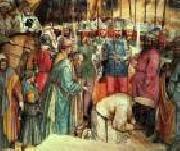
Altichiero da Verona (also called Aldighieri da Zevio; c. 1330 ?C c. 1390) was an Italian painter of the Gothic style. A follower of Giotto, Altichiero is credited with founding the Veronese school. He worked in Verona and Padua ?? works by him survive in the church of Sant'Anastasia in Verona and in the basilica of Sant'Antonio and the Oratorio di San Giorgio in Padua (where the credit for the work has been generally shared with Jacopo d'Avanzi, about whom little is known).
Altichiero was probably born somewhere near Zevio. He became an important member of the della Scala's household, and around 1364 painted a series of frescoes based upon Flavius Josephus's The Wars of the Jews at the della Scala palace of Sala del Podest??.
There are frescoes by him in the Basilica of Saint Anthony of Padua. In conjunction with D'Avanzo Veronese, he frescoed the chapel of St. James for which he was paid 792 ducats. The first seven frescoes on the life of St. James the Elder were by Altichiero.
|
|
 |
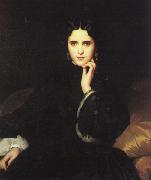
Amalia del Pilar de Borbon
|
|
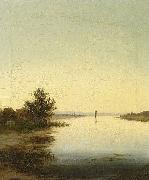
painted Abendliche Chiemseelandschaft in
|
|
 |
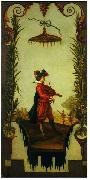
Amaury-Duval, Eugene-Emmanuel
|
|
French Academic Painter, 1808-1885
|
|
 |
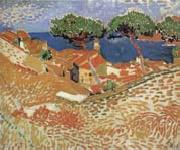
Andien de Clermont
|
|
Andien de Clermont (d.1783) was a French artist who worked in England in the 18th century (ca.1716-1756). He was particularly known for his decorative flower paintings in the Rococo style, and for "singeries, chinoiseries, and turqueries." He decorated interiors at Kirtlington Park, Langley Hall, Wentworth Castle, Wilton House, and "the second earl of Strafford's (now destroyed) dining room at No. 5 St. James's Square, London."
|
|
 |
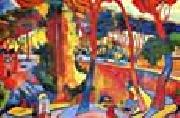
Andre Derain
|
|
French Fauvist Painter and Sculptor.1880-1954
|
|
 |
Andre Derain Prints
|
|
French
1880-1954
French painter and co-founder of Fauvism with Henri Matisse.
Biography The Turning Road, L Estaque (1906), The Museum of Fine Arts, HoustonAndre Derain was born in 1880 in Chatou, Yvelines, Lle-de-France, just outside Paris. In 1898, while studying to be an engineer at the Acad??mie Camillo, he attended painting classes under Eugene Carriere, and there met Matisse. In 1900, he met and shared a studio with Maurice de Vlaminck and began to paint his first landscapes. His studies were interrupted from 1901 to 1904 when he was conscripted into the French army. Following his release from service, Matisse persuaded Derain parents to allow him to abandon his engineering career and devote himself solely to painting; subsequently Derain attended the Acad??mie Julian.
Derain and Matisse worked together through the summer of 1905 in the Mediterranean village of Collioure and later that year displayed their highly innovative paintings at the Salon d Automne. The vivid, unnatural colors led the critic Louis Vauxcelles to derisively dub their works as les Fauves, or the wild beasts, marking the start of the Fauvist movement. In March 1906, the noted art dealer Ambroise Vollard sent Derain to London to compose a series of paintings with the city as subject. In 30 paintings, Derain put forth a portrait of London that was radically different from anything done by previous painters of the city such as Whistler or Monet. With bold colors and compositions, Derain painted multiple pictures of the Thames and Tower Bridge. These London paintings remain among his most popular work.
|
|
 |
ANDREA DA FIRENZE
|
|
Italian Gothic Era Painter, ca.1343-1377
|
|
 |
ANDREA DA MURANO
|
|
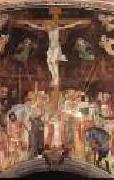
Italian painter, Venetian school (known 1462-1502)
Italian painter. He is first recorded working as a gilder at S Zaccaria, Venice, in 1463-5. He was one of a number of artists from the island of Murano. Among these he is closest to Bartolomeo Vivarini, whose pupil he may have been. The two collaborated in 1468 on a narrative canvas (destr.) for the Scuola di S Marco, Venice, which probably depicted scenes from the Life of Abraham. The rather harsh sculptural quality of his forms owes much to the influence of Mantegna and Donatello in Padua, and his work has often been associated (and sometimes confused) with that of Andrea del Castagno. He did not, however, ignore the more recent developments of Giovanni Bellini. His triptych depicting SS Vincent Ferrer, Roch, Sebastian and Peter Martyr, with a lunette of the Madonna of Mercy and Four Saints (Venice, Accad.), probably painted in the late 1470s, shows a real concern with light and colour. By the mid-1480s Andrea had settled in Castelfranco on the mainland, chiefly painting altarpieces in the (by then well established) Venetian sacra conversazione form. The altarpiece (1484-1502) in the parish church at Trebaseleghe, nr Padua, is a variation on the form, with Christ embracing the plague saints Sebastian and Roch above and other saints and musicians below, all showing the high degree of expression characteristic of his works. It is one of his finest paintings and also perhaps the most expensive Venetian altarpiece of its day. The altarpiece depicting the Virgin Enthroned with SS Peter, Nicholas of Bari, John the Baptist and Paul (1502; Mussolente, Santuario della Madonna dell' Acqua) is typical of Andrea's work and shows both the strengths and limitations of his art: firm draughtsmanship and expressive qualities combined with a rather conservative composition and somewhat ungainly figures.
|
|
 |
Andrea del Castagno
|
|
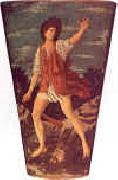
Italian
c1421-1457
Andrea del Castagno Location
Italian
c1421-1457
Andrea del Castagno Location
Italian painter. He was the most influential 15th-century Florentine master, after Masaccio, of the realistic rendering of the figure and the representation of the human body as a three-dimensional solid by means of contours. By translating into the terms of painting the statues of the Florentine sculptors Nanni di Banco and Donatello, Castagno set Florentine painting on a course dominated by line (the Florentine tradition of disegno), the effect of relief and the sculptural depiction of the figure that became its distinctive trait throughout the Italian Renaissance, a trend that culminated in the art of Michelangelo.
|
|
 |
Andrea del Sarto
|
|
b.July 16, 1486, Florence
d.Sept. 28, 1530, Florence
Italian Andrea del Sarto Galleries
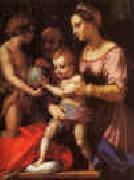
Andrea del Sarto (1486 ?C 1531) was an Italian painter from Florence, whose career flourished during the High Renaissance and early-Mannerism. Though highly regarded by his contemporaries as an artist "senza errori" (i.e., faultless), he is overshadowed now by equally talented contemporaries like Raphael.
Andrea fell in love with Lucrezia (del Fede), wife of a hatter named Carlo, of Recanati; the hatter dying opportunely, Andrea married her on 26 December 1512. She has come down to us in many a picture of her lover-husband, who constantly painted her as a Madonna and otherwise; even in painting other women he made them resemble Lucrezia. She was less gently handled by Giorgio Vasari, a pupil of Andrea, who describes her as faithless, jealous, and vixenish with the apprentices; her offstage character permeates Robert Browning's poem-monologue "Andrea del Sarto called the 'faultless painter'" (1855) .
He dwelt in Florence throughout the memorable siege of 1529, which was soon followed by an infectious pestilence. He caught the malady, struggled against it with little or no tending from his wife, who held aloof, and he died, no one knowing much about it at the moment, on 22 January 1531, at the comparatively early age of forty-three. He was buried unceremoniously in the church of the Servites. His wife survived her husband by forty years.
A number of paintings are considered to be self-portraits. One is in the National Gallery, London, an admirable half-figure, purchased in 1862. Another is at Alnwick Castle, a young man about twenty years, with his elbow on a table. Another youthful portrait is in the Uffizi Gallery, and the Pitti Palace contains more than one.
|
|
 |
Andrea del Verrocchio
|
|
Italian Early Renaissance Sculptor, ca.1435-1488
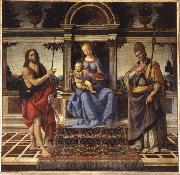
Florentine sculptor and painter, whose real name was Andrea di Michele di Francesco di Cioni. He was a leading figure in the early Renaissance, and his workshop was a center for the training of young artists in Florence. A virtuoso metalworker, Verrocchio was primarily concerned with the spirited rendering of movement and the elaboration of detail. Many of his paintings are lost. Of the remaining panels, his hand is evident in the Baptism of Christ (Uffizi), assisted by Leonardo da Vinci. In the Pistoia altarpiece he was aided by Lorenzo di Credi. Other attributions are Tobias and the Angel (National Gall., London), two paintings of the Madonna and Child (National Gall., London; Berlin), and a Crucifixion with Saints (Argiano). Most of Verrocchio's achievements in sculpture have survived. His earlier work includes the bold group Incredulity of St. Thomas (Orsanmichele). In 1472 he designed the tombs of Piero and Giovanni de' Medici (San Lorenzo). In the same period he created the graceful Boy with a Dolphin and a lithe portrayal of David (Bargello). He went to Venice (c.1480) to work on the equestrian monument of the condottiere Bartolomeo Colleoni.
|
|
|
|
|
|
|
|
|
| Wholesale China Oil Painting Wholesale Oil Painting China Xiamen Portrait Reproduction on canvas Chinese Oil Painting Wholesale USA Oil Painting |
|
|
|
|


