|

|
|
| |
|
China Oil Painting Direct
|
|
100% hand painted, 100%
cotton canvas,
100% money back if not satisfaction.
|
|
|
|
ART WORKS
INDEX
A B C D E F G H I J K L M N O P Q R S T U V W X Y Z
|
|
ARTISTS
INDEX
A B C D E F G H I J K L M N O P Q R S T U V W X Y Z
|
|
|
|
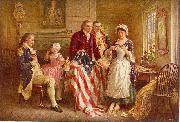 |
Jean Leon Gerome Ferris 
|
|
(August 18, 1863 - March 18, 1930) was an American painter best known for his series of 78 scenes from American history, entitled The Pageant of a Nation, the largest series of American historical paintings by a single artist.
He was born in Philadelphia, Pennsylvania, the son of Stephen James Ferris, a portrait painter and a devotee of Jean-L??on G??rôme (after whom he was named) and Mariano Fortuny.He grew up around art, having been trained by his father and having two acclaimed painters, Edward Moran and Thomas Moran, as uncles.
Ferris enrolled in the Pennsylvania Academy of the Fine Arts in 1879 and trained further at the Acad??mie Julian beginning in 1883 under William-Adolphe Bouguereau.He also met his namesake G??rôme, who greatly influenced Ferris's decision to paint scenes from American history. As Ferris wrote in his unpublished autobiography, "[G??rôme's] axiom was that one would paint best that with which he is most familiar".
However, initially his subjects were Orientalist in nature, that movement having been in vogue when he was young. Some of his material was original, some of it took after Fortuny, but he was skilled enough, despite never having had any experience with Asia. In 1882, he exhibited a painting entitled Feeding the Ibis, which was valued at $600.
By 1895, Ferris had gained a reputation as a historical painter, and he embarked on his dream of creating a series of paintings that told a historical narrative. In 1898 he sold one of these, General Howe's Levee, 1777, but he later regretted it, realizing that such a series could not be complete if the separate paintings could not be kept together. As such, he never sold another one of those, but he did sell the reproduction rights to various publishing companies. This later would have the effect of greatly popularizing his work, as these companies made prints, postcards, calendars and blank-backed trade cards use in advertisements. Laminated cards of these works were still being sold as late as 1984.
The Landing of William PennThe paintings showed idealized portrayals of famous moments from American history, but were often historically inaccurate. The Landing of William Penn, for example, shows Penn being greeted at New Castle by American Indians who are clothed in the tradition of tribes from the Great Plains. In The First Thanksgiving 1621, the black outfits the Pilgrims are shown wearing are wrong, and the Wampanoag did not wear feathered war bonnets, nor would they have been sitting on the ground.
The complete series was shown at Independence Hall in Philadelphia from 1913 to 1930, then moved next door to Congress Hall. In later years it was shown in a number of locations, including the Smithsonian Institution, before being returned to the Ferris family.
|
|
 |
Jean Louis Voille
|
|
1744-1805
French
Jean Louis Voille
|
|
 |
Jean-Baptiste Lallemand
|
|
(1716-1803) was a French artist born in Dijon. He was mainly a painter and draftsman of landscapes and genre works. He sometimes signed himself Lallemant or Allemanus.After a stay in Italy, he went to Paris and became a member of the Academie de Saint-Luc. He died in Paris.
The Musee des Beaux-Arts de Dijon owns many of his works, including a drawing and a painting showing the Château de Montmusard. His works also feature in the collections of the Musee Carnavalet and the Cabinet des estampes of the Bibliotheque nationale, both in Paris.
|
|
 |
Jean-Baptiste Le Prince
|
|
French Painter, 1734-1781,French painter, draughtsman and printmaker. Born to a family of ornamental sculptors and gilders, he became famous for creating a new kind of genre picture, based on the direct observation of Russian subjects, and also for perfecting aquatint technique. Sometime around 1750 he became a pupil of Fran?ois Boucher, thanks to the protection of the Mar?chal de Belle-Isle (1684-1761), governor of Metz. Boucher's saturated brushwork, highly finished surfaces and incisive drawing had a decisive impact upon the young artist, as did, perhaps, the diversity of his output. He was also inspired by 17th-century Dutch and Flemish genre and landscape painters.
|
|
 |
Jean-Etienne Liotard
|
|
1702-1789
Swiss
Jean Etienne Liotard Gallery
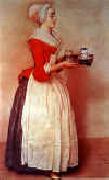
He began his studies under Professor Gardelle and Petitot, whose enamels and miniatures he copied with considerable skill. He went to Paris in 1725, studying under J. B. Masse and François Lemoyne, on whose recommendation he was taken to Naples by the Marquis Puysieux. In 1735 he was in Rome, painting the portraits of Pope Clement XII and several cardinals. Three years later he accompanied Lord Duncannon to Constantinople. His eccentric adoption of oriental costume secured him the nickname of the Turkish painter. He went to Vienna in 1742 to paint the portraits of the imperial family. Still under distinguished patronage he returned to Paris. In 1744 he visited England, where he painted the princess of Wales in 1753, and went to Holland in 1756, where, in the following year, he married Marie Fargues. She also came from a Hugenot family, and wanted him to shave off his beard. Another visit to England followed in 1772, and in the next two years his name figures among the Royal Academy exhibitors. He returned to his native town in 1776. In 1781 Liotard published his Trait?? des principes et des r??gles de la peinture. In his last days he painted still lifes and landscapes. He died at Geneva in 1789.
Liotard was an artist of great versatility, and though his fame depends largely on his graceful and delicate pastel drawings, of which La Liseuse, The Chocolate Girl, and La Belle Lyonnaise at the Dresden Gallery are delightful examples, he achieved distinction by his enamels, copperplate engravings and glass painting. He also wrote a Treatise on the Art of Painting, and was an expert collector of paintings by the old masters. Many of the masterpieces he had acquired were sold by him at high prices on his second visit to England. The museums of Amsterdam, Berne, and Geneva are particularly rich in examples of his paintings and pastel drawings. A picture of a Turk seated is at the Victoria and Albert Museum, while the British Museum owns two of his drawings. The Louvre has, besides twenty-two drawings, a portrait of Lieutenant General Hrault and a portrait of the artist is to be found at the Sala di pittori, in the Uffizi Gallery, Florence. While his son also married a Dutch girl, the Rijksmuseum inherited an important collection of his drawings and paintings.
|
|
 |
Jean-Laurent Mosnier
|
|
French portrait Painter , b. ca. 1743, Paris, d. 1808, St. Petersburg
|
|
 |
Jean-Leon Gerome
|
|
French Academic Painter and Sculptor, 1824-1904
was a French painter and sculptor in the style now known as Academicism. The range of his oeuvre included historical painting, Greek mythology, Orientalism, portraits and other subjects, bringing the Academic painting tradition to an artistic climax. Born at Vesoul (Haute-Saône), he went to Paris in 1840 where he studied under Paul Delaroche, whom he accompanied to Italy (1843-1844). He visited Florence, Rome, the Vatican and Pompeii, but he was more attracted to the world of nature. Taken by a fever, he was forced to return to Paris in 1844. On his return he followed, like many other students of Delaroche, into the atelier of Charles Gleyre and studied there for a brief time. He then attended the Ecole des Beaux-Arts. In 1846 he tried to enter the prestigious Prix de Rome, but failed in the final stage because his figure drawing was inadequate. He tried to improve his skills by painting The Cockfight (1846), an academic exercise depicting a nude young man and a lightly draped girl with two fighting cocks and in the background the Bay of Naples. He sent this painting to the Salon of 1847, where it gained him a third-class medal. This work was seen as the epitome of the Neo-Grec movement that had formed out of Gleyre's studio (such as Henri-Pierre Picou (1824-1895) and Jean-Louis Hamon), and was championed by the influential French critic Theophile Gautier. G??rôme abandoned his dream of winning the Prix de Rome and took advantage of his sudden success. His paintings The Virgin, the Infant Jesus and St John (private collection) and Anacreon, Bacchus and Cupid (Mus??e des Augustins, Toulouse, France) took a second-class medal in 1848. In 1849 he produced the paintings Michelangelo (also called In his studio) (now in private collection) image of the painting and A portrait of a Lady (Mus??e Ingres, Montauban). In 1851 he decorated a vase, later offered by Emperor Napoleon III of France to Prince Albert, now part of the Royal Collection at St. James's Palace, London. He exhibited Bacchus and Love, Drunk, a Greek Interior and Souvenir d'Italie, in 1851; Paestum (1852); and An Idyll (1853). In 1852 G??rôme received a commission by Alfred Emilien Comte de Nieuwerkerke, Surintendant des Beaux-Arts to the court of Napoleon III, for the painting of a large historical canvas, the Age of Augustus image of the painting. In this canvas he combines the birth of Christ with conquered nations paying homage to Augustus. Thanks to a considerable down payment, he was able to travel in 1853 to Constantinople, together with the actor Edmond Got. This would be the first of several travels to the East : in 1854 he made another journey to Turkey and the shores of the Danube, where he was present at a concert of Russian conscripts, making music under the threat of a lash. In 1854 he completed another important commission of decorating the Chapel of St. Jerome in the church of St. S??verin in Paris. His Last communion of St. Jerome in this chapel reflects the influence of the school of Ingres on his religious works. To the exhibition of 1855 he contributed a Pifferaro, a Shepherd, A Russian Concert, The Age of Augustus and Birth of Christ.
|
|
 |
Jean-Louis Forain
|
|
1852-1931
French painter, printmaker and illustrator. Around 1860 he moved with his family to Paris, where he was taught by Jacquesson de la Chevreuse (1839-1903), Jean Baptiste Carpeaux and Andre Gill. He participated in the Franco-Prussian War (1870-71) and was a friend of the poets Paul Verlaine and Arthur Rimbaud; the latter is the presumed subject of a portrait (1874; priv. col., see 1982 exh. cat., no. 1) that may have influenced Manet late portrait of Mallarme (1876; Paris, Louvre). Forain first met Manet through his friendship with Degas in the early 1870s at the salon of Nina de Callias. He continued to associate with Manet, meeting the group of young Impressionists at the Cafe Guerbois and the Cafe de la Nouvelle Athenes. In 1878 Forain painted a small gouache, Cafe Scene (New York, Brooklyn Mus.), which probably influenced Manet Bar at the Folies-Bergere (1881-2; London, Courtauld Inst. Gals).
|
|
 |
Jean-Louis Hamon
|
|
Plouha 1821 - Saint - Raphael, 1874.
French Academic Painter, 1821-1874.
Studied under Charles Gleyre.
French Academic Painter, 1821-1874. Studied under Charles Gleyre. French painter and designer. He was encouraged to practise drawing by the Brothers of the Christian Doctrine at Lannion. Through the intervention of Felicite-Robert de Lamennais (1782-1854), he was made drawing-master at a religious seminary at Ploermel, Brittany, although at this stage he had received no instruction and had never seen an oil painting. In 1840 he asked his conseil general for help and left for Paris the following year with a grant of 500 francs. He went to Delaroche's studio, where he made friends with Picou, Jean-Leon Gereme, Jean Aubert (1824-1906) and Jean Eugene Damery (1823-53). Charles Gleyre, who took over Delaroche's studio in 1843, encouraged and protected him during years of poverty.
|
|
|
|
Jean-Louis prevost le jeune
|
|
Noitel circa
1740-after 1810
|
|
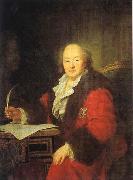 |
Jean-Louis Voille
|
|
painted Ivan Perfilevich Elagin in 1789
|
|
 |
Jean-Paul Laurens
|
|
1838-1921
French
Jean Paul Laurens Gallery
was a French painter and sculptor, and one of the last major exponents of the French Academic style.
Born in Fourquevaux, he was a pupil of L??on Cogniet and Alexandre Bida. Strongly anti-clerical and republican, his work was often on historical and religious themes, through which he sought to convey a message of opposition to monarchical and clerical oppression. His erudition and technical mastery were much admired in his time, but in later years his hyper-realistic technique, coupled to a highly theatrical mise-en-sc??ne, came to be regarded as overly didactic and even involuntarily comical.
Laurens was commissioned to paint numerous public works by the French Third Republic, including the steel vault of the Paris city hall, the monumental series on the life of Saint Genevieve in the apse of the Panth??on, the decorated ceiling of the Od??on Theater, and the hall of distinguished citizens at the Toulouse capitol. He also provided illustrations for Augustin Thierry's R??cits des temps m??rovingiens ("Accounts of Merovingian Times").
Laurens was a professor at the École nationale sup??rieure des Beaux-Arts in Paris, where he taught Andr?? Dunoyer de Segonzac and George Barbier. Two of his sons, Paul Albert Laurens (1870-1934) and Jean-Pierre Laurens (1875-1932), became painters and teachers at the Acad??mie Julian. He died in Paris in 1921.
|
|
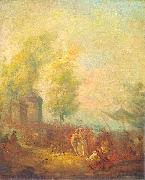 |
Jean-Pierre Norblin de La Gourdaine
|
|
(in Polish, Jan Piotr Norblin; 15 July 1745 - 23 February 1830) was a French-born painter, draughtsman, engraver, drawing artist and caricaturist. From 1774 to 1804 he resided in the Polish-Lithuanian Commonwealth, where he obtained citizenship.
He is considered one of the most important painters of the Polish Enlightenment. He achieved great success in Poland. Given many commissions from some of the most notable families of the Polish-Lithuanian Commonwealth, he stayed there for many years, not returning to Paris until the early 19th century. His style showed the influence of Antoine Watteau, and combined the Rococo tradition of charming fates galantes and fetes champetres with a panorama of daily life and current political events, captured with journalistic accuracy. He created a gallery of portraits of representatives of all social classes in the last years of the Polish-Lithuanian Commonwealth.
|
|
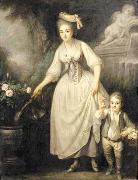 |
Jeanne-Philiberte Ledoux
|
|
painted Portrait of a lady, said to be the Duchesse de Choiseul in 18th century
|
|
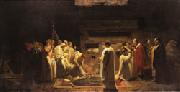 |
Jeles-Eugene Lenepveu
|
|
French Neoclassical Painter, 1819-1898.
Studied under François-Edward Picot.
|
|
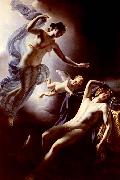 |
Jerome-Martin Langlois
|
|
French Academic Painter,
1779-1838
|
|
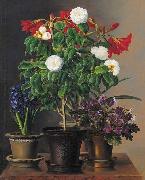 |
Johan Laurentz Jensen
|
|
(8 March 1800, Gentofte - 26 March 1856, Copenhagen) was a Danish artist who specialized in flower painting.
In parallel with his studies at the Danish Academy, he became a pupil of Christoffer Wilhelm Eckersberg and also of Cladius Detlev Fritzsch. Specializing in flower painting, Jensen continued his education in Paris under the Flemish flower painting brothers, Gerard and Cornelis van Spaendonck, and at the porcelain factory in Sevres where he learnt the art of miniature flower painting. Taking 17th-century Dutch flower painting as a starting point, he revived the art in Denmark. His floral arrangements often had both a decorative and symbolic value. Danish plants were often accompanied by exotic flowers and fruits, sometimes even birds. He also became head artist at the Danish Procelain Factory. Jensen had an extensive circle of customers and many students, especially women, including Louise of Hesse-Kassel who later married King Christian IX. Since the 1980s, his works have gained wide international recognition. Many are exhibited in Statens Museum for Kunst and in Thorvaldsens Museum.
|
|
 |
Johan-Erik, Lim Johan Olsson
|
|
Swedish, 1965-1944
|
|
 |
Johann Carl Loth
|
|
German Baroque Era Painter, 1632-1698
was a German painter, born in Munich but active most of his life in Venice. He is also called Johann Karl, Carlotto, and Carlo Lotti. He was the son and pupil of Johann Ulrich Loth (1590- 1662). He was commissioned to paint for the emperor Leopold in Vienna. He was influenced by Pietro Liberi. His brother Franz Loth was also a painter in Venice and Germany. He had numerous pupils including Willem Drost, Cornelis de Bruijn, Johann Michael Rottmayr, Paul Strudel, Santo Prunati, Daniel Seiter, and Giovan Battista Langetti.
|
|
 |
Johann Jakob de Lose
|
|
Johann Jakob de Lose (1755 - 1813), German painter, working in Frankfurt/Main.
|
|
 |
Johann Liss
|
|
Also called Jan Lys, (c. 1590 or 1597 - 1627 or 1631) was a leading German Baroque painter of the 17th century, active mainly in Venice.
Liss was born in Oldenburg (Holstein) in Schleswig-Holstein, Germany. After an initial education in his home state, he continued his studies, according to Houbraken, with Hendrick Goltzius in Haarlem and Amsterdam. Around 1620 he travelled through Paris to Venice. He moved to Rome around 1620?C1622, and his first works there were influenced by the style of Caravaggio.
Although his earlier work was concerned with the contrasts of light and shadow, his final move to Venice in the early 1620s modified his style and gave impetus to brilliant color and a spirited treatment of the painted surface.In 1627, he was created an admired large altarpiece, the Inspiration of Saint Jerome in San Nicole da Tolentino. His loose brushstrokes seem precursor to rococo styles of Guardi brothers.This final style, along with that of other "foreign" painters residing in Venice, Domenico Fetti and Bernardo Strozzi, represent the first inroads of Baroque style into the republic.
Liss fled to Verona to escape the Plague spreading in Venice, but succumbed there prematurely in 1629. According to Houbraken, he worked day and night on his paintings, so that Joachim von Sandrart felt that his health was at risk and urged him to join him in Rome
|
|
 |
Johann Ludwig Aberli
|
|
Swiss, 1723-1786, Swiss painter, draughtsman and engraver. In 1741 he moved to Berne, where he took drawing lessons with Johann Grimm (1675-1747), whose school of drawing he took over in 1747. He visited the Bernese Oberland with Emanuel Handmann, Christian Georg Schetz (1718-91) and Friedrich Wilhelm Hirt (1721-72) in 1759 and in the same year travelled to Paris with Adrian Zingg (1734-86). This was his only trip abroad, but it determined him to work exclusively as a landscape painter. After nine months he returned to Berne, where his landscape views became popular, particularly with foreign travellers, enamoured of 'Nature' and keen to retain souvenirs of their travels. He was one of the first artists to portray the beauties of the Swiss countryside; his favourite subjects were the Aare Valley and views of Swiss lakes (e.g. View of Erlach on the Lake of Biel; Berne, Kstmus.). He invented a technique known as the 'Aberli style', which consisted of watercolour washes added to an image in which slightly smudged outlines were achieved through a combination of engraving and etching. The prints were made from drawings taken from nature and finished in the studio. His style was characterized by delicate execution, an intimate narrative approach, refined colours and the ability to convey a light and vaporous atmosphere. Aberli's success was such that he had to employ assistants and pupils to aid him in the coloration process; his pupils included Erasmus Ritter, Johann Jakob Biedermann, Marquard Wocher (1760-1830), Gabriel Ludwig Lory the elder (1763-1840) and Peter Birmann. From 1773 to 1775 Aberli also painted a series of costumes in response to tourist demand.
|
|
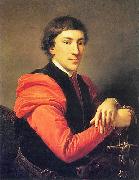 |
Johann-Baptist Lampi the Elder
|
|
painted Portrait of Paweł Grabowski. in1790
|
|
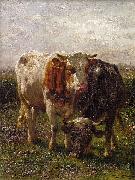 |
Johannes Hubertus Leonardus de Haas
|
|
(25 March 1832 - 4 August 1908) was a Dutch animal and landscape painter, and a peripheral figure of the Hague School.
Born at Hedel, De Haas spend his youth in Amsterdam where he got his first art education at evening-classes at the Koninklijke Academie. Consequently he moved to Haarlem where he was apprenticed to the artist Pieter Frederik van Os. During his stay in Haarlem he befriended Paul Gabriël and Hendrik Dirk Kruseman Van Elten who were also studying with Van Os.
In 1853, together with his two friends, De Haas decided to go to Oosterbeek. Here they came into contact with the influential landscape painter Johannes Warnardus Bilders and the group of painters which had gathered around him, many of whom would later be part of the Hague School. De Haas also met his future wife in Oosterbeek, Bilders' daughter, Caroline. In 1855 he received good reviews for his pictures that were exhibited in Paris from the noted art critic Jean Baptiste Gustave Planche.
In 1857 De Haas first went to Brussels, where he became friends with Willem Roelofs. De Haas frequently returned to the Netherlands and Oosterbeek for inspiration and Caroline. From 1860 his friend Gabriël also lived in Brussels, and De Haas often painted cattle in the landscapes of both Roelofs and Gabriel, fitting in perfectly with both their styles. In 1860 he won the gold medal at the exhibition of Utrecht.
From 1861 until 1869 De Haas is permanently settled in Brussels, painting mainly on the coasts of Flanders and Picardie in northern France. He married Caroline Bilders in 1862, and in 1864 they are briefly joined by her brother, the promising painter Gerard Bilders. In 1865 Caroline dies at the age of 24 of tuberculosis, leaving him with a young son. During his stay in Brussels De Haas is instrumental in passing on the style of the Barbizon school to the painters at Oosterbeek.
|
|
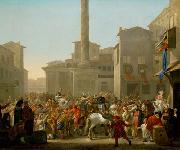 |
Johannes Lingelbach
|
|
(Frankfurt, 1622 - Amsterdam - 1674), was a Dutch Golden Age painter, associated with the second generation of Bambocciate, a group of genre painters working in Rome from 1625 - 1700.
|
|
 |
John Berney Ladbrooke
|
|
United Kingdom (1803 -1879 ) - Painter
|
|
 |
John Dalbiac Luard
|
|
LD 1872-1944 Nationality: English
|
|
 |
John Frederichk Lewis RA
|
|
1805-1876
|
|
 |
John Frederick Lewis
|
|
1805-1876
British
John Frederick Lewis Gallery
John Frederick Lewis (July 14, 1805 ?C August 15, 1876) was an Orientalist English painter. He specialized in Oriental and Mediterranean scenes and often worked in exquisitely detailed watercolour. He was the son of Frederick Christian Lewis (1779-1856), engraver and landscape-painter.
Lewis lived in Spain between 1832 and 1834. He lived in Cairo between 1841 and 1850, where he made numerous sketches that he turned into paintings even after his return to England in 1851. He lived in Walton-on-Thames until his death.
Lewis became an Associate of the Royal Academy (ARA) in 1859 and a member (an RA) in 1865.
After being largely forgotten for decades, he became extremely fashionable, and expensive, from the 1970s and good works now fetch prices into the millions of dollars or pounds at auction.
|
|
 |
John La Farge
|
|
1835-1910
John La Farge (March 31, 1835 ?C November 14, 1910) was an American painter, stained glass window maker, decorator, and writer.
Born in New York City, New York, his interest in art was aroused during his training at Mount St. Mary's University and St. John's College (now Fordham University). He had only the study of law in view until he returned from his first visit to Paris, France where he studied with Thomas Couture and enjoyed the most brilliant literary society of the day. Even his earliest drawings and landscapes, done in Newport, Rhode Island, after his marriage in 1861 to Margaret Mason Perry, sister-in-law of Lilla Cabot Perry, show marked originality, especially in the handling of color values, and also the influence of Japanese art, in the study of which he was a pioneer.
La Farge's inquiring mind led him to experiment with color problems, especially in the medium of stained glass. He succeeded not only in rivaling the gorgeousness of the medieval windows, but in adding new resources by his invention of opalescent glass and his original methods of superimposing and welding his material. Among his many masterpieces are the "Battle Window" at Harvard and the cloisonn?? "Peacock Window" in the Worcester Art Museum. Two of his largest windows are located in Unity Church in North Easton, Massachusetts. The earliest of these, the "Angel of Help" was completed in 1887 while the "Figure of Wisdom" dates to 1901. Both of these windows were restored by "Victor Rothman for Stained Glass Inc" of Yonkers, New York in the 1990's.
Between 1859 and 1870, he illustrated Tennyson's Enoch Arden and Robert Browning's Men and Women. Breadth of observation and structural conception, and a vivid imagination and sense of color are shown by his mural decorations. His first work in mural painting was done in Trinity Church, Boston, in 1873. Then followed his decorations in the Church of the Ascension (the large altarpiece) and St. Paul's Church, New York. For the State Capitol at St. Paul he executed, in his seventy-first year, four great lunettes representing the history of religion, and for the Supreme Court building at Baltimore, a similar series with Justice as the theme. In addition there are his vast numbers of other paintings and water colors, notably those recording his extensive travels in the Orient and South Pacific.
His labors in almost every field of art won for him from the French Government the Cross of the Legion of Honor and membership in the principal artistic societies of America, as well as the presidency of the Society of Mural Painters. Enjoying an extraordinary knowledge of languages (ancient and modern), literature, and art, by his cultured personality and reflective conversation he greatly influenced all who knew him. Though naturally a questioner he venerated the traditions of religious art, and preserved always his Catholic faith and reverence.
In 1904, he was one of the first seven chosen for membership in the American Academy of Arts and Letters. On his passing in 1910, John LaFarge was interred in the Green-Wood Cemetery in Brooklyn, New York. During his life, he maintained a studio at 51 West 10th Street, in Greenwich Village, which today is part of the site of Eugene Lang College
|
|
 |
John Lavery
|
|
1856-1941
Sir John Lavery (20 March 1856 ?C 10 January 1941) was an Irish painter best known for his portraits.
Belfast-born John Lavery attended the Haldane Academy in Glasgow, Scotland, in the 1870s and the Acad??mie Julian in Paris in the early 1880s. He returned to Glasgow and was associated with the "Glasgow School". In 1888 he was commissioned to paint the state visit of Queen Victoria to the Glasgow International Exhibition. This launched his career as a society painter and he moved to London soon after. In London he became friendly with James McNeill Whistler and was clearly influenced by him.
Like William Orpen, Lavery was appointed an official artist in the First World War. Ill-health, however, prevented him from travelling to the Western Front. A serious car crash during a Zeppelin bombing raid also kept him from fulfilling this role as war artist. He remained in Britain and mostly painted boats, planes and airships. During the war years he was a close friend of the Asquith family and spent time with them at their Sutton Courtenay Thames-side residence, painting their portraits and idyllic pictures like Summer on the River (Hugh Lane Gallery).
After the war he was knighted and in 1921 he was elected to the Royal Academy. During this time, he and his wife both became interested in their Irish heritage and were tangentially involved in both the Irish War of Independence and the Irish Civil War: they gave the use of their London home to the Irish negotiators during the Treaty negotiations. After Michael Collins was killed, Lavery painted Michael Collins, Love of Ireland, now in the Hugh Lane Municipal Gallery.
In 1929 John Lavery made substantial donations of his work to both The Ulster Museum and the Hugh Lane Municipal Gallery and in the 1930s he returned to Ireland. He received honorary degrees from the University of Dublin and Queen's University of Belfast. He was also made a free man of both Dublin and Belfast.
He died in County Kilkenny, aged 84, from natural causes. He was buried in Putney Vale Cemetery.
|
|
 |
John Leslie Breck
|
|
1860-1899
|
|
 |
John linnell
|
|
1792-1882
|
|
 |
John Liston Byam Shaw
|
|
1872-1919
|
|
 |
John Longstaff
|
|
Australian war artist, 1862-1941
|
|
 |
John Seymour Lucas
|
|
(21 December 1849 - 8 May 1923) was a Victorian English historical and portrait painter as well as an accomplished theatrical costume designer. He was born into an artistic London family, and originally trained as a woodcarver, but turned his attention to portrait painting and entered first the St. Martin's Lane Art School and later the Royal Academy Schools. Here he met his French wife, fellow artist Marie Cornelissen, whom he married in 1877. Lucase artistic education included extensive travels around Europe, particularly Holland and Spain, where he studied the Flemish and Spanish Masters. He first started exhibiting in 1872, was elected an associate member of the Royal Academy in 1876 and a full Royal Academician in 1898.
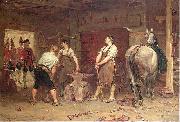
John Seymour Lucas was first and foremost a historical genre painter with a particular talent for realism in the depiction of costumes and interiors. Inspired by van Dyck and particularly Diego Velezquez, he excelled in depicting scenes from the English 16th to 18th century Tudor and Stuart periods, including in particular the Spanish Armada, Preparing for the Voyage, the English Civil War and the Jacobite rebellions.
His first major work to achieve widespread public acclaim was Rebel Hunting after Culloden, executed in 1884. It was praised not only for the obvious tension between the muscular blacksmiths and the redcoated forces of law and order (or repression) but for the extraordinary realism in the depiction of the rough smithy and glowing horsehoe on the anvil. In 1885 his next major work whas "Preparing for the Voyage".
As his reputation grew, Lucas increasingly mixed in society circles, and became firm friends with the famous society portrait painter John Singer Sargent who was his almost exact contemporary. A portrait of Lucas executed by John Singer Sargent is displayed in Tate Britain. Towards the 1890s John Seymour Lucas executed a number of major works for prestigious public buildings or royal clients. These include: The Flight of the Five Members (Houses of Parliament), The Granting of the Charter of the City of London (Royal Exchange), Reception by HM King Edward VII of the Moorish Ambassador (Royal Collection), HRH the Prince of Wales in German Uniform (Royal Collection)
Apart from executing over 100 major oil paintings and a host of drawings, Lucas was renowned as a set and costume designer for the historical dramas popular on the late Victorian and early Edwardian stages. One of his more unusual commissions was the "Duke of Normandy" costume for the ill-fated prince Alfred of Saxe Coburg-Gotha for the Devonshire House Ball in 1897. Lucas was also a prolific watercolour painter and was elected a member of the Institute of Painters in Water Colours in 1877.
During most of his artistic career, John Seymour Lucas lived in a purpose-built studio in South Hampstead, London, designed for him by his friend and fellow artist, architect Sydney Williams-Lee.
He retired from painting towards the end of World War I, and moved to Blythburgh, Suffolk, where re-designed a house next to the church known as 'The Priory'. Lucas died in 1923 and is interred in Blythburgh church yard. His son, Sydney Seymour Lucas, was also an artist, and illustrator.
|
|
 |
Jonas Lie
|
|
Jonas Lauritz Idemil Lie (6 November 1833 - 5 June 1908) was a Norwegian novelist, poet, and playwright who is considered to have been one of the Four Greats of 19th century Norwegian literature, together with Henrik Ibsen, Bjornstjerne Bjørnson and Alexander Kielland.
|
|
 |
Jose Gutierrez De La Vega
|
|
Spanish , 1791-1865
|
|
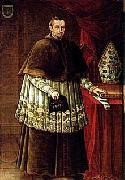 |
Jose Legarda
|
|
painted Portrait of Manuel de Alday, bishop of Santiago de Chile in 1772
|
|
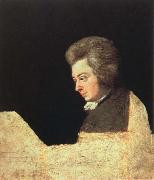 |
joseph lange
|
|
Joseph Lange (1 April 1751 W??rzburg - 17 September 1831 Vienna) was an actor and amateur painter of the 18th century. Through his marriage to Aloysia Weber, he was the brother-in-law of Wolfgang Amadeus Mozart.
|
|
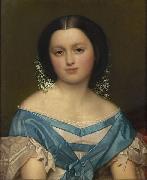 |
Joseph van Lerius
|
|
painted Portrait of Henriette Mayer van den Bergh in 1857
|
|
 |
joseph-Louis-Hippolyte Bellange
|
|
b.1800-d.1866
|
|
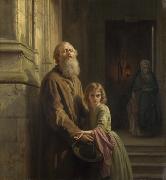 |
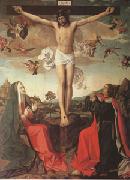
Josephus Laurentius Dyckmans
|
|
painted The Blind Beggar in 1853
|
|
 |
Josse Lieferinxe
|
|
active in Provence 1493-1505/08
was a South Netherlandish painter, formerly known by the pseudonym the Master of St. Sebastian. Originating in the diocese of Cambrai in Hainaut, then part of the territories ruled by the Dukes of Burgundy. Josse Lieferinxe was documented as a "Picard" in the regions of Avignon and Marseille at the end of the fifteenth and in the early sixteenth centuries. He was first mentioned in Provence in 1493. Thus he figures among the painters of the Provençal school, whose most prominent members in an earlier generation had also been from the far north of the French-speaking world Barth lemy d'Eyck and Enguerrand Quarton. In 1503 he married Michelle, a daughter of Jean Changenet, the most prominent painter of Avignon, in whose atelier Lieferinxe may have matured his style. He was last mentioned living in 1505, and in 1508 as deceased. Before he was identified by Charles Sterling who linked his work with a document, his artistic personality was recognized, as the "Master of St. Sebastian", through a former retable of eight scenes depicting the acts and miracles of Saint Sebastian and Saint Roch, protectors against the plague, which was commissioned in 1497 for the church of Nôtre Dame des Accoul's in Marseille. Bernardino Sismondi, who originally received the commission, died, however, before he could finish the work.
|
|
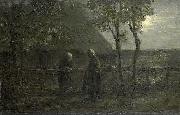 |
Jozef Israels
|
|
(27 January 1824, Groningen - 12 August 1911, Scheveningen) was a Dutch painter, and "the most respected Dutch artist of the second half of the nineteenth century".
|
|
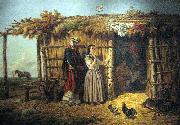 |
Juan Leon Palliere
|
|
painted Idilio criollo in c. 1861
|
|
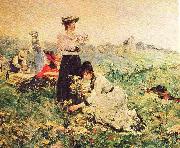 |
Juan Luna
|
|
Juan Luna y Novicio (October 23, 1857 - December 7, 1899) was an Ilocano Filipino painter, sculptor and a political activist of the Philippine Revolution during the late 19th century. He became one of the first recognized Philippine artists.
His winning the gold medal in the 1884 Madrid Exposition of Fine Arts, along with the silver win of fellow Filipino painter Felix Resurreccien Hidalgo, prompted a celebration which was a major highlight in the memoirs of members of the Propaganda Movement, with the fellow Ilustrados toasting to the two painters' good health and citing their win as evidence that Filipinos and Spaniards were equals.
Regarded for work done in the manner of the Spanish and French academies of his time, Luna painted literary and historical scenes, some with an underscore of political commentary.
|
|
 |
Juan Pantoja de la Cruz
|
|
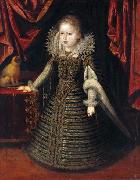
(Valladolid, 1553 - 26 October 1608, Madrid) Spanish painter, one of the best representatives of the Spanish school of court painters. He worked for Philip II and Philip III. The Museo del Prado contains examples of his severe portraiture style.
Juan Pantoja de La Cruz was, born 1553 in Valladolid. Very little is known of his formative years as a painter. He was a pupil of the court painter Alonso Senchez Coello in Madrid and he must have assisted his master in complying with his duties as painter of the Spanish King, Philip II. Pantoja probably continued to work in his master studio after completing his training. He married in 1585 beginning to paint for the court around that time. After Sanchez Coello's death in 1588, Pantoja took over his master workshop and became court painter to Philip II of Spain.
Pantoja kept working for the court and the nobility, painting portraits of Prince Philip, the future Philip III, in 1592 and 1594. Among his most well known works is the portrait of Philip II wearing a cape and hat all in black, painted around 1594 for the Escorial. This portrait is one of the best representations of the idea of Spanish majesty, based on the remoteness of the monarch. On Philip II's death in 1598, Philip III confirmed Pantoja's status as court painter. When the court settled in Valladolid in 1601, Pantoja moved to the new capital, remaining in this city, several years.
|
|
 |
Juan van der Hamen y Leon
|
|
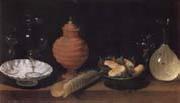
Spanish Baroque Era Painter, 1596-1631, was a Spanish painter, a master of the still life paintings, also called bodegones. During his lifetime, he was prolific and versatile, painting allegories, landscapes, and large-scale works for churches and convents. However, today he is remembered mostly for his still lifes. In the 1620s, He popularized still life painting in Madrid.Juan van der Hamen y (Gemez de) Leen was born in Madrid in 1596 but he was baptized late on April 8, 1596 in Madrid, therefore, he must had been born there just days before that date. He was the son of Jehan van der Hamen, a Flemish courtier, who had moved to Madrid from Brussels before 1586, and Dorotea Whitman Gemez de Leen, a half-Flemish mother of noble Toledan ancestry [1]. Van der Hamen and his two brothers Pedro and Lorenzo (both of whom were writers) emphasized their Spanish roots by using all or part of their maternal grandmother's family name, Gemez de Leen.. The painter's father, Jan van der Hamen, had come to Spain, as an archer, to the court of Philip II were he settled, married, and his children were born. According to 18th-century sources, the artist's father had also been a painter, but there is no evidence for this. Juan van der Hamen inherited his father's honorary positions at court and also served as unsalaried painter of the king. Van der Hamen's artistic activity in the service of the crown is first recorded on 10 September 1619, when he was paid for painting a still-life for the country palace of El Pardo, to the north of Madrid.
|
|
 |
Judith leyster
|
|
1609-60
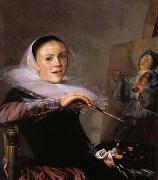
Dutch painter. She painted genre scenes, portraits and still-lifes, and she may also have made small etchings; no drawings by her are known. She specialized in small intimate genre scenes, usually with women seated by candlelight, and single half-length figures set against a neutral background.
|
|
|
|
|
|
|
|
|
| Wholesale China Oil Painting Wholesale Oil Painting China Xiamen Portrait Reproduction on canvas Chinese Oil Painting Wholesale USA Oil Painting |
|
|
|
|


